
Yes, most Warhammer games share a common fictional universe, but their gameplay and specific narratives differ significantly.
Ever wondered if the Space Marines you command in one game are somehow fighting alongside the Skaven from another? The question of whether are all Warhammer games connected is a frequent one. While they all exist under the expansive umbrella of the Warhammer setting, each offers its unique take.
Think of it like this: various historical fiction books all set in the same era; they share the same background. So, while factions and lore tie them together, each game focuses on unique stories and mechanics. They are linked, but not identical experiences.

Are All Warhammer Games Connected?
Okay, let’s dive into the big question: are all those cool Warhammer games connected? You see, there are a lot of them, from massive battles on tabletop to intense video games. It’s easy to wonder if they’re all part of one giant story, or if each one is its own thing. The simple answer is… it’s complicated! But don’t worry, we’ll break it all down and make it easy to understand.
Understanding the Two Main Universes
The first thing you need to know is that there isn’t just one ‘Warhammer’ world. There are actually two main settings where these games take place:
Warhammer 40,000 (40k)
This is the dark, futuristic universe. Imagine a really, really far-future where humanity is spread across the stars, fighting aliens and crazy space demons. Think space marines, powerful psykers (people with mind powers), and massive starships. Games set in the 40k universe are generally grim, action-packed and full of epic battles. The technology is often seen as old and hard to maintain. The aesthetic is gothic and industrial.
Warhammer Fantasy Battles (and its successor, Age of Sigmar)
This one is set in a world that is more like classic fantasy, with elves, dwarves, orcs, and magic. But it’s a pretty brutal and dangerous world. Think castles, forests, and big battles with swords and shields. It originally started as Warhammer Fantasy Battles, and then the world literally blew up and was reborn into Age of Sigmar. The focus is on war between different factions, each with its own unique culture and beliefs.
Are They Connected? A Look at the Lore
Now for the tricky part. Are these two universes connected? Here’s the truth:
No Direct Connection
Warhammer 40,000 and Warhammer Fantasy (and Age of Sigmar) are not directly connected in the sense of characters or events crossing over. You won’t see space marines fighting orcs from the fantasy world in a game of 40k. They are distinct universes with separate histories and rules. So you won’t find an elven mage hopping onto a spaceship to go fight a Tyranid horde.
Thematic Connections
However, there are thematic connections. Both universes are born from the same creative minds and share similar concepts and themes. They both feature:
- Grim and Dark Settings: Both are known for their dark and violent tones, where war is a constant reality.
- Epic Battles: Both settings have incredible scale with large-scale conflicts between many different factions.
- The Power of Gods (and Dark Gods): Both have powerful beings or gods that influence the world and the people. These beings can be benevolent or chaotic and evil.
- Factions with Similar Archetypes: You’ll find elements in one that mirror the other, for example, the brutal Orcs in Fantasy/Age of Sigmar have similarities to the Orks in 40k, which are also quite savage and enjoy a good fight. There is also the concept of Elves (or Aelves) who have a highly developed society and are often aloof.
These connections make the universes feel like they come from the same family, even though they are separate. It’s like cousins who have similar features but live in different houses.
The Shared Creative DNA
The similarities are not accidental. Games Workshop, the company that created both Warhammer Fantasy and Warhammer 40,000, deliberately uses many of the same concepts, but twists them to suit each different setting. It gives the whole brand a cohesive feel even though the settings don’t exist in the same time or place.
How This Affects the Games
So, what does all this mean for the games themselves?
Different Gameplay Experiences
The fact that they are separate universes means the gameplay is completely different. A game set in 40k will have you controlling heavily armored futuristic soldiers, tanks, and spaceships with guns and lasers. Warhammer Fantasy and Age of Sigmar, on the other hand, will have you commanding armies of warriors with swords, spears, magic and dragons. They are completely different experiences tailored to each setting.
No Character Transfer
You won’t be able to take your favorite space marine and use them in an Age of Sigmar game, or vice-versa. The characters, units, and the way they work are specific to the setting they belong in. Each setting has their own rules and mechanics, tailored for the type of conflict and warfare that would take place there.
Examining Specific Warhammer Games
Let’s look at some popular Warhammer games and see where they fit in:
Warhammer 40,000 Games
These games are all set in the grim darkness of the far future. Here are a few examples:
- Warhammer 40,000: Dawn of War Series: These games are real-time strategy games where you command armies in large-scale battles.
- Warhammer 40,000: Space Marine: An action-packed game where you play as a mighty space marine, fighting hordes of enemies.
- Warhammer 40,000: Boltgun: A retro-style shooter with a fast pace, and lots of fun for fans of the setting and old school shooter games.
- Warhammer 40,000: Mechanicus: A turn-based strategy game where you control the Adeptus Mechanicus (tech-priests) in their missions.
All these games, while having different gameplay, fit within the same 40k timeline and universe.
Warhammer Fantasy Games (and Age of Sigmar Games)
These are the games that are set in the fantasy worlds. Some examples:
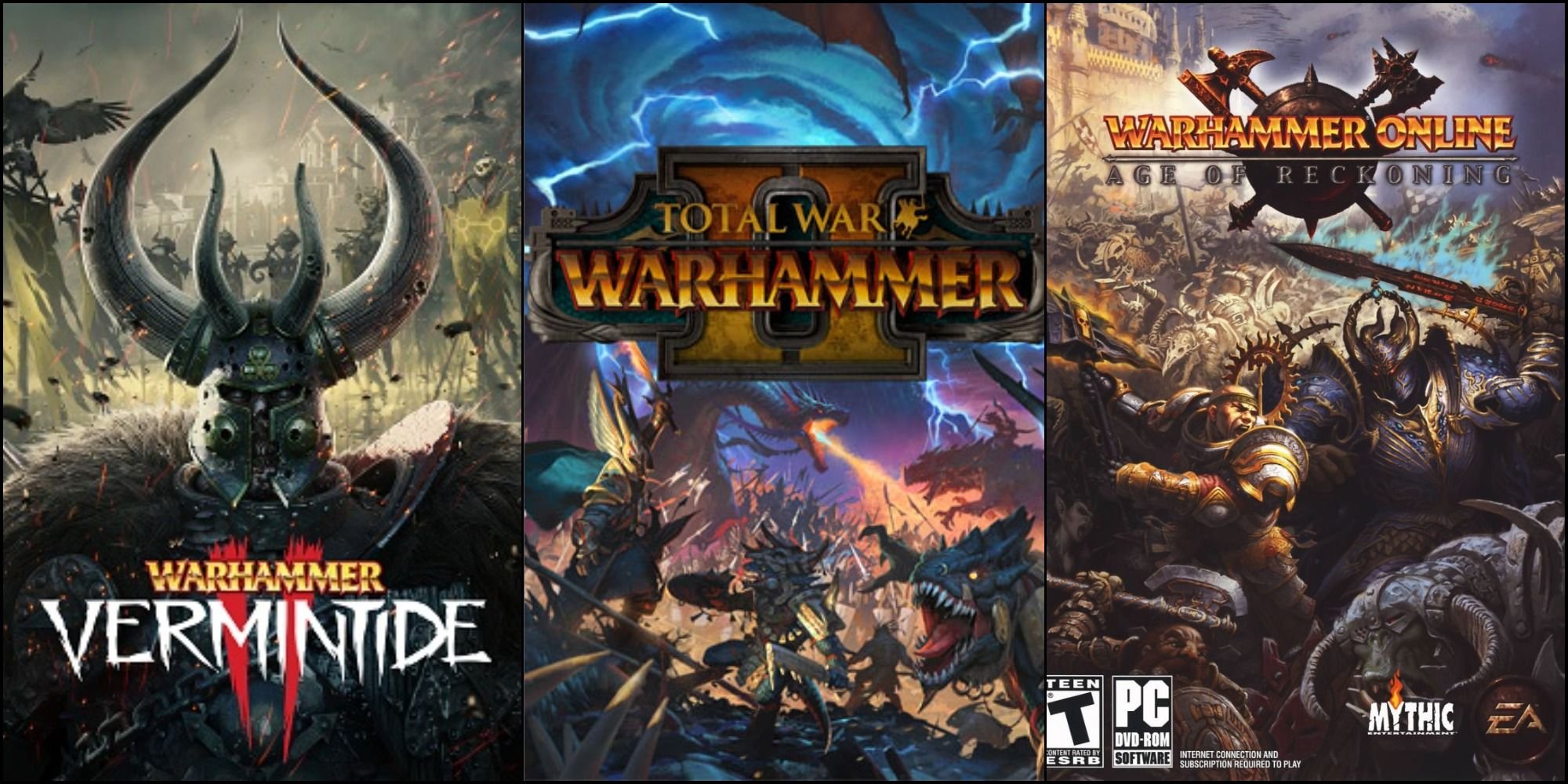
- Total War: Warhammer Series: These games are a mix of real-time battles and turn-based strategy on a large map. They feature many factions from Warhammer Fantasy, including elves, dwarfs, and chaos. The games allow you to control a variety of forces from small skirmishes to large battles.
- Warhammer: Vermintide Series: These are first-person action games where you fight hordes of Skaven (rat-like creatures) in the Warhammer Fantasy setting.
- Warhammer Age of Sigmar: Storm Ground: A turn-based strategy game set in the Age of Sigmar setting.
Again, these games are all within the same overall fantasy setting, even with the transition from Fantasy Battles to Age of Sigmar.
The Exception: Crossovers and Easter Eggs
Sometimes, Games Workshop does create some crossovers, but these are mostly playful nods, not a formal part of the main story. They might do things like:
Limited-Time Events
In some of their mobile or smaller-scale games, you might see an event that temporarily brings in characters or elements from the other Warhammer setting. These events are not considered official lore but are intended as fun crossovers.
Easter Eggs
Sometimes, you’ll spot easter eggs (hidden references) in one game that reference the other setting. These are usually just for fun and don’t indicate that the settings are truly connected.
Tabletop Rules
In the tabletop games themselves, they sometimes release extra rules that might allow you to play one faction from one universe against the other, but these are not considered part of the main lore.
The Multiverse and the Warp
Some fans have speculated that a concept called “the Warp” could act as a bridge between both universes. The Warp, a dimension of raw psychic energy and chaos, exists in both Warhammer 40,000 and Warhammer Fantasy (and to a lesser degree, Age of Sigmar). Some argue that the Warp is a chaotic realm that could, in theory, connect different realities. However, this is still not a concrete link, and it is a theory that is yet to be officially confirmed.
Why Separate Universes Work
You might be wondering why Games Workshop keeps them separate. Here are a couple of reasons:
Creative Freedom
Keeping them separate allows the designers to explore different themes and ideas. They aren’t limited by the existing rules or lore of the other setting, allowing them to create unique stories. The universes are allowed to explore different genres and have their own identity.
Different Player Preferences
Some fans prefer the futuristic action of 40k, while others like the fantasy setting of Age of Sigmar. By keeping them separate, they can appeal to a wider audience with different tastes and gaming preferences.
So, to recap, while the Warhammer games are all part of the same big family created by Games Workshop, they aren’t connected in one unified timeline or universe. They share similar themes and ideas but exist in separate worlds, allowing for unique game experiences.
Is Warhammer 40k connected to Warhammer Fantasy/Age of Sigmar?
Final Thoughts
Essentially, the various Warhammer games share a core setting and lore, offering different perspectives on the same universe. Many titles exist within the same broad historical timeline. However, they are not always directly interconnected in terms of narrative or mechanics.
Each game usually tells its own contained story within this established world. Thus, while the overall setting is shared, a strict, singular continuity is not the focus. The question, “are all warhammer games connected” can be answered as they are connected by lore, but not always directly narrative-wise.

