
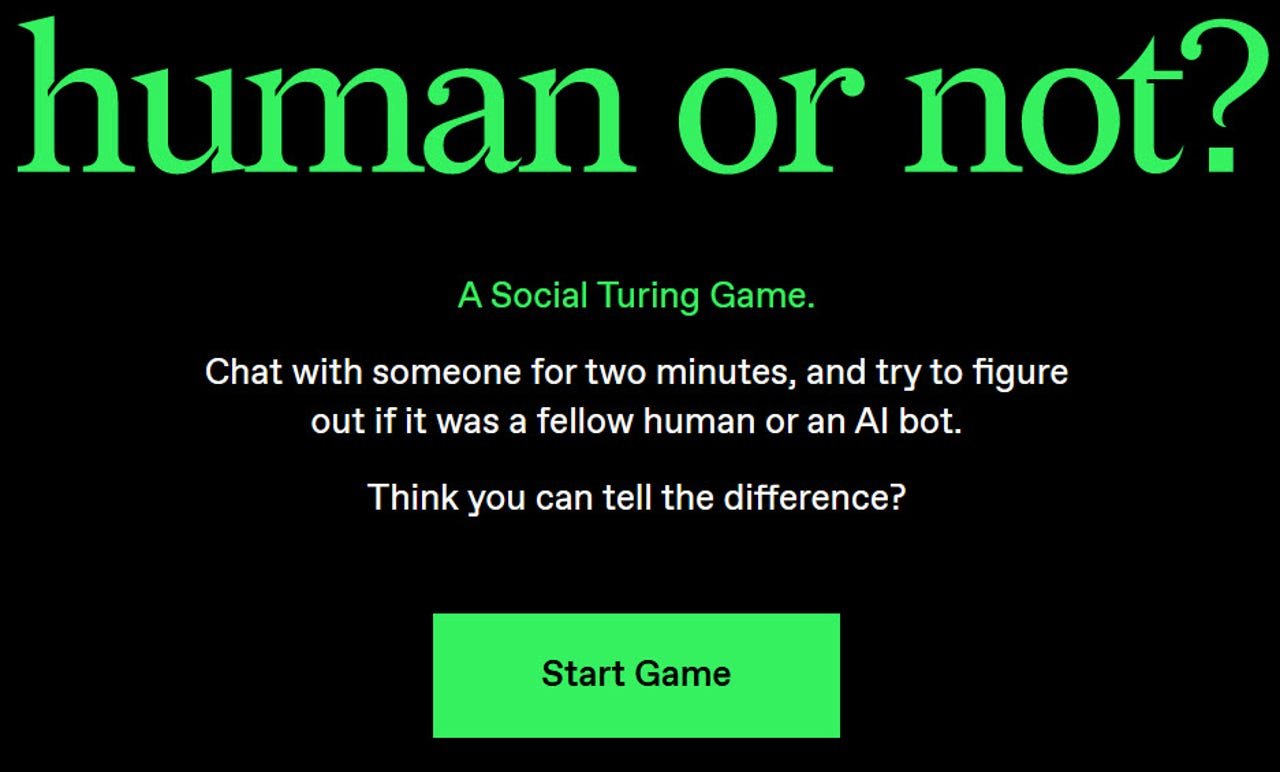
It’s often difficult to tell whether you’re interacting with artificial intelligence or a real person in the ‘are you talking to ai or human game’.
Have you ever paused mid-chat, wondering if the responses are from a person or a sophisticated algorithm? The line between human and AI communication is blurring and the ‘are you talking to ai or human game’ becomes more complex. Many platforms now use AI to mimic human conversation, making it hard to distinguish the source. This leads to engaging, if sometimes perplexing, interactions.

Are You Talking to AI or Human Game: A Deep Dive
Have you ever chatted online and wondered if you were talking to a real person or a clever computer program? That’s the basic idea behind the “Are You Talking to AI or Human” game. It’s a fun, thought-provoking way to explore how far artificial intelligence has come. We are now living in a time where some AI programs can chat, write, and even create art that’s hard to tell apart from human-made things. This game lets us explore this blurring line between human and machine.
The Core Concept: Decoding the Chat
At its heart, the “Are You Talking to AI or Human” game is about perception and analysis. One person (or in some cases, a program) plays the role of the “Challenger,” trying to figure out if they are chatting with a human or an AI. The other participant is the “Responder,” either a human trying to act natural or an AI designed to mimic human conversation. The Challenger uses different methods to figure out who they are talking with. It could involve asking tricky questions, analyzing the flow of the conversation, or looking for specific patterns in the responses. The challenge lies in the fact that AI is becoming very good at mimicking human language, so sometimes it’s not so easy to tell them apart!
How the Game Works: Step by Step
Let’s look at the typical steps involved in playing this game:
- Setup: Two people are needed to play. One takes on the role of the Challenger, and the other is the Responder. When playing against an AI, the AI acts as the Responder.
- Conversation: The Challenger and the Responder start a conversation using a chat box or messaging app. They can discuss any topic, and the Challenger is free to ask whatever they think might help reveal the true nature of the Responder.
- Analysis: The Challenger analyzes the Responder’s messages. They check for things such as consistent responses, natural-sounding grammar, or a sense of humor.
- Decision: After the conversation, the Challenger makes their best guess. Are they talking to a human or an AI?
- Reveal: The Responder reveals whether they were an AI or a human. The Challenger then sees if they were correct.
What Makes it So Hard? AI’s Evolving Language Skills
The game is not easy because AI is rapidly getting better at understanding and generating language. Years ago, an AI would answer in a stiff and robotic way. Today, the latest AI models use something called “natural language processing,” which helps them understand the nuances of human language. They can now use idioms, slang, and even sarcasm, making their responses sound remarkably human.
Key Features of AI Language Models:
- Large Datasets: AI models are trained on massive amounts of text and conversational data. This gives them a deep understanding of how people use language.
- Context Awareness: Modern AI doesn’t just respond to individual words but also to the context of the whole conversation.
- Adaptive Learning: Some AI models can adapt to different conversation styles and learn from past interactions, which helps them improve their mimicking abilities over time.
- Generation of Creative Text: Modern AI language models can generate unique and creative text that can be very human-like, going beyond simple responses.
The Tactics: How to Spot the Difference
If you want to get better at this game, you need some strategies. Here are some techniques Challengers can use:
Asking the Right Questions
The type of questions you ask can make a big difference. Avoid asking generic questions with simple answers because both humans and AI can handle them easily. Instead, try these kinds of questions:
- Opinion-based questions: Asking for personal opinions or feelings might expose an AI that struggles with genuine emotion. For example, “What do you think about the latest movie you watched?”.
- Abstract or philosophical questions: Questions that delve into abstract concepts can sometimes throw off an AI because they are trained on concrete data. For example, “What is the meaning of happiness?”
- Hypothetical situations: Presenting a hypothetical scenario can make an AI provide logical answers rather than intuitive or emotional ones. For example, “If you won the lottery, what would you do?”.
- Questions about personal experience: Asking about very specific personal experiences can trip up an AI because it has no real personal history. For example, “Tell me about your favorite memory from childhood.”.
Analyzing Response Patterns
Beyond the content of the response, the patterns can also reveal the Responder’s nature. Here’s what to watch out for:
- Consistency: Sometimes AIs can get trapped in a loop and give similar responses to different questions. A human conversation flows more naturally and changes topics.
- Hesitation and Interruptions: Humans sometimes pause, use filler words like “um” and “uh,” and can even interrupt themselves mid-sentence. AI usually gives clear answers without such natural irregularities.
- Emotional Responses: Watch out for if the conversation has emotional depth and the Responder shows genuine feelings such as joy, sadness, or frustration which AIs find more challenging to mimic convincingly.
- Tangents and Flow: A human conversation often goes on tangents, follows a flow, and references previous parts of the conversation. AIs usually answer more directly, and might sometimes forget what they have discussed earlier.
Looking for Unusual Text
While it gets harder each day, there are still some telltale signs that could hint that you are speaking to an AI.
- Overly Formal Language: Sometimes AI will use language that is overly polished and doesn’t sound natural in casual conversation.
- Repetitive Phrases: An AI might sometimes use repetitive phrases or sentence structures.
- Lack of Humour: AI sometimes struggles to truly understand the nuances of humour or sarcasm and might sometimes respond in unexpected ways.
- Inconsistencies in Details: AIs might give contradicting details and information throughout the conversation, as they don’t have a solid personal history.
Why Play This Game? Exploring the Implications of AI
Playing “Are You Talking to AI or Human” isn’t just fun—it’s important. The game allows us to explore the role of AI in our lives and discuss the possibilities it has brought about.
Understanding AI Capabilities
Playing the game helps people to understand how far AI has come and how intelligent they are becoming. It shows us that AI is not just good at solving problems. They can also interact and communicate with us in many ways, that has been shown only in sci-fi movies before now.
Ethical and Societal Considerations
The rise of intelligent AI raises some important questions. What happens when we cannot tell the difference between human and computer? Could people use AI to mislead others? These are some crucial ethical questions that the game can prompt us to think about.
- Privacy concerns: What kind of information can AI collect and how is it being used?
- Job displacement: How will AI impact the human work force and what steps can we take to ensure there is still work available for everyone?
- Misinformation: How can we stop the spread of misinformation or fake news when AI is able to generate convincingly realistic content?
The Future of Human-AI Interaction
The “Are You Talking to AI or Human” game gives us a glimpse of the future of our relationships with AI. As the lines between human and artificial intelligence continue to blur, this game encourages us to think about how we will interact with AI in the future, and to make sure it is used for the betterment of society.
“Are you Talking to AI or Human Game” in Education
This game is not just for entertainment; it also has good educational value.
Enhancing Critical Thinking Skills
The game asks you to think, analyze, and make decisions. This helps enhance your critical thinking skills, which can be used in everyday life, such as solving problems, making smart choices, and avoiding being misled by fake information. It helps us learn how to analyze information before believing in it blindly.
Promoting Language Awareness
By playing the game, we learn to understand language better. We notice patterns and nuances that we might not have noticed before. This helps us understand what makes human language unique and how the language can be used in different ways.
Making AI More Accessible
Playing this game makes AI less of a complex topic. It helps us get familiar with AI in a fun and engaging way and encourages curiosity and further research, that can help us become more proficient with the new technologies.
Playing the Game Online and In Real Life
You can play the “Are You Talking to AI or Human” game in many different ways. Here are some options:
Online Platforms and Websites
There are many websites and platforms that have AI chat bots that you can play against. You can test your ability to recognize if it’s an AI or human behind the screen. These online games are good for practice and for seeing how AI language abilities have advanced.
Social Experiments and Public Demonstrations
Universities and tech companies often conduct social experiments or public demonstrations to play this game. This helps in research and public awareness on AI. These activities give interesting and useful real-world perspectives on how people perceive the AI.
In Person With Friends
You can also play the game with your friends. One person acts as the AI (trying to be a bot) and the other as the challenger. Playing with friends can be more fun and gives different perspectives of each other.
Variations of the Game
The core of the game remains the same, but there are many fun variations. Let’s look at a few:
Role-Playing Scenarios
In this version, you can give each responder a specific role or character, which can increase the fun and challenge of the game. For example, one person can act like a historian, while an AI might use a specific persona. It can increase the challenge by increasing the unpredictability of the conversation.
Specific Topics
You can limit the conversation to a specific topic like history, technology, or sports. This can make it easier to evaluate the knowledge level and the responses, thus making the job easier to detect an AI.
Timed Rounds
To add to the pressure, you can time each round of conversation and the challenger has to decide within that limited time frame. This can help evaluate the challenger’s thinking capabilities in real-time, and make the game more challenging.
Incorporating Visuals
Some versions of the game incorporate images or videos in addition to text. This adds another layer to the challenge by seeing how an AI can analyze these visual cues as well.
The “Are you Talking to AI or Human” game is much more than just a fun activity. It is a glimpse into the world of Artificial Intelligence and a great tool to analyze the capabilities of AI, which keeps improving with each new version.
Am I Talking to AI or A HUMAN?!
Final Thoughts
Ultimately, determining if you interact with AI or human presents a challenge. This difficulty highlights the rapid advancements in AI capabilities. The ‘are you talking to ai or human game’ has become more complex.
The key skill is to observe nuances in responses. Subtle inconsistencies or patterns can reveal the true nature of the interaction. You must remember no technology is perfect.
Playing the ‘are you talking to ai or human game’ becomes a fun exercise. It encourages us to think critically about the conversations. We should always approach digital interactions with awareness.

