
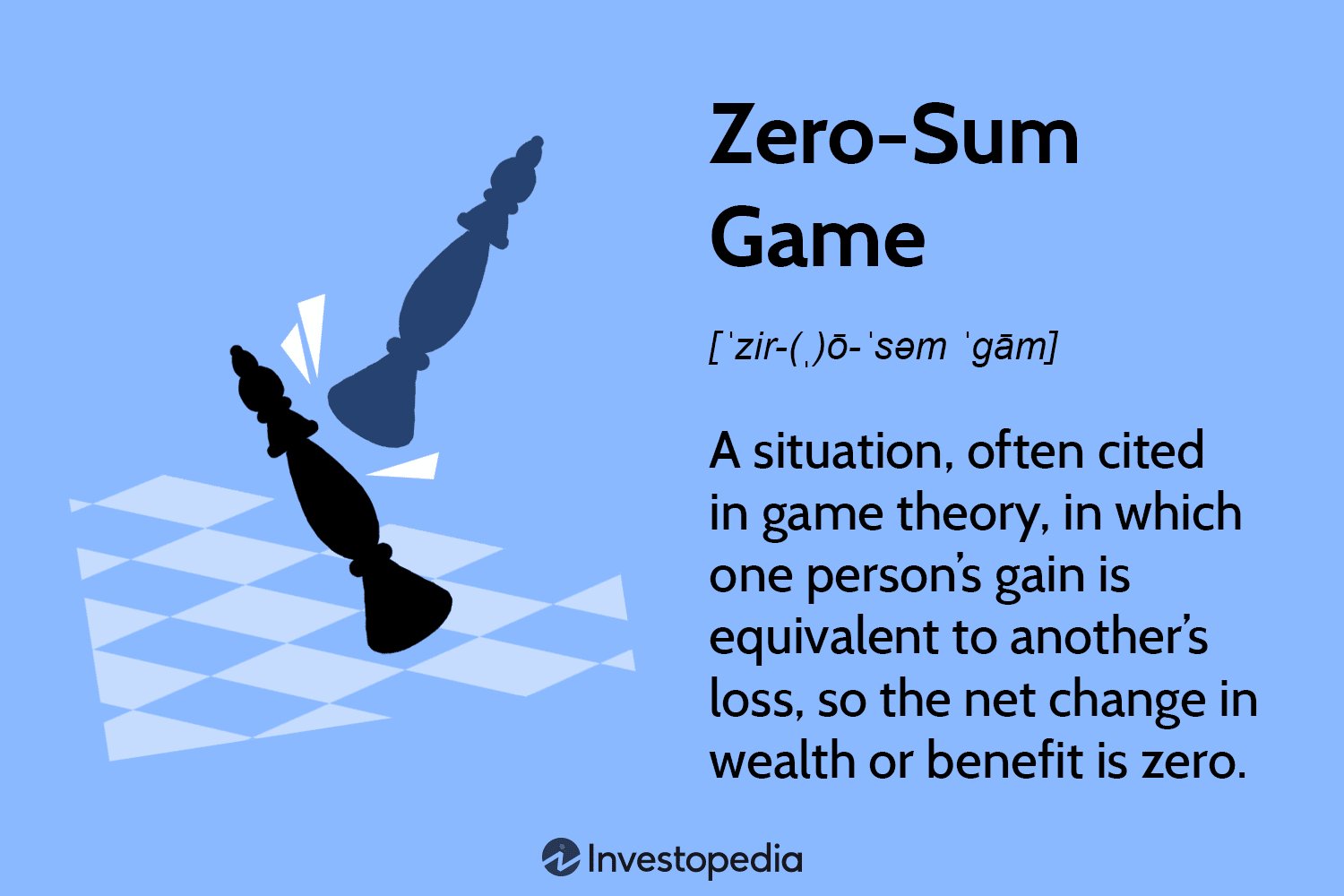
Zero-sum games are mathematically fair in that the total gains equal the total losses, creating a balanced system where no net value is created or destroyed.
Have you ever wondered if every win comes at someone else’s expense? The concept of a zero-sum game paints a stark picture where gains for one player mean equal losses for another. We often hear about these scenarios in economics and even in everyday arguments.
But, are zero-sum games mathematically fair? Is it simply a matter of equal give and take, or are there hidden complexities? Let’s delve into the mathematics behind these games to find out.

Are Zero Sum Games Mathematically Fair?
Let’s dive into the world of games, but not just any games – we’re talking about zero-sum games. Now, what exactly are these games? Imagine a see-saw. When one side goes up, the other side goes down by the exact same amount. That’s kind of how zero-sum games work. In a zero-sum game, the total amount of “stuff” – whether it’s points, money, or anything else – stays the same. If one player wins, another player loses an equal amount. So, does this mean they’re automatically fair? Not always! It’s more complicated than it looks, and we need to explore the ins and outs to really figure it out.
Understanding Zero-Sum Games: The Basics
Before we jump into fairness, let’s make sure we all understand the basic concept of a zero-sum game. A zero-sum game is a situation where one person’s gain is exactly equal to another person’s loss. The “sum” of all outcomes is always zero. Think of it like this:
- Coin Toss: If you bet on heads and win, you gain one point. The person who bet on tails loses one point. +1 and -1 equals 0.
- A Simple Card Game: Imagine a game where you and a friend each put in $5. The winner takes the whole $10. The winner gains $5, and the loser loses $5. +5 and -5 still equals 0.
- Chess: In chess, if one player wins, the other player loses. In terms of the game outcome (win/loss), it’s zero-sum.
Notice how, in each case, what one person gains, another loses. There is no new “stuff” created or destroyed within the game. This is the core feature of a zero-sum game.
Is “Zero-Sum” the Same as “Fair”?
Here’s the tricky part: Just because a game is zero-sum doesn’t mean it’s automatically fair. Fairness is a concept that has many layers, while zero-sum is a mathematical description of a situation. Let’s break down some of the reasons why:
The Role of Skill and Knowledge
Even in a zero-sum game, one player may have a significant advantage due to their skill or knowledge. Think about chess again. Both players start with the same pieces, but a seasoned chess player will almost always defeat someone who is new to the game. Is that unfair? Mathematically, the game is still zero-sum – one win and one loss. But in terms of a level playing field, it’s very imbalanced. Here’s an example using table:
| Scenario | Zero-Sum? | Fair? |
|---|---|---|
| Two beginners playing chess | Yes | Likely Fair (Due to equal skill level) |
| A beginner playing against a chess master | Yes | Not Fair (Due to unequal skill level) |
So, if one player has better strategy, more experience, or a deeper understanding of the game, they’re likely to have an edge. The mathematical balance of zero-sum doesn’t magically create fairness if the players aren’t on equal footing.
Initial Conditions and Starting Advantages
Sometimes, the “fairness” of a zero-sum game is decided even before the game begins, thanks to the initial conditions. Even if the rules and the mechanics of the game seem neutral, a player may have an advantage from the start. For example, consider a game where two people are given different starting points on a race track. Even if they run at the same speed, the person with the closer starting point is more likely to win. This difference in the initial setup introduces an imbalance that isn’t addressed by the zero-sum rule. Consider a zero-sum game where the starting amounts are not the same. For example, one player starts with $10 and the other starts with $100. Even if they play a perfectly balanced game, the person with $100 starts with a huge advantage.
The Problem of Randomness
Many zero-sum games include randomness – the classic coin toss being the simplest example. While a coin toss has a 50/50 chance of each outcome (making it fair over a long period), any single flip is completely random. In the short term, you could have a string of losses despite the game being, overall, statistically balanced. In games involving random dice rolls or cards, the initial draws, or random nature could lead to perceived unfairness in a limited number of games. One player can win multiple times through random events, and they may be perceived as an unfair situation by another player. Although each instance has an equal chance, and over many repetitions each player will win close to half, but a player may encounter perceived unfairness in a limited number of instances.
Game Theory and Zero-Sum Scenarios
When we talk about games, even simple ones, we often get into the topic of ‘Game Theory’. Game theory is a study of how people make choices when their actions affect others. It’s particularly useful in understanding zero-sum situations. In game theory, we analyze the actions players take and try to find the best strategy. There are certain strategies which can be adopted and used by the players in the zero sum game scenarios.
The Concept of a Nash Equilibrium
One of the most important ideas in game theory is the Nash equilibrium. This is a situation where no player can improve their outcome by changing their strategy alone, assuming that the other players keep their strategies unchanged. In zero-sum games, finding the Nash equilibrium can help players understand the best course of action. Sometimes, the Nash equilibrium can demonstrate why a game might feel unfair even though it’s mathematically zero-sum. In some zero-sum games, the “best” strategy for one player might always be to take a very aggressive approach, while for another player the “best” strategy can be to adopt a very defensive approach, leading to a situation where one player seems to dominate all the time, and even when the math is balanced, it feels unfair.
Mixed Strategies and Randomness
Game theory also teaches us about mixed strategies. In certain situations, the best strategy isn’t to pick the same move each time but to randomize your actions. This element of randomness is often employed when the choices of the players are known to others, or the players know what moves they have been making consistently. This can make a game feel more unpredictable, and potentially even fairer, as no player will always get the best outcome. A mixed strategy can be useful in hiding the moves of the players from another player and can prevent them from predicting the outcomes all the time. The element of unpredictability in the zero sum game, introduced through the mixed strategy, can improve the perceived fairness of the game.
Real-World Examples of Zero-Sum Scenarios
Zero-sum concepts are not only used in games but also in several real life scenarios. Let’s look at few real-world situations and examine how these concepts apply in these scenarios.
Financial Markets
While real-world financial markets are rarely strictly zero-sum, some transactions operate this way. For example, when you buy a stock, someone else is selling it. If the price remains the same, your gain is equal to the seller’s loss (or vice versa). Futures and options trading often involves zero-sum situations. In some cases, for example in the case of certain options, one party gains precisely what the other party has lost. However, it’s important to note that markets also involve the creation of value through economic growth, which is not strictly zero-sum.
Political Elections
In many elections, the seats or the power are of fixed quantity. The gain of one party is at the expense of the another party. When one political party gets the majority seats, the other parties typically lose. The total number of seats remains constant, making it a zero-sum system at least in this aspect. The game can be complex with many players involved in this complex zero sum game, but the basic rules remain the same.
Resource Allocation
In the real world, resources like water, land, and funds are often finite. When one group gets more resources, other groups often get less. This can create zero-sum situations. For example, if two cities are drawing water from the same river, the increased allocation to one city is likely to lead to reduced allocations to the other city. In the context of water resource allocation, these types of scenarios often lead to political tensions, disputes and conflicts between two groups. These scenarios, while not always perfect examples, illustrate how the principles of zero-sum games can be seen in real life.
Perceptions of Fairness and the Psychology
Now, let’s get into how we actually feel about fairness. It’s not just about the math, is it? What we feel and how we see a situation play a big role. How fair or unfair a game seems also depends on our perception and emotions involved with the game.
The Impact of Loss Aversion
People tend to feel the pain of a loss more strongly than the pleasure of a gain. This is known as loss aversion. In a zero-sum game, where one person’s gain is directly tied to another’s loss, the loser may feel the unfairness of the outcome more intensely, even if the game is fair mathematically. A lot of times the player who loses, does not feel happy about it. This is an important factor in shaping our perceptions, and this plays an important role in shaping our perceptions of fairness. Even when the players are equally skilled, losing in a zero sum game can evoke negative emotional response and may be perceived as an unfair game.
The Influence of the Narrative
How we tell the story of a game matters. If a player feels that they were cheated or that their opponent had an unfair advantage (even if not true), they’re more likely to view the game as unfair. The narrative around a game can impact the perceived fairness, and this may or may not align with the mathematical reality of zero sum game. Sometimes it is not the reality of the zero sum game, but the narrative associated with it, that determines the perception of the fairness. For example, if a player believes the other player had better resources or external advantages, they may view the game as unfair.
The Importance of Transparency
When people understand the rules of the game, and when there is transparency in the process, the perception of fairness is much higher. If the rules are complex or difficult to understand, or if it feels that the game is unfair, even if that’s not the case, there can be negative emotions. This can often be mitigated by making sure that all the rules are known in advance. An open and clear communication system can enhance the feeling of fairness, even if the game itself is zero-sum.
So, are zero-sum games mathematically fair? The answer is not a simple yes or no. While the mathematical structure of a zero-sum game guarantees that gains are always balanced by losses, this doesn’t automatically make the game fair. Factors like skill, initial conditions, randomness, and our psychological responses all play a role in shaping our perception of fairness. Zero sum games can be inherently balanced in terms of mathematical outcomes but can feel unfair because of unequal skill levels, starting advantages and sometimes due to bad luck due to random events. Understanding the nuances between mathematical balance and the perception of fairness is crucial in evaluating real-world zero sum scenarios and zero sum games. Whether in a board game or in complex real world scenarios, the balance between the rules of the game and the player experiences is something which needs to be taken into account when assessing the overall fairness.
Zero Sum Stochastic Games – Georgia Tech – Machine Learning
Final Thoughts
Ultimately, zero sum games are mathematically fair in that one player’s gain directly equals another’s loss. This balance ensures a net outcome of zero, preventing overall value creation or destruction.
However, this mathematical fairness does not guarantee equal skill or opportunity among participants. Therefore, while the game is mathematically balanced, individual player experience may vary significantly. So, we can debate that are zero sum games mathematically fair.

