
Use DLSS settings within the game for optimal performance, as this allows game developers to integrate DLSS effectively for that specific title.
Figuring out the best settings for your games can be a pain, especially with features like DLSS. The question often arises, do i usee dlss in game or nvidia settings? This choice impacts how well your games run and look.
It’s quite important to understand that game developers often integrate DLSS in a way that’s specifically tailored for their game. Using in-game settings provides the intended experience. You can control this directly there, leading to a better implementation of DLSS.

Do I Use DLSS in Game or NVIDIA Settings?
Alright, let’s dive into a question that many gamers are pondering: where should you turn on NVIDIA’s DLSS (Deep Learning Super Sampling)? Should you flip the switch within the game’s settings, or should you go digging into the NVIDIA Control Panel? It might seem like a small thing, but the answer can impact how your games look and perform. We’re going to break it all down, so you can make the best choice for your gaming setup.
Understanding DLSS: A Quick Recap
Before we get into the “where,” let’s briefly touch on the “what.” DLSS is a fancy technology developed by NVIDIA that uses AI to make games run faster and look better. It works by rendering a game at a lower resolution and then using AI to intelligently upscale it to your monitor’s native resolution. Think of it like taking a small picture and making it bigger without losing too much detail. This lets you achieve higher frame rates (smoother gameplay) without sacrificing too much visual fidelity.
Why Does Resolution Matter?
The resolution of your game is how many pixels are displayed on your screen. More pixels usually means a sharper and more detailed picture, but also puts a bigger strain on your graphics card. This is where DLSS comes to the rescue. By starting with a lower resolution, the graphics card doesn’t have to work as hard, giving you those higher frame rates everyone wants. DLSS is one of many ways to improve your gaming experience.
The In-Game DLSS Option
Most modern games that support DLSS have an option for it right in the graphics settings menu. This makes it super easy to find and turn on. Usually, you’ll see different DLSS modes like “Quality,” “Balanced,” “Performance,” and sometimes “Ultra Performance.”
- Quality Mode: This setting aims to keep your game looking as good as possible while still improving frame rates. It’s like a gentle helping hand for your graphics card.
- Balanced Mode: As the name suggests, this mode tries to find a sweet spot between image quality and performance. It’s a good option if you want a nice balance.
- Performance Mode: This setting prioritizes frame rates over image quality. It will make your game run much smoother, but there might be a slight drop in detail.
- Ultra Performance Mode: If it exists, this mode is all about getting the highest possible frame rates. You will probably see a larger impact on how sharp the game looks.
Choosing one of these modes really comes down to the particular game and what your priorities are. If you want to get the best image quality, go for “Quality”. If you want smoother frame rates, pick “Performance”. Most people will likely choose “Balanced”. It is important to try different settings to see what works best for you.
Advantages of Using In-Game DLSS
- Easy to Access: It’s right there in the game’s menu, no need to dig around in other places.
- Game-Specific Tweaks: Games often have DLSS settings that are tuned to that specific game’s needs. Developers work hard to optimize the way DLSS works in their game.
- Clear Mode Selection: You usually have different modes to choose from, making it easy to customize.
Disadvantages of Using In-Game DLSS
- Limited to Games: If a game doesn’t have DLSS support, you’re out of luck.
- Game by Game Adjustments: You have to change the settings individually for each game that uses DLSS.
The NVIDIA Control Panel: A Global Approach
Now, let’s talk about the NVIDIA Control Panel. This is a piece of software that controls how your graphics card works on a more general level. Within the NVIDIA Control Panel, you might see options related to DLSS or similar technologies. However, It’s crucial to understand that the NVIDIA Control Panel isn’t the primary place to activate or control DLSS for individual games. In most scenarios, this is about other functions.
Image Scaling and Sharpening
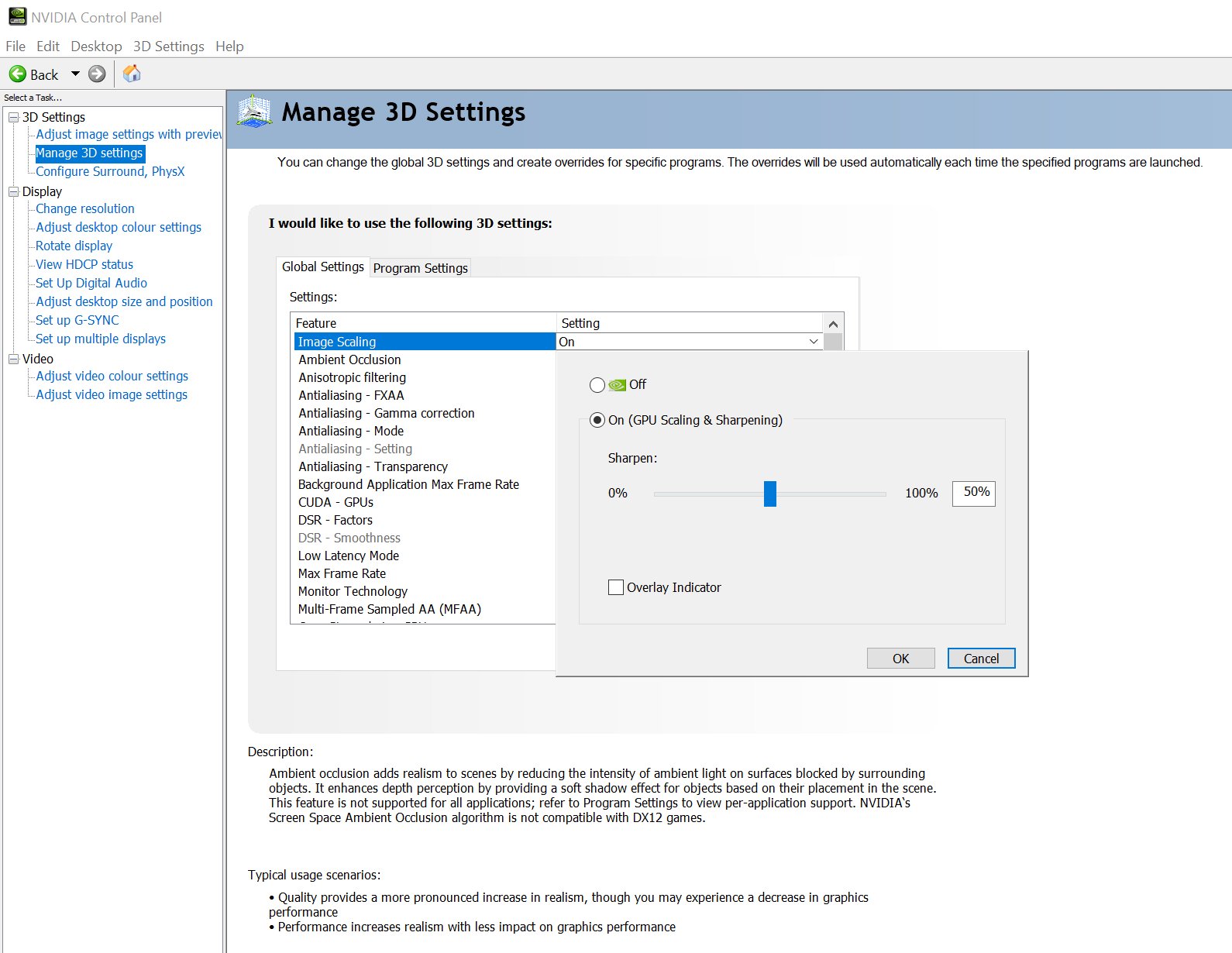
While not directly related to activating DLSS, the NVIDIA Control Panel does offer similar technologies, such as “Image Scaling.” This setting will upscale and sharpen your games, potentially improving image quality and performance. This isn’t the same as DLSS, but it is still a helpful feature to have access to. It works on a broader selection of games and doesn’t need direct game support. You might want to use Image Scaling for games that don’t have DLSS or to further enhance image quality alongside DLSS.
The following details will help you better understand these features:
- Image Sharpening: The NVIDIA Control Panel allows you to tweak the level of sharpness in your games. This is helpful for some games that have slightly blurry graphics.
- Global Setting: This impacts all games or programs that are running on your computer, unlike DLSS, which you have to activate per game.
- Compatibility: Image Scaling is available for a wider selection of games because it doesn’t require the game to have specific settings.
Advantages of Using NVIDIA Control Panel
- Global Application: Changes you make here can affect all games, not just one.
- Sharpening and Scaling: The control panel gives you options to sharpen and scale games that don’t have their own built-in options.
Disadvantages of Using NVIDIA Control Panel
- Not DLSS Specific: The Control Panel won’t let you turn on or tweak DLSS directly.
- Can Be Confusing: There are many settings in the control panel and the result may not be obvious.
The Key Difference: Game-Specific vs. Global
The essential difference between the two places is that in-game settings are specific to each game while NVIDIA Control Panel settings affect all of them. When it comes to DLSS, always start with the game’s settings. This is because game developers work closely with NVIDIA to get DLSS working best in their games. If a game has an option for DLSS in its menu, that’s where you want to adjust it. You can use the NVIDIA Control Panel for games that don’t have DLSS or other sharpening settings, or if you want to make more general changes to how your graphics card handles images.
When to Use Which: A Practical Guide
Here is a simple way to think about it:
- DLSS In Game: Use this option when the game has DLSS support. It will give you the best-tuned results, and you can choose from different performance modes.
- NVIDIA Control Panel: Use the control panel for general things like image sharpening or when you’re playing games that don’t have their own settings.
Let’s break down a few real-world scenarios:
Scenario 1: Playing Cyberpunk 2077
Cyberpunk 2077 has excellent DLSS support, with multiple modes available. In this case, you’d definitely use the in-game settings to enable DLSS and choose your preferred quality mode. Start with “Balanced” and then adjust as needed. Use NVIDIA Control Panel to make changes for other graphic settings if you want to.
Scenario 2: Playing an Older Game Without DLSS
If you’re playing a game that doesn’t have any DLSS support, the NVIDIA Control Panel is the place to experiment. Use the “Image Sharpening” or the “Image Scaling” options, as well as other features like “Texture Filtering.” Tweak the settings to your liking and see what you like.
Scenario 3: Wanting a Global Sharpening Setting
If you generally want your games to look a bit sharper, you can use the “Image Sharpening” option in the NVIDIA Control Panel. This is a good way to improve how most games look, instead of having to tune every game individually.
Fine-Tuning Your Gaming Experience
Getting the best gaming experience with DLSS and NVIDIA settings is often a process of trial and error. Here are a few tips to help you along the way:
- Experiment with Modes: Try out the different DLSS modes in your game to find the right balance between visuals and performance.
- Keep an Eye on Frame Rates: Use an in-game performance overlay (often built into the game or provided by third-party software) to see how different settings affect your frame rate.
- Update Your Drivers: Always make sure you have the newest NVIDIA drivers installed. NVIDIA is constantly optimizing its drivers and making improvements to DLSS.
- Read Reviews and Guides: For some games, there are great guides from players who have experimented with different settings. You can use these to help you better optimize your settings.
Ultimately, the best approach is to play around with the different options until you find the combination that works perfectly for you. Every system is different, and what is ideal for one person may not be ideal for another.
So, to recap: if your game has DLSS, you should use the in-game setting to enable it. If the game doesn’t, then you can experiment with some of NVIDIA’s other features. This should help you get the best out of your system, improving how your games look and feel.
Explaining NVIDIA DLSS So You Can Actually Understand It!
Final Thoughts
Ultimately, deciding where to enable DLSS depends on the game. If the game offers granular DLSS control, use in-game settings. These typically provide more specific options for quality.
If the game lacks in-depth DLSS controls, the Nvidia Control Panel provides a fallback. This helps force DLSS when the in-game options are limited. Ultimately, for the best experience, always check first the game’s settings.
Therefore, the best answer for ‘do i usee dlss in game or nvidia settings’ is to use the in-game settings when available and prefer them over the Nvidia Control Panel.

