
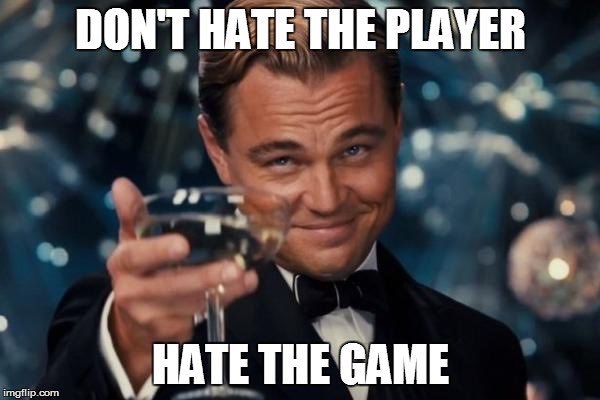
The ‘dont hate the player hate the game’ meme suggests that we should direct our frustration toward the system or rules that enable negative behavior, rather than blaming individuals acting within that system.
Ever found yourself getting annoyed at someone’s actions, only to realize they’re simply playing by the rules? That’s the essence of the “dont hate the player hate the game meme”. It highlights the often overlooked influence of systems and environments on individual choices. Instead of focusing blame solely on individuals, it encourages us to analyze the game itself.

Don’t Hate the Player, Hate the Game Meme: Understanding the Phrase
Have you ever heard someone say, “Don’t hate the player, hate the game?” It’s a pretty popular saying, and it’s often used when someone does something that feels unfair, but they’re not really breaking any rules. It’s like when your friend always wins at a board game because they know all the tricks – you might feel a little frustrated, but you probably shouldn’t be mad at them. This phrase, often seen as a meme, helps us think about who is really at fault when things don’t seem right.
What Does “Don’t Hate the Player, Hate the Game” Mean?
At its heart, this phrase encourages us to look at the bigger picture. It suggests that instead of getting angry at the person who’s benefiting from a situation, we should examine the situation itself. It’s like when a video game has an overpowered character. Instead of being mad at the person who chooses that character, maybe you should be thinking, “Wow, this game needs some fixing!” It urges us to direct our attention towards the structure, the rules, or the system that allows certain behaviors to happen.
The Player’s Role
Let’s think about what a “player” represents. The player is someone who is acting within the defined rules or conditions. They are not usually the ones who created the situation. In the context of a game, they are simply trying to win using the given rules and tools. It’s like playing tag – someone is “it” and they’re running around trying to catch others. They didn’t make the game; they’re just playing it as it is supposed to be played. This perspective is important; it’s about understanding their position in the framework. We need to realize players are reacting to the existing context and circumstances, and their choices are made within this framework.
The Game’s Influence
Now, let’s dive deep into the “game” part of the saying. The “game” stands for the set of rules, policies, circumstances, or environment in which the player operates. The game encompasses everything that influences their actions. If a game has a flaw, a rule that is easy to exploit, or is fundamentally unequal, it doesn’t matter who plays; the same outcome will likely occur. For example, if a school has a rule that allows some students to use calculators on a test while others cannot, it creates an unfair advantage. It’s not the students’ fault that the rule is there, it’s the game (the school rule) that needs to be fixed. Identifying these structural flaws is the first step towards creating fair circumstances for everyone.
Exploring Different Situations: Where “Don’t Hate the Player” Fits
This saying applies to more situations than just games. Think about school, sports, work, and even social situations. Let’s go through some examples to understand how to use this in our everyday life.
School Scenarios
Imagine this: a student always gets great marks in tests because they have a private tutor. Other students might feel jealous or frustrated. But, should they really be mad at the student? If we apply the “don’t hate the player” idea, we understand that the issue isn’t the student using the resources available to them. The actual problem is the inequity in access to those resources. The ‘game’ is the educational system that doesn’t provide the same support and opportunities for all students. The solution isn’t to stop the student with a tutor from succeeding; it’s about finding ways to provide extra help for every student.
- The Player: The student getting better grades because of tutoring.
- The Game: The educational system that allows some to have an unfair edge.
This can also be applied to standardized tests, which some people find easier than others. It’s not the person doing well on a test we should be mad at; it’s the test itself and its ability to accurately measure intelligence or potential.
Sports Examples
In sports, athletes often push the limits of rules to gain an advantage. Some players might take advantage of a poorly written rule or an obscure loophole in the game’s regulations. Instead of pointing fingers at them, the focus should be on the rules themselves and how they need to be improved. Sometimes, players find ways to gain an advantage, which is not breaking the rules, but it makes the competition feel unbalanced. It’s like in a racing game, someone uses a shortcut not listed in the rules, it is an advantage, but not cheating, and that’s a part of the game that needs some fixing. The sports management should review the rules, making the game fair for everyone and that everyone can have equal opportunity to win.
- The Player: A sports player who uses a loophole to their advantage.
- The Game: The set of rules that allowed for the loophole.
Consider a basketball player who is known for drawing fouls. They may not be breaking the rules, but their style of play might be seen as frustrating or annoying. This is not the player’s fault because they are playing within the rules of the game. Instead, we need to think about the rules around fouls and whether they need to be improved to make the game less exploitable.
Workplace Dynamics
This concept applies significantly in the workplace. Consider a situation where someone gets promoted quickly because they are good at networking, not necessarily because they are more competent. Their colleagues might feel resentful. But, instead of blaming the promoted employee, we need to analyze the workplace structure. If networking skills are valued more than actual skills for promotions, then the problem is with the system. The organization needs to change how it assesses and promotes employees. It can be used in any type of job, if a company rewards sales persons based on the total amount of sales they have done and not for how many new clients they have brought, or the amount of product they have sold, the company can’t blame the salesman who is selling more expensive products rather than selling new products or amount of product.
- The Player: The employee getting promoted based on networking.
- The Game: The company’s promotion system.
Similarly, if a workplace has an “open door policy” which is not being followed and supervisors do not allow employees to speak, the issue lies with the management not with employees, hence, focusing on addressing issues within the game, not players.
Social Interactions
This also shows up in how we interact with each other. For example, a person who is naturally charming or persuasive might get their way more often. It’s tempting to feel resentful towards them, but it’s more productive to examine how society values these traits. Does the system unfairly reward them? If it does, then it’s not necessarily the fault of this particular person; the issue is the social system that promotes certain types of behaviors more than others.
- The Player: A naturally charming person who gets their way.
- The Game: Societal norms and values that reward certain personalities.
Why Is This Idea Important?
Understanding the “don’t hate the player, hate the game” concept makes us more effective in problem-solving. It stops us from blaming people who are merely acting within a system and encourages us to look for ways to fix the system. Instead of getting stuck in a cycle of blaming individuals, we can focus our efforts on creating fairer rules, better policies, and more equal opportunities for everyone.
Promotes Constructive Criticism
When we focus on the game instead of the player, we shift our approach from emotional reactions to rational analysis. When we are thinking about the actual issue, we can come up with constructive solutions. Instead of only blaming the person, we can start thinking about the situation, and this promotes a healthier way of dealing with any kind of conflicts. Instead of blaming a student, who may be doing well in their exams due to their resources, we can start thinking about making the education system better for all of the students. This type of approach promotes progress and ensures that problems are addressed fairly.
Encourages Systemic Change
Recognizing the limitations or flaws in “the game” motivates us to seek improvements. When we identify the problem in the system rather than the person, we can make changes to achieve fairness. When we see flaws in the rules of a game, we work to create rules that are better. This idea encourages us to question existing power structures, outdated policies, and unfair practices. Instead of focusing only on individual actions, we also seek to build a system that works for everyone. In the long run, this approach will produce better results because it resolves the root of the problem.
Builds Empathy
By understanding that people are acting within the constraints of a system, we develop empathy. We can relate to why the person is acting in a certain way, and we can view the person as just a player, who is doing their part to win. This way of thinking helps us to understand different perspectives and find common ground. We are less likely to jump to a conclusion and blame an individual and are more inclined to see the bigger picture. This type of perspective allows us to develop more meaningful and productive relationships.
How to Use This Mindset in Daily Life
It’s important to use this concept in our daily lives. It’s not always easy to separate the player from the game, but these steps can help:
Pause and Reflect
The first step is to pause whenever you feel frustrated or angry with someone’s behavior. Think about the bigger picture and ask yourself: “Is this person really the problem, or is it something bigger?” Ask yourself questions like:
- What are the rules or structures at play?
- What conditions may have led to this action?
- Is it possible that there may be systemic issues influencing the outcome?
By pausing, you give yourself time to think before reacting. This will make you approach any problem in a more rational way, which will help you find the root problem.
Analyze the Context
Once you’ve taken a moment to think, look at the circumstances around the situation. Consider all the things that might be impacting the situation. Look at the rules, the policies, and all the things that may be influencing the person’s actions. This allows you to identify the limitations or flaws in the current structure that may be causing the problem. This allows us to address the real issues.
Focus on Solutions
Instead of dwelling on who is at fault, think about possible solutions to address the flaws in the system. Think about ways to improve the rules, policies, or environments. This kind of solution-oriented way of thinking helps us to fix the game rather than just blaming the player. Ask yourself:
- How can we make this more fair?
- What changes can we make to improve the rules?
- What policies can we revise or create to make a more equitable system?
This process of focusing on solutions helps shift us away from negativity and blame to constructive action that can make a difference. When we concentrate on systemic issues and make them better, we can make a fair environment for everyone.
Communicate Constructively
When discussing your concerns, choose to do so in a constructive manner. Avoid personal attacks and instead, communicate the problems you see in the system. Explain the ways the structure is influencing the outcome, and make suggestions to make improvements in the environment. This approach helps others to see the big picture, and it makes them work towards positive changes. The focus should be on explaining the flaws in the “game” rather than placing blame on any one person.
The “Don’t Hate the Player” Meme in Pop Culture
The phrase “don’t hate the player, hate the game” has become very common online, mainly as a meme. Memes take ideas and make them easy to share on the internet through images, videos, or simple text. This particular saying is very popular because it’s a good way to express something we often feel in many situations. These memes help people understand and talk about the concept through a light and easy way. These memes can be found everywhere, on social media platforms such as Twitter, Instagram, and Reddit, etc. They come in many different forms, often using humor and relatable scenarios to highlight how individuals can be a product of their circumstances and that they may not be in the wrong.
How Memes Help
Memes can make complex ideas simpler and relatable. By showing these kinds of situations, memes help people understand that issues are more systemic rather than individual. This approach makes conversations more fun and relatable. It encourages the audience to engage in a topic that they might not have otherwise engaged with. Using memes can be effective in spreading messages across different platforms, and it can easily influence people’s perspective on a topic. These memes often use humor, which makes it easy to engage people and makes them more open to changing how they think about problems.
Impact on Social Discussions
The use of the “don’t hate the player, hate the game” meme has helped encourage conversations about social and systemic issues. These discussions are critical because they encourage people to start thinking about the bigger problems that are happening in society. It has been used in politics, workplaces, and other important social contexts to help people to analyze and discuss important issues. These social discussions are important because it will help people make better choices and make an impact in making society better and fairer for everyone.
In summary, the “don’t hate the player, hate the game” concept is a powerful way to think about how rules, systems, and structures influence our actions. By looking at the big picture, we can move past unproductive blame and instead find solutions that make things more fair for everyone. This mindset will promote justice and empathy by shifting the focus from individuals to the environment in which they act.
Don’t hate the player, hate the game.
Final Thoughts
Essentially, the “don’t hate the player hate the game” meme highlights systemic flaws, not individual actions. People often criticize individuals within a system without addressing the flawed system itself. It is important we analyze the system before blaming an individual.
This meme encourages us to focus on the bigger picture. It reminds everyone that behavior is shaped by the environment. We must strive to improve the system, not just condemn the participants within.

