
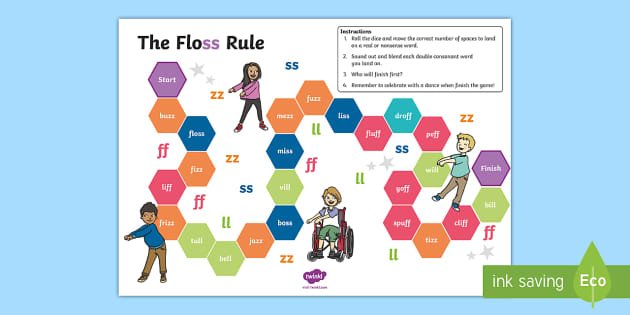
‘Floss rule games’ help children practice and solidify their understanding of the doubling rule for single-syllable words ending in f, l, or s, by making learning interactive and fun.
Ever wondered how to make spelling rules stick? Many struggle with the “floss rule,” but what if we could make it enjoyable?
‘Floss rule games’ are the key. These activities turn a tricky spelling rule into a positive experience.
These games provide engaging and interactive methods for kids to absorb this essential skill. With strategic game play, children grasp the concept easily and strengthen their literacy foundation!

Floss Rule Games: A Deep Dive
The “floss rule” is a fundamental concept in phonics, particularly useful for early readers and spellers. It dictates when to double the letters ‘f’, ‘l’, and ‘s’ at the end of a one-syllable word immediately following a short vowel sound.
Learning this rule can significantly improve a child’s reading and writing accuracy. Let’s explore how to make mastering this rule fun with engaging floss rule games.
Understanding the Floss Rule
The floss rule, often presented as a simple mnemonic, helps children remember when to double final ‘f’, ‘l’, and ‘s’ after a short vowel in one-syllable words. Think of it as a helpful guideline for decoding and encoding words.
Essentially, if a one-syllable word has a short vowel sound immediately followed by ‘f’, ‘l’, or ‘s’, then that letter is usually doubled. This applies to words like “staff,” “ball,” and “kiss.”
Why Use Games to Teach the Floss Rule?
Games offer a playful and interactive way to reinforce learning. They can transform a potentially dry phonics rule into an engaging activity.
Children are more likely to remember concepts when they are presented in a fun and memorable context. Games provide that context.
Floss Rule Games: A Variety of Options
There are many different types of games you can use to teach the floss rule. These range from simple card games to more elaborate board games.
The key is to choose games that are appropriate for the child’s age and skill level. Let’s look at some examples.
Floss Rule Card Games
Card games are a versatile and affordable way to practice the floss rule. They are easy to adapt and can be played individually or in small groups.
Here are some ideas for floss rule card games.
Go Fish with Floss Words
This classic game can be easily adapted to focus on floss words. Create a deck of cards featuring pairs of floss words.
The rules are the same as traditional Go Fish, but players ask for matches of floss words. This reinforces recognition of words following the floss rule.
Floss Rule Memory Match
Create pairs of cards – one with a picture representing a floss word (e.g., a picture of a bell), and the other with the written floss word (“bell”).
Players take turns flipping over two cards at a time, trying to find a matching pair. This helps connect the visual representation with the written form.
Floss Rule Snap
Prepare a deck of cards with various words, some adhering to the floss rule and some that don’t. When two cards in a row show a word following the floss rule, players shout “Snap!”.
This reinforces quick recognition of floss rule words under pressure. This quick-thinking format keeps students engaged.
Floss Rule Board Games
Board games offer a more structured and engaging way to practice the floss rule. They often involve strategic thinking and can be played with multiple players.
Here are some board game ideas.
Floss Rule Word Ladder
Create a game board with a winding path. Players roll a dice and move along the path.
When they land on a space, they must say a floss word or a word that fits a specific criteria (e.g., a floss word that rhymes with “tall”). This game encourages quick thinking and expands vocabulary.
Floss Rule Bingo
Create bingo cards with various floss words. Call out definitions or clues related to the words.
Players mark off the words on their cards as they are called. The first player to get bingo wins.
Floss Rule Treasure Hunt
Hide floss word cards around a room or outdoor area. Provide clues that lead children to the cards.
Once they find a card, they must read the word aloud and use it in a sentence. This incorporates movement and reading skills.
Digital Floss Rule Games
Technology provides numerous opportunities for interactive floss rule games. These games can be accessed on computers, tablets, or smartphones.
Here are a few digital game ideas.
Floss Rule Spelling Apps
Many educational apps focus on phonics and spelling skills. Look for apps that specifically target the floss rule.
These apps often feature interactive exercises, quizzes, and games. They provide immediate feedback and track progress.
Online Floss Rule Quizzes
Several websites offer free online quizzes that test knowledge of the floss rule. These quizzes can be a fun and quick way to assess understanding.
They can also be used as a warm-up activity before a more comprehensive game. These quizzes provide instant scoring for a quick assessment.
Create Your Own Floss Rule Game
Many platforms allow you to create your own educational games. Tools like Kahoot! or Quizizz can be used to design interactive quizzes and games that focus on the floss rule.
This allows you to tailor the game to your child’s specific needs and interests. You can also customize the game with images and audio.
Adapting Games for Different Learning Styles
Not all children learn in the same way. It is important to adapt floss rule games to suit different learning styles.
Consider these adaptations:
- Visual Learners: Use flashcards with pictures, colorful diagrams, and visual aids.
- Auditory Learners: Emphasize rhyming words, create songs or chants, and read floss word stories aloud.
- Kinesthetic Learners: Incorporate movement into the games, such as jumping or clapping for each floss word.
Creating Your Own Floss Rule Games
You don’t have to rely solely on pre-made games. Creating your own floss rule games can be a fun and rewarding experience.
Here are some tips for designing your own games.
Brainstorming Ideas
Start by brainstorming a list of floss words. Use a whiteboard or piece of paper to write down all the words you can think of that follow the floss rule.
Next, think about games that you enjoy playing. How can you incorporate floss words into those games?
Simplifying the Rules
Keep the rules of your games simple and easy to understand. Children are more likely to engage with games that are not overly complicated.
Use clear and concise language when explaining the rules. It helps to demonstrate the game before starting.
Making it Engaging
Add elements of fun and excitement to your games. Use colorful materials, silly voices, or create a theme around the game.
Consider adding a reward system to motivate children. Small prizes or stickers can be effective incentives.
Example Games: Detailed Breakdown
Let’s break down some specific floss rule games with detailed instructions and variations.
Floss Rule Scavenger Hunt
This game combines physical activity with word recognition. It’s perfect for engaging kinesthetic learners and making learning an adventure.
Preparation
Create Floss Word Cards: Write floss words on index cards (e.g., “bell,” “puff,” “kiss,” “hill,” “pass,” “muff”). You’ll need several cards.
Prepare Clues: Write simple clues related to the locations where you’ll hide the cards. Clues can be rhyming riddles, simple instructions, or even pictures. For example: “Where you rest your weary head” (for a card hidden under a pillow).
Choose Hiding Spots: Select various hiding spots around the room or house. Make sure the spots are safe and accessible.
How to Play
1. Present the First Clue: Give the child the first clue.
2. Find the First Card: The child follows the clue to find the first floss word card.
3. Read the Word: The child reads the word aloud.
4. Use in a Sentence (Optional): Have the child use the word in a sentence. This reinforces comprehension.
5. Repeat: Continue giving clues until all the floss word cards have been found.
Variations
Team Scavenger Hunt: Divide children into teams and have them compete to find the cards the fastest.
Timed Scavenger Hunt: Set a timer and see how quickly the child can find all the cards.
Reverse Scavenger Hunt: Have the child hide the cards and write the clues for you.
Floss Rule Dominoes
This game uses dominoes to connect floss words and create chains of associated words. It reinforces spelling and word association skills.
Preparation
Create Dominoes: Make dominoes using cardstock or thick paper. On each domino, write two words. Ensure that some of the words follow the floss rule and can be connected logically or thematically. Examples:
Domino 1: “Kiss” – “Tell”
Domino 2: “Tall” – “Cliff”
Domino 3: “Staff” – “Miss”
How to Play
1. Deal Dominoes: Distribute an equal number of dominoes to each player.
2. Start the Chain: One player starts by placing a domino in the center.
3. Connect the Words: Players take turns adding dominoes to the chain, connecting words that follow the floss rule or are related in some way (e.g., rhyming, similar meaning). If a player cannot play, they skip their turn.
4. Winning: The first player to use all their dominoes wins the game.
Variations
Themed Dominoes: Create dominoes with words related to a specific theme (e.g., animals, food).
Picture Dominoes: Use pictures instead of words on the dominoes.
Advanced Dominoes: Include more challenging words or add rules for connecting words (e.g., must rhyme or start with the same letter).
Essential Materials for Floss Rule Games
Having the right materials on hand can make it easier to create and play floss rule games.
Index Cards: Useful for creating flashcards, game cards, and dominoes.
Markers or Pens: Essential for writing words and drawing pictures.
Dice: Can be used in board games or as a random number generator.
Game Board: A blank game board can be customized for various floss rule games.
Small Prizes: Stickers, candy, or small toys can be used as rewards.
Timer: Helpful for timed games and activities.
Construction Paper: Useful for creating colorful game components.
Addressing Common Challenges
Sometimes, children may struggle with the floss rule despite playing games. It’s important to address these challenges with patience and understanding.
Confusing the Rule with Other Phonics Rules
Children may confuse the floss rule with other phonics rules, such as the silent ‘e’ rule. Provide clear explanations and examples to differentiate the rules.
Focus on the specific conditions that apply to the floss rule (one syllable, short vowel, followed by f, l, or s). Use visual aids to highlight these conditions.
Difficulty with Short Vowel Sounds
Some children may have difficulty distinguishing short vowel sounds. Practice identifying short vowel sounds through auditory exercises and visual cues.
Use picture cards to associate short vowel sounds with specific images. Provide plenty of opportunities for repetition and practice.
Lack of Motivation
If a child lacks motivation, try to make the games more engaging and personalized. Choose games that align with their interests.
Offer positive reinforcement and praise for effort, not just correct answers. Celebrate small successes to build confidence.
Floss Rule Games: Examples in Action
Let’s consider a few real-world examples of how to implement floss rule games in different settings.
Classroom Setting
In a classroom, a teacher can use floss rule bingo as a whole-class activity. This allows for simultaneous participation and provides a fun way to review the rule.
The teacher can call out definitions or clues, and students mark off the corresponding words on their bingo cards. This activity fosters engagement and reinforces learning.
Homeschooling Environment
In a homeschooling environment, a parent can create a customized floss rule scavenger hunt. This allows for individualized instruction and caters to the child’s specific interests.
The parent can create clues that are related to the child’s favorite books or activities. This makes learning more meaningful and enjoyable.
Tutoring Sessions
In a tutoring session, a tutor can use a digital floss rule spelling app. This provides a structured and interactive way to practice the rule.
The app can track the student’s progress and provide targeted feedback. This allows the tutor to address specific areas of weakness.
Advanced Floss Rule Concepts
While the basic floss rule is straightforward, there are some advanced concepts that can be explored with older or more advanced learners.
Exceptions to the Floss Rule
There are some exceptions to the floss rule, such as words borrowed from other languages. Discuss these exceptions with students and provide examples.
Examples include “gas,” “bus,” and “chef.” Explain that these words do not follow the typical pattern.
Compound Words
When dealing with compound words, the floss rule only applies to the individual one-syllable words. For example, in the word “grasshopper,” the “grass” follows the floss rule, but “hopper” does not.
Break down compound words into their individual components and analyze each part separately. This helps students understand how the rule applies in different contexts.
Morphological Awareness
Explore how adding suffixes to floss words can affect their spelling. For example, adding “-ing” to “kiss” results in “kissing.”
Discuss how the floss rule is maintained even when suffixes are added. This reinforces the importance of understanding morphemes and their impact on spelling.
Long-Term Benefits of Mastering the Floss Rule
Mastering the floss rule has numerous long-term benefits for literacy development.
- Improved Spelling Skills: Understanding the floss rule enhances spelling accuracy and reduces common spelling errors.
- Enhanced Reading Fluency: Recognizing floss words quickly improves reading fluency and comprehension.
- Increased Confidence: Success in mastering phonics rules boosts confidence and motivation in literacy activities.
- Stronger Foundation: A solid understanding of phonics provides a strong foundation for more advanced reading and writing skills.
Ze Floss Rule 🎉GRAMMAR and SPELLING for Kids📝 Superlexia ⭐ Episode 14
Final Thoughts
Floss rule games are an effective way to solidify spelling skills. They turn practice into engaging activities, helping children remember the FF, LL, SS, and ZZ at the end of one-syllable words after a short vowel.
Engaging games make learning fun and memorable. This active participation helps kids grasp the floss rule.
In summary, floss rule games turn learning into play. Incorporating these games into your teaching methods must improve spelling proficiency and student engagement.

