
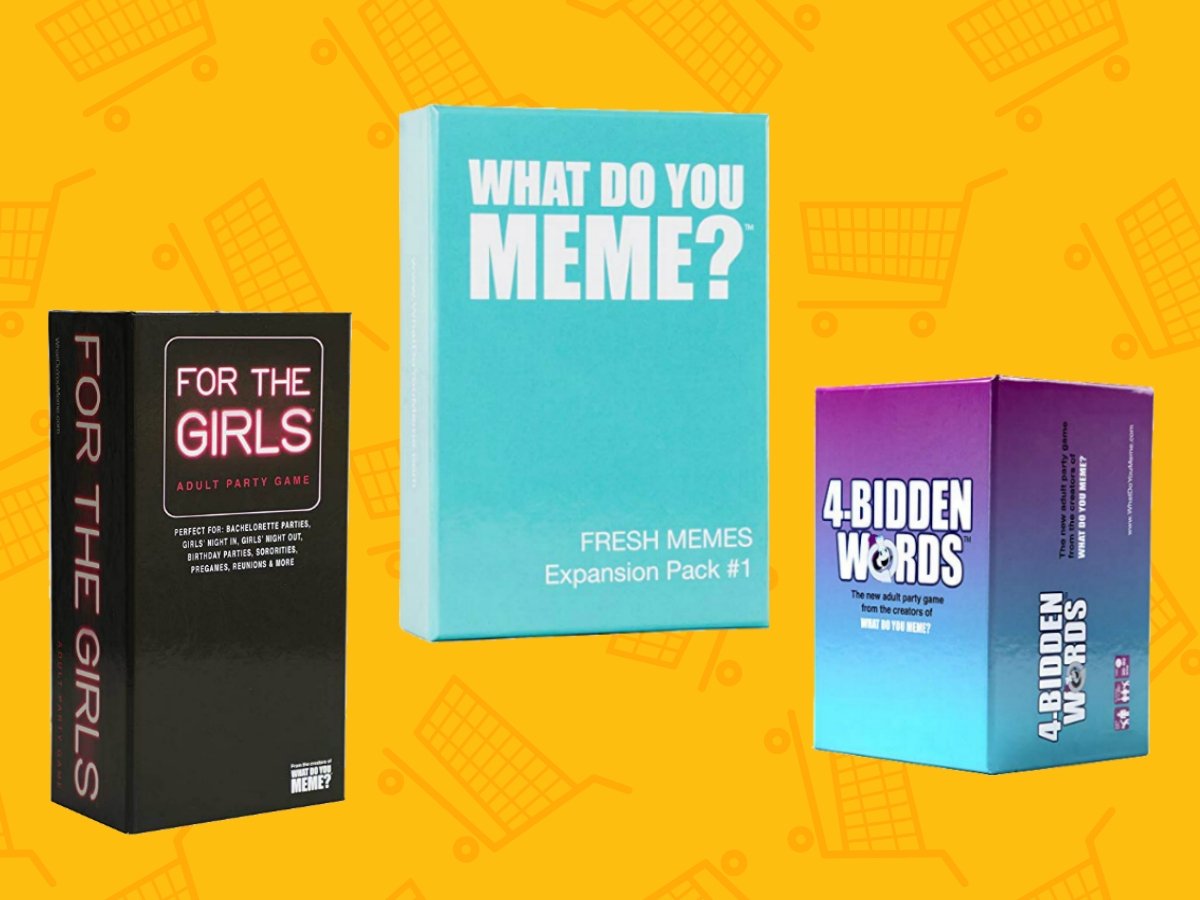
Here are some games like What Do You Meme: Cards Against Humanity, Apples to Apples, and relative newcomer, New Phone, Who Dis?
Ever laugh so hard your sides hurt? The card game What Do You Meme provides that kind of entertainment. Its popularity has sparked a search for similar hilarious experiences.
If you are seeking games like What Do You Meme, you’re in luck! There are plenty of options that deliver similar laughs and social fun.
These games often involve matching prompts or images with funny responses. They guarantee a night of laughter with friends.

## Games Like What Do You Meme
What Do You Meme? is a modern classic. It’s a party game that thrives on irreverent humor and relatable internet culture.
It’s all about pairing caption cards with meme images to create the funniest combinations. So, what if you’re looking for similar games to spice up your game night?
Let’s explore some alternatives that offer similar vibes, strategic twists, or unique humor styles.
Cards Against Humanity: The Original Adult Party Game
Cards Against Humanity paved the way for adult-oriented party games. It challenges players to create the most offensive or absurd phrases.
It uses fill-in-the-blank prompts with players submitting answer cards. The judge chooses the funniest, darkest, or most shocking response.
Similarities to What Do You Meme?: Both games thrive on edgy humor and encourage players to think creatively (or destructively!).
Differences: Cards Against Humanity relies on text-based humor. What Do You Meme? uses visual prompts.
New Phone, Who Dis?: A Text Message Game
New Phone, Who Dis? brings text message humor to the table. It’s a game of absurd text exchanges.
Players rotate as the “incoming text” person. They read out a text message card.
The other players submit their funniest reply cards. The judge picks the best response.
Similarities: Both capture the essence of internet humor and quick-witted responses.
Differences: This game focuses on text message exchanges rather than visual memes.
Relative Insanity: A Stand-Up Comedy Game
Relative Insanity aims to tickle your funny bone with family-themed jokes. It was created by comedian Jeff Foxworthy.
Players read a setup card. The other players choose punchline cards to create a funny ending.
Similarities: This game emphasizes creating humorous combinations from different cards.
Differences: The humor is more family-centric and relies on comedic timing and delivery.
Codenames: A Word Association Game
Codenames challenges players to think strategically about word associations. Two teams compete to identify their secret agents.
One player from each team gives one-word clues that relate to multiple words on the board. The other players must guess which words are their team’s agents.
Similarities: This game also relies on creative thinking and associations.
Differences: Codenames is more strategic and cooperative, focusing on wordplay rather than explicit humor.
Apples to Apples: A Classic Comparison Game
Apples to Apples is a classic party game centered around making comparisons. The judge plays a descriptive card.
Other players submit noun cards that they think best fit the description. The judge chooses the “best” match, often based on humor or absurdity.
Similarities: It shares the concept of combining cards to create funny or interesting pairings.
Differences: Apples to Apples is generally more family-friendly and less focused on internet culture.
Scattergories: A Category Word Game
Scattergories challenges players to think quickly and creatively within specific categories. A letter is chosen at random.
Players must come up with words that fit the categories and start with that letter. Points are awarded for unique answers.
Similarities: Requires quick thinking and creative word association.
Differences: Scattergories focuses on individual creativity and speed. It doesn’t involve combining cards or visual prompts.
Telestrations: A Combination of Telephone and Pictionary
Telestrations combines the fun of Telephone and Pictionary. Players start with a word or phrase.
They draw a picture of it. The next player guesses what the picture is.
This process repeats, with hilarious results as the original meaning gets distorted.
Similarities: Encourages creativity and embraces misinterpretations for comedic effect.
Differences: Relies on drawing skills and the “telephone” effect. What Do You Meme? uses pre-made images and text.
Dixit: A Storytelling Card Game
Dixit is a visually stunning card game that encourages storytelling and interpretation. Players take turns being the storyteller.
The storyteller chooses a card from their hand and gives a clue related to it. The other players choose cards that they think fit the clue.
All the cards are shuffled, and players vote on which card belongs to the storyteller.
Similarities: It encourages creative thinking and finding associations.
Differences: Dixit focuses on artistic interpretation and subtle clues, rather than explicit humor.
FunkoVerse Strategy Game: A Pop Culture Mashup
FunkoVerse Strategy Game lets you battle with your favorite pop culture characters. It combines Funko Pop figures with strategic gameplay.
Players move their characters around a board, using unique abilities to complete objectives. Different FunkoVerse sets can be combined.
Similarities: Capitalizes on pop culture references.
Differences: It is a strategy game with a focus on tactical movement and combat. It is less about humor.
Meme Mania: Another Meme-Based Party Game
Meme Mania is very similar to What Do You Meme? Players pair caption cards with meme images to create funny combinations.
The judge chooses the funniest combination. This game often features more niche or trending memes.
Similarities: The core gameplay is nearly identical to What Do You Meme?.
Differences: It may feature different meme images or a slightly different tone.
Joking Hazard: A Comic Strip Game
Joking Hazard is a game where players create their own comic strips. Players draw cards to create three-panel comics.
The goal is to make the funniest (and often darkest) comic strip possible.
Similarities: It involves using cards to create humorous combinations.
Differences: It focuses on visual storytelling in the form of comic strips. It is made by Cyanide & Happiness.
Say Anything: A Game of Opinions
Say Anything challenges players to write down answers to open-ended questions. The question reader chooses a question.
Players write down their answers. The question reader chooses their favorite answer. Other players bet on which answer will be chosen.
Similarities: It encourages creative and humorous responses.
Differences: It relies on open-ended questions and personal opinions. It is not based on visual prompts or memes.
Never Have I Ever: A Game of Secrets and Stories
Never Have I Ever is a classic party game where players reveal things they’ve never done. Players take turns saying “Never have I ever…”
If someone has done the thing, they take a drink or perform a consequence. It leads to sharing funny (and sometimes embarrassing) stories.
Similarities: It promotes sharing and laughter among friends.
Differences: It is a social game based on personal experiences, not card combinations.
The Voting Game: A Game of Hidden Opinions
The Voting Game reveals what your friends really think about each other. A question is read aloud, such as “Who is most likely to become famous?”.
Players secretly vote for the person they think best fits the question. The votes are revealed, leading to discussion and (hopefully) laughter.
Similarities: It encourages social interaction and playful teasing.
Differences: It is based on opinions and perceptions of the other players. It is not based on pre-determined cards.
Bad People: A Game of Savage Judgments
Bad People is a party game where you judge your friends based on horrible questions. Players vote anonymously for the person who best fits a particular question, like “Who is most likely to sell out their friends for a million dollars?”.
The answers are revealed, and hilarity (and maybe some hurt feelings) ensues.
Similarities: Relies on humor derived from judging and understanding your friends’ personalities.
Differences: Focuses solely on judging your friends, not on combining cards or creating memes.
The Jackbox Party Pack Games
The Jackbox Party Packs offer a variety of digital party games. Players use their phones or tablets as controllers.
Games range from trivia to drawing to writing funny prompts.
Similarities: Offer a diverse range of party game experiences. Many Jackbox games encourage creativity and humor.
Differences: These are digital games requiring a screen and internet access.
Cards Against Originality: A UK Edition with a British Twist
Cards Against Originality is a UK-based card game similar to Cards Against Humanity. It uses British humor and cultural references.
Players fill in the blanks with offensive or absurd answer cards. The judge chooses the funniest combination.
Similarities: The gameplay is nearly identical to Cards Against Humanity.
Differences: It features British-specific humor and references.
Fake Artist Goes to New York: A Collaborative Drawing and Deception Game
A Fake Artist Goes to New York is a party game that combines drawing with social deduction. One player is secretly the “fake artist” who doesn’t know what they are drawing.
All players except the fake artist know what to draw. Everyone takes turns drawing a single stroke on a shared canvas, trying to both contribute to the drawing and identify the fake artist.
Similarities: Requires creativity and social interaction.
Differences: Focuses on drawing and deception rather than humor through combining prompts.
Monikers: A Hilarious Guessing Game with Three Rounds
Monikers is a party game where players guess names from cards, with increasing difficulty over three rounds. In the first round, players can say anything.
In the second round, players can only use one word. In the third round, players must act out the name with no words.
Similarities: Encourages quick thinking and creative wordplay.
Differences: Uses charades and guessing rather than combining pre-made prompts.
Concept: Communicate with Universal Icons
Concept is a board game that challenges players to communicate ideas using universal icons. Players work together to guess a word, phrase, or concept.
One player or team chooses a concept and tries to convey it to the others by placing tokens on various icons on the game board.
Similarities: Relies on creative associations and teamwork.
Differences: Uses abstract icons for communication, rather than specific images or text.
Anomia: A Fast-Paced Word Association Game
Anomia is a card game where players quickly call out a word that fits a category on their card. When two players have cards with matching symbols, they must race to shout out a word that fits the category on their opponent’s card.
The player who shouts first wins the round. This is a fast-paced and challenging game.
Similarities: Requires quick thinking and word association.
Differences: Relies on speed and reflexes rather than combining prompts.
Bring Your Own Book: The Game of Borrowed Phrases
Bring Your Own Book is a unique party game where players find phrases in their own books to answer prompts. A card is drawn with a prompt, like “A good excuse for being late.”
Players race to find a phrase in their own books that best answers the prompt. The reader chooses the best answer, and the winner gets the point.
Similarities: Encourages creative thinking and uses existing material in a new way.
Differences: Requires players to have books and search for phrases rather than using pre-made cards.
You’ve Got Crabs: A Secret Team Game by Exploding Kittens
You’ve Got Crabs is a team-based party game from the creators of Exploding Kittens. Players secretly form teams of two.
They try to collect four of the same card without being caught by the other team.
Similarities: Promotes teamwork and social interaction.
Differences: It is a team-based game of deception. It is not focused on humor through combining prompts.
Are We Relatable? | Board AF: What Do You Meme?
Final Thoughts
Essentially, What Do You Meme? sparked a hilarious trend. You can find similar games that capture the same comedic essence. These involve matching images with text for funny results.
Card games such as Cards Against Humanity also offer adult-oriented fun. They share that irreverent humor. So, you must consider these alternative options for your game nights.
For those seeking games like what do you meme, these alternatives will surely bring laughter. They offer similar social and comedic experiences.

