
To play Hand and Foot, you form melds (sets of three or more cards of the same rank), build canastas (melds of seven or more cards), and use red and black 3s strategically. The game involves two rounds per hand, starting with your “hand” and moving to your “foot”.
Have you ever wondered how do you play hand and foot card game? It’s a fantastic partnership game, quite similar to Canasta, that will have you and your friends strategizing and laughing for hours. This game includes a lot of card melding. The game is played over multiple rounds, and the goal is to score points by creating specific card combinations.
You’ll start with a hand of cards, and once you use them all, you get to pick up the “foot” of cards. Then you’ll want to form those melds and canastas to secure victory. It is not very hard to learn to play this addictive card game.

How Do You Play Hand and Foot Card Game?
Alright, let’s dive into the fun world of Hand and Foot! This card game is a blast for families and friends, and while it might seem a little complicated at first, it’s actually pretty easy to pick up once you understand the basic rules. Think of it as a combination of Rummy and Canasta, but with its own unique twist. We’ll go through everything step-by-step, so you’ll be playing like a pro in no time!
What You Need to Get Started
Before you start shuffling, you’ll need a few things:
- Multiple Decks of Cards: Usually, you’ll need at least four standard 52-card decks, but depending on how many people are playing, you might need even more. For 4 players, use four decks; for 6 players use six decks; for 8 players use eight decks etc..
- A Flat Playing Surface: A table works great!
- Players: Hand and Foot is best played with 4 or more players. You can play with 2, but it’s more fun with larger groups. Teams of two work really well with four or more players.
- Paper and Pencil (or a Scorepad): To keep track of your points.
Understanding the Cards
Each card has a value in Hand and Foot, which helps when you’re making point counts. Here’s the lowdown:
- Number Cards (2-9): These cards are worth their face value (for example, a 5 is worth 5 points).
- 10s, Jacks, Queens, and Kings: These are all worth 10 points each.
- Aces: These are worth 20 points each.
- Jokers: These are worth 50 points each, and they are wild cards, meaning they can be used as any other card to make a set.
- Red 3s: These are special! You’ll usually put them face up, and each red 3 has a special point value at the end of the round. Typically, a player receives 100 points for every red 3 that they pick up from the draw or discard pile during play. If a player holds red 3 at the end of the round, they receive a penalty of 300 points.
- Black 3s: These also have special roles to play. These cannot be played in a meld but also cannot be held in a player’s hand at the end of a round, otherwise the penalty is 100 points each. Black 3’s can be discarded at any time in a player’s discard pile.
Setting Up the Game
Before the game begins, let’s get everything organized.
Dealing the Cards
One player is the dealer, but the job rotates to the left after each hand. The dealer shuffles all the decks together to make one big deck. They then deal out 11 cards to each player. Each player also gets a second set of 11 cards, known as the “foot”. These are placed face down near the player, to be used later in the game.
Creating the Stock Pile
The rest of the cards are placed in the center of the table to form the stock pile. The dealer then flips the first card from the stock pile to start the discard pile.
Teams and Play
If you’re playing with more than two players, you can form teams. Usually, partners sit across from each other. Players take their first set of 11 cards, called the “hand”. They look at their hand and decide what they want to keep and what they want to meld (create sets) before starting the game.
How to Play: The Basics
Now for the fun part, playing the game!
Starting Your Turn
The player to the left of the dealer goes first, and play continues clockwise. Each turn consists of the following steps:
- Draw a Card: Pick up the top card from either the stock pile (face down pile in the middle of the table) or the discard pile (face up).
- Meld (Optional): If you can, you can meld or lay down cards to the table.
- Discard a Card: Choose a card from your hand and place it face up on the discard pile. Make sure you discard a card at the end of each turn.
Making Melds
Melding is how you score points in Hand and Foot. A meld is a set of at least three cards of the same rank. For example, you can make a meld of three 7s or four queens. You may make more than one meld per turn. Melds are placed face up on the table in front of you or your team.
- Books: Melds with cards from 4 to aces are called “books.”
- Wild Cards: Jokers can be used in any book, and so can a 2.
- Opening Melds: To start melding, you need to have a certain number of points in your melds. The minimum point value for opening a meld depends on the round being played. We will talk about how the points work later.
Taking the Foot
Once you’ve used all the cards in your “hand,” you get to take your “foot.” Here’s how that works:
- Clear Your Hand: You must get rid of all your cards in your hand before you are able to take your foot.
- Take Your Foot: Once all the cards from your hand have been played (through melds and discarding), you pick up your foot. This is your new hand, and you continue playing until you use this hand too.
Going Out
The round ends when one player or team “goes out” this is done after completing all cards in the “foot” by melding the cards or discarding them. To go out, you must have at least one completed “book”, and no cards in your hand. You can use all of the cards in your foot if you have created a complete book for that round. Completing the hand and foot, not holding any cards, earns a bonus. This bonus usually consists of 500 points, but the scoring amount could change according to your rule set.
The Rules of The Game
Every game has its rules, and here are some things to remember in Hand and Foot:
- Wild Card Rules: As mentioned before, jokers and twos can be used as any card in a book. You can’t have more wild cards than the total of normal cards within a set. For example, in a 4 card book, 2 wild cards and 2 of same number cards is the most wild cards you can have in a set.
- Red Three’s: Red 3’s are not a part of any meld. Immediately after picking a red 3 from the discard or drawing from stock, you must put the card face up on the table. If you hold a red 3 at the end of the round, the penalty is usually 300 points each. The points are counted at the end of the round.
- Black Three’s: Black 3s can not be used in a meld. Also, you are not allowed to hold black 3s at the end of the round. If you hold one or more black 3s in your hand, you receive a penalty of 100 points for every black 3. Black 3’s can be discarded at any time in a player’s discard pile.
- The Discard Pile: There are some rules when picking cards from the discard pile. If you take a card from the discard pile, you must take all the cards above it in the discard pile and add them to your hand as well. This is a risky strategy to pick up cards from the discard pile and must be thought out.
- You Must discard: Every turn a player must discard a card on the discard pile. No turn is complete without a discard, even if there are no cards to play.
Rounds and Opening Requirements
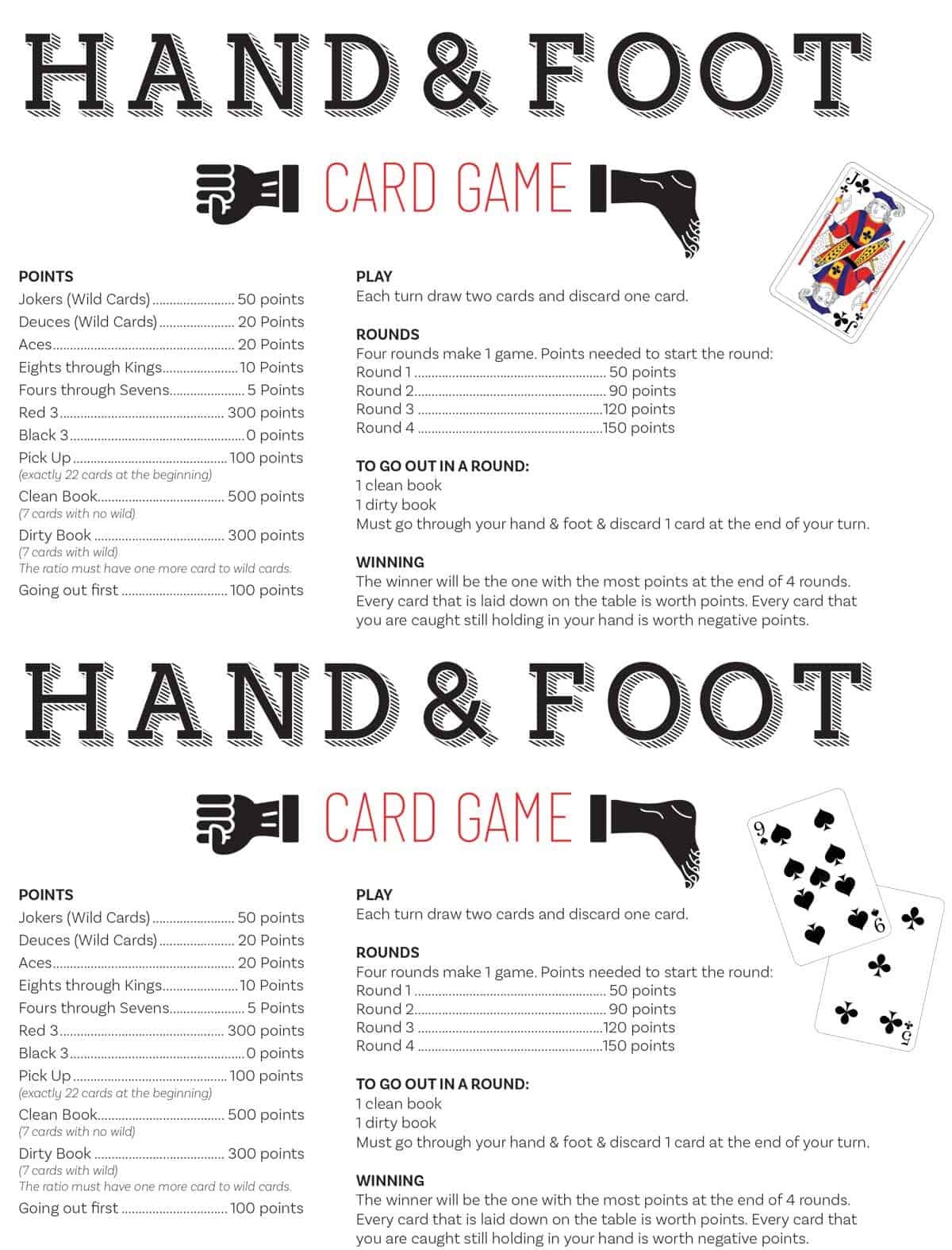
Hand and Foot is usually played in multiple rounds. The opening meld value increases with each round. Here are the general guidelines for a four-round game:
| Round | Opening Meld Points |
|---|---|
| 1 | 50 Points |
| 2 | 90 Points |
| 3 | 120 Points |
| 4 | 150 Points |
So, in round one, you’ll need at least 50 points worth of melds to “open” and start laying cards down on the table. In round two, you need 90 points, and so on.
Keeping Score
Keeping score is super important to know who wins. Here’s the point breakdown:
- Card Values: Remember the point values of each card (2-9 = face value, 10-K = 10 points, Aces = 20 points, Jokers = 50 points).
- Completed Books: At the end of a round, your team adds up the points of all the cards in your completed melds on the table. Add points of books as you finish them in the round.
- Going Out Bonus: As stated before, when a player or team goes out, they earn a bonus of 500 points.
- Red Threes: 100 points are added for each red 3. -300 points are deducted from the total score if the red 3 is not played.
- Penalties: Deduct any points for black 3s left in hand (-100 points for each). Deduct any red 3s left in your hand (-300 points for each).
- Total Score: Add the points from the melds, the “out” bonus, and any card penalties to calculate your total score for the round.
After each round, teams add their scores to the cumulative total. Usually the first team to 5000 points wins, but you can adjust it to a target of 7500 or 10000.
Strategies for Hand and Foot
Here are some simple strategies to help you get better at the game:
- Focus on Opening: Prioritize getting enough points to open your melds, especially in the early rounds.
- Save Wild Cards: Don’t use all of your wild cards at the beginning, because you may need them later in the game to make books.
- Watch the Discard Pile: Pay attention to what other players are discarding. This can give you hints about what they might be collecting.
- Team Communication: If you are playing with teams, discuss your strategies with your partner.
- Don’t Be Afraid to Pass on the Discard Pile: Picking up the pile can be risky and you will also have to pick up the cards above the one that you want. Sometimes it is better to pass on the discard pile.
Hand and Foot is a card game that is enjoyable by all age groups and is a wonderful game to play with friends and family. It might seem a bit difficult when you first start out, but with practice, you’ll quickly become a pro at this fun and engaging card game.
How to Play Hand and Foot
Final Thoughts
To quickly recap, players form teams and deal themselves hands and feet. They aim to meld sets of cards and make books. A player must go out by playing all cards. How do you play hand and foot card game? The game requires strategy and good teamwork.
You must have canastas to go out. Remember to discard wisely so you don’t give your opponents an advantage. The first team to reach a target score wins the game.

