
Playing the card game Shanghai requires players to complete specific card combinations in a series of rounds, aiming to be the first to go out.
Ever wondered how do you play the card game shanghai? It’s a fast-paced rummy-style game that’s easy to learn but offers plenty of strategic depth. Each round presents a new challenge with different card combinations to achieve.
Players need to meld sets, runs, and sometimes a combination of both, while also trying to get rid of all their cards before their opponents. This blend of luck and skill makes it a fun experience for everyone.

How Do You Play the Card Game Shanghai?
Shanghai is a fun and engaging card game that’s perfect for families and friends. It combines strategy, a little bit of luck, and a whole lot of card-matching fun. If you’ve ever played Rummy or a similar game, you’ll pick up Shanghai pretty quickly. But even if you’re a complete beginner, don’t worry! We’re going to break down exactly how to play Shanghai step-by-step.
Setting Up for a Game of Shanghai
Before you can start playing, you need to get everything ready. Here’s what you’ll need to do:
Gather Your Players and Deck
- Players: Shanghai is typically played with 2 to 6 players, but it’s most enjoyable with 3 or 4.
- Deck: You’ll need one standard 52-card deck. For more players, or to make the game longer, you can add another deck of cards. This is a personal preference and based on your group.
Deciding Who Goes First
There are a few ways to pick who goes first, and you can choose the method you like best:
- High Card: Each player draws a card from the deck. The person with the highest value card goes first. Suits don’t matter here; only the number is important. Ace is the highest, followed by King, Queen, and so on down to 2.
- Age: The youngest player can start first.
- Random Pick: Someone can simply pick a player at random to begin.
Dealing the Cards
Once you’ve decided who goes first, they become the dealer for the first round. Here’s how the cards are dealt:
The number of cards dealt to each player changes with each round, as there are 10 different rounds in the game. We will discuss this in detail in the next section. For the first round of the game, each player gets three cards.
After dealing, the remaining cards are placed in the center of the table, forming a “stock pile”. The top card from the stockpile is flipped face up next to it, starting the “discard pile.”
Understanding the Objective of Shanghai
The main objective in Shanghai is to be the first player to get rid of all of your cards in a hand, by creating combinations of cards called “melds”. This is done over 10 different rounds, with each round having specific melding requirements. The first player to achieve the melds of the current round can discard any remaining cards, and their round ends.
The Core Gameplay: Round by Round Breakdown
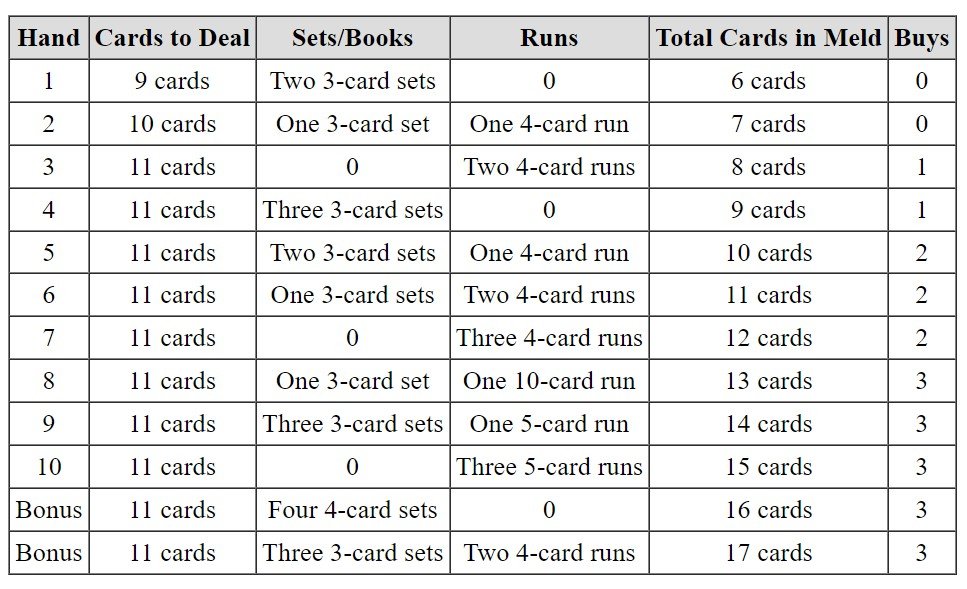
As we discussed, Shanghai is a game of rounds. Each of the 10 rounds has a different melding requirement. Here is a detailed explanation of each round’s objective.
Round 1: Three of a Kind
In the first round, your goal is to form one group of three cards of the same rank (e.g., three 7s, three Queens). Suits don’t matter; just the value of the card. When you achieve this and no cards are left in your hands you can “go out” and end the round.
Example: You might collect three 8s, or three Kings, or three 2s.
Round 2: Two Sets of Three of a Kind
This round is similar to the first, but a little harder. This time, you need two sets of three cards of the same rank. These two groups must be different ranks.
Example: You may need three 7’s and three queens in your hand.
Round 3: One Run of Four
In this round, you’re working on a “run” of cards. A run (also called a sequence) is when the cards are in order, such as 5, 6, 7, 8 all in same suit. This time you need one run of four cards, all in the same suit.
Example: You could collect the 2, 3, 4, and 5 of hearts, or the 9, 10, Jack, and Queen of clubs.
Round 4: Two Runs of Three
Now you need two runs of three cards. Again, the cards in each run must be in sequence, in the same suit. The runs don’t need to be in the same suits or to contain cards of the same value.
Example: you could have the 4, 5, and 6 of spades, and the 9, 10, and Jack of clubs
Round 5: Three of a Kind & One Run of Four
Here, you need one group of three cards of the same rank, plus one run of four cards of the same suit. This is a combination of rounds one and three.
Example: you could collect three 7’s and the 5,6,7 and 8 of diamonds.
Round 6: Two Sets of Three of a Kind & One Run of Three
In this round, your goal is to create two sets of three cards of the same rank, along with one run of three cards of the same suit. This is a combination of rounds two and four.
Example: You might need three 5s, three kings, and then the 9, 10, and Jack of hearts.
Round 7: Three Sets of Three of a Kind
This round goes back to the basics, requiring you to make three groups of three of a kind. The three of a kind should be different in value.
Example: You could collect three 2s, three 9s, and three Queens
Round 8: Two Runs of Four
This round is all about sequencing. Create two runs of four cards that are in the same suit and in order.
Example: You can collect the 2, 3, 4, and 5 of diamonds and the 7, 8, 9, and 10 of clubs.
Round 9: One Set of Three of a Kind & Two Runs of Three
This is a challenging combination, requiring you to build one three of a kind and two runs of three, making it a more complex melding combination.
Example: You might collect three 7s, the 2, 3, and 4 of hearts, and the 9, 10, and Jack of spades.
Round 10: One Run of Four & One Set of Four of a Kind
The final round is the most challenging. You will have to build one run of four cards in the same suit, along with one four of a kind, of the same rank.
Example: You could collect the 6, 7, 8, and 9 of diamonds, and four Kings
How to Play a Round: Taking Your Turn
Each player takes a turn in a clockwise direction. On your turn, you will do the following things:
- Draw a Card: Start by drawing one card from either the top of the stock pile, or the top of the discard pile.
- Look for Melds: Check if you can create one or more required melds based on the current round’s requirements.
- Lay Down Melds (If You Can): If you can make a meld (or melds), you can place them face-up on the table in front of you. You must meet all melding requirements of the current round to lay down.
- Discard a Card: To finish your turn, discard one card, face-up, onto the discard pile.
“Going Out” and Ending the Round
If you achieve the round’s objective and are able to lay down all the required melds (for example, in the first round, all three cards of a three of a kind), and you are out of cards, you are able to “go out.” This ends that particular round, and everyone else will stop playing and they will have to calculate the points in their hand. Remember you can only go out if your hand meets the round’s requirements.
Scoring
At the end of each round, the players who did not “go out” must count the cards remaining in their hands. Here’s how the scoring works:
- Face Cards (Jack, Queen, King): Count as 10 points each
- Number Cards: Count at their face value (e.g. a 7 is worth 7 points)
- Aces: Count as 11 points each
The scores are added up over all 10 rounds. The person with the lowest score at the end of the 10 rounds is the winner.
Strategic Tips for Shanghai Success
Now that you know the rules, here are a few strategic tips to help you play even better:
Pay Attention to Discards
Keep a close eye on the cards that other players are discarding. It can give you clues about what combinations they might be trying to make, and help you to decide whether it will benefit you to use those cards from the discard pile or not. You can also avoid discarding cards that your opponents may need.
Don’t Hold Onto High Cards
While you may think the high value cards are worth keeping, it may be better to discard them earlier, especially if they are not helping you to achieve the melds for the round, as they are worth the most points at the end of the round.
Be Flexible
Sometimes, your original plan might not work out because someone takes the card that you are needing, or it might be discarded to the discard pile. Be ready to adjust your strategy and use whatever cards come your way.
Watch Out for Runs
Pay close attention to the cards that you are holding, as it will benefit you to hold on to consecutive cards of the same suit, to prepare for the rounds where you will be required to create a sequence.
Don’t Be Afraid to Take Risks
Sometimes it pays off to take a card from the discard pile that seems like it might help someone else, just to prevent them from reaching their objective quicker.
Practice Makes Perfect
Like any game, the more you play Shanghai, the better you’ll get. You’ll begin to develop a feel for the flow of the game and you will start making your own strategies as you go. Don’t get discouraged if you don’t win every time. The real goal is to have fun!
With practice and a bit of strategy, you’ll be playing like a pro in no time. So gather your friends and family, grab a deck of cards, and get ready for some fun with Shanghai!
How to Play Shanghai Rummy | Game Rules | Card Games
Final Thoughts
Shanghai is a fun, fast-paced card game. The goal is to complete specific card combinations, round by round. Players aim to be the first to get rid of all their cards. The combinations increase in difficulty as you progress.
The game uses multiple decks. You play through several rounds of set, run, and combo-based objectives. Remember, you must complete each objective to advance. How do you play the card game shanghai? Players must carefully manage their hand and strategic discard to succeed.

