
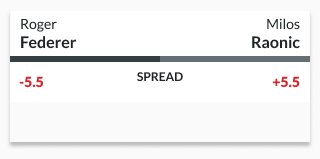
Game spread in tennis refers to the difference in games won between players in a set. It’s simply the math of how many more games one player has won over their opponent.
Ever wondered about the dynamics that shift momentum during a tennis match? You see scores like 6-2, 6-4, or maybe even 7-6, but what do those numbers really tell us? The key to understanding the story behind the score lies in recognizing how does game spread work in tennis.
It isn’t just about winning a set; it’s also about the margin of those wins, the literal count. That difference in games won can often be a great indicator of a player’s dominance within a particular set.

How Does Game Spread Work in Tennis?
Tennis, a game of precision and power, often comes down to more than just winning individual points. The concept of “game spread” plays a vital role in determining the victor. Imagine it like this: instead of just keeping track of who won more individual points, we think about who has won more games. It’s about building a lead, a cushion, so you have room for error and pressure doesn’t feel as huge. But how exactly does this game spread work? Let’s break it down and see the magic of game spread in tennis.
Understanding Games, Sets, and Matches
Before we dive into game spread, it’s crucial to understand the basic structure of a tennis match. A match is made up of sets, and sets are made up of games. Think of it like a building: games are the bricks, sets are the walls, and the match is the entire building. In most matches, a player needs to win a certain number of sets to win the match.
- Game: A game is won by the first player to reach at least four points and has a two-point advantage over their opponent. The scoring goes from zero to 15, 30, 40, and then the game point. If the score becomes 40-40 (also known as deuce), a player must win two consecutive points to win the game.
- Set: A set is usually won by the first player to reach six games with a lead of at least two games. For instance, a score of 6-4 would win the set. However, if the score reaches 5-5, the set continues until one player wins two games in a row, or a tie-break is played at 6-6.
- Match: A match is won by the first player to reach a certain number of sets. This is most commonly a best-of-three or best-of-five sets. Men’s Grand Slam matches are best-of-five, whereas women’s Grand Slam matches and most other tournaments are best-of-three.
What is Game Spread in Tennis?
Game spread is simply the difference between the number of games won by one player and the number of games won by their opponent. It is a useful measure of a player’s dominance in a set and overall match. The bigger the spread, the more dominant a player has been, and often, the more likely they are to win the match.
For instance, if Player A has won 4 games and Player B has won 1 game, then Player A has a game spread of +3, while player B has a game spread of -3. Game spread paints a different picture than just looking at the raw score. It shows how efficiently a player is winning and how they are managing the pressure. A player could win a set 6-4, but a player with a game spread of +2 might be not that dominant in the set, compared to a player who won 6-2 with a spread of +4.
How Game Spread Impacts Strategy
Understanding game spread helps players and coaches develop smarter strategies. It’s not just about winning points; it’s about building momentum and creating a buffer against setbacks. The strategy often changes depending on game spread of both players.
Early Game Strategy
Early in a set or match, players are often looking to establish a rhythm and gain a game spread. Winning the first few games can be a great confidence boost.
- Aggressive Play: Players might take more risks early in the set to try and get ahead. If you win three or four of the initial games and create an early game spread, your opponent will be under more pressure for the rest of the set.
- Serving Well: Holding serve is very important. It avoids the need to have to break your opponent’s serve. And even if you have a bad game or two, holding serve helps to keep a set close, preventing a large game spread.
Mid-Game Strategy
As a set progresses, the strategy can change depending on the game spread. Here’s how it works.
- Protecting a Lead: If a player has a positive game spread (e.g., +3 or more), they may focus on maintaining their serve and playing smart points. They don’t necessarily need to take as many risks or aim for winners, they have created a buffer.
- Closing the Gap: If a player has a negative game spread (e.g., -2 or more), they need to increase their risk, try to win more points and break their opponent’s serve. They need to create opportunities to level the playing field and erase the deficit. They may change their approach by being more aggressive or try different tactics.
Late Game Strategy
Late in a set, strategy becomes even more crucial. A small game spread can make a big difference.
- Defensive Play: When a player is near winning the set, they might play with more caution and take fewer risks in order to secure the set. The strategy focuses on not giving away points and making it difficult for the other player. They might focus more on serving well, playing solid, consistent shots and winning easy points.
- Aggressive Play with nothing to lose: A player that has to win games in order to stay in the set, will likely increase aggression and serve more powerfully. They will try to hit more winners and try to force the opponent into errors.
Game Spread and Momentum
Game spread often correlates with momentum. When a player wins a few games in a row, they build confidence and often begin to play better, creating an even bigger game spread. Momentum can have a strong influence on a match, and game spread is a good indicator of who has it.
- Positive Spread: A positive game spread usually builds confidence and allows players to play more freely. This positive energy can help them win more points and games, further increasing their lead.
- Negative Spread: A negative spread might cause a player to lose confidence and become more tentative. It can feel like they are constantly trying to play catch-up and this negative feeling can compound losing.
Game Spread vs. Point Differential
While game spread is important, it’s not the only measure of performance. Another concept is the point differential, which is the difference between points won and lost by a player. While the point differential can reveal if you are winning more points than your opponent, it doesn’t always translate to winning games or matches. It’s entirely possible for a player to win more points but lose more games and the set. Game spread can be a more useful measure of how a player is performing in the context of the actual match structure.
Let’s take a simple example. Imagine two players: Player A and Player B.
| Scenario | Player A Points | Player B Points | Player A Games | Player B Games | Game Spread | Point Spread |
|---|---|---|---|---|---|---|
| Scenario 1 | 32 | 30 | 6 | 4 | +2 | +2 |
| Scenario 2 | 35 | 33 | 4 | 6 | -2 | +2 |
In Scenario 1, Player A has both a positive game spread and a positive point spread, which is often the case, as winning points usually leads to winning games. However, in scenario 2, Player A wins more points, but lost more games and lost the set. A positive point spread doesn’t always translate to a positive game spread, and the reverse is also true. Game spread is often a better measure of match performance.
Game Spread in Different Match Formats
The importance of game spread can vary slightly depending on the match format. For example, a best-of-five-sets match provides more time to recover from early setbacks compared to a best-of-three-sets match. The game spread in a single set of a longer match, might be less important than a set in a shorter match.
- Best-of-Three Sets: Here, each set is crucial. A big game spread early on can be difficult to overcome, so maintaining control in early games is very important in shorter matches.
- Best-of-Five Sets: Players have more opportunities to come back from a bad set, so creating a big game spread in the first set might be less important. It’s usually more important to keep your serve, stay close to the opponent and wait for your opportunity.
Tracking Game Spread
Tracking game spread can provide useful insights. Coaches and analysts often look at game spread to understand a player’s patterns and see how well they are performing in certain situations. Some stats that coaches and analysts often track include.
- Game Spread per Set: This helps identify when a player is performing well or struggling in particular sets.
- Game Spread Trends: Observing the flow of game spreads throughout a match helps in understanding momentum shifts.
- Game Spread on Serve and Return: Looking at game spread while serving and returning, gives information about a player’s effectiveness on serve and the effectiveness of a player’s return game.
Game Spread and Psychology
Game spread doesn’t just have tactical implications, it also affects a player’s psychology. A player who has created a big game spread might feel more relaxed and confident. Conversely, a player with a negative game spread might feel more pressure and desperation, potentially leading to errors.
- Pressure and Confidence: A positive game spread can be a confidence boost, whilst negative game spread can impact a player’s confidence. Players learn to manage these emotions as part of their mental game.
- Mental Toughness: The ability to handle a negative game spread, regroup and battle back is a key sign of mental strength and an important aspect of a tennis player’s game.
In short, game spread is a crucial aspect of tennis that goes beyond simply winning points. It’s a measure of how well players are building leads, handling pressure, and managing their game throughout a match. Understanding game spread helps players develop more effective strategies and gives coaches useful information on match performance.
How Does Game Spread Work In Tennis? – The Racket Xpert
Final Thoughts
Game spread in tennis refers to the difference in games won by one player over their opponent. A larger game spread indicates a more dominant performance. Players aim to achieve a positive game spread.
“How does game spread work in tennis?” It directly impacts match outcomes. It is a key indicator of a player’s success within a set. This metric offers insights into consistency and control on the court.

