
Lax games typically last for 60 minutes, divided into four 15-minute quarters.
Ever wondered about the duration of a lacrosse match? It’s a common question for newcomers to the sport and even for seasoned spectators. Understanding exactly how long are lax games helps you plan your day around the thrilling action on the field.
The standard format for most lacrosse games includes those 15-minute quarters, totaling an hour of game time. Keep in mind that stoppages for penalties, timeouts, and goals can extend the total time beyond just 60 minutes.

How Long Are Lax Games?
Okay, so you’re curious about how long a lacrosse game actually lasts? It’s a super common question, and the answer isn’t always as simple as saying “one hour” or “two hours.” It changes based on a few key things, kind of like how the time for your favorite TV show can be different depending on if it’s a regular episode or a special. Let’s break down all the factors that affect the length of a lacrosse game, from the tiny tots just starting out to the pros who play on TV. We’ll also explore how things like time-outs, penalties, and even halftime play a role in the overall game clock. Understanding these different aspects will give you a really good idea of what to expect when you watch or play a lacrosse game.
Understanding the Basic Game Clock
The foundation of understanding game length is knowing the basic time structure. Lacrosse games are divided into periods, also called quarters. The length of these quarters can vary, and that’s where one of the main differences in game length comes from. We are talking about two main lacrosse types here: Men’s and Women’s. Each has their own rules regarding period length, but there are also age related adjustments that have to be taken into the account.
Men’s Lacrosse Game Length
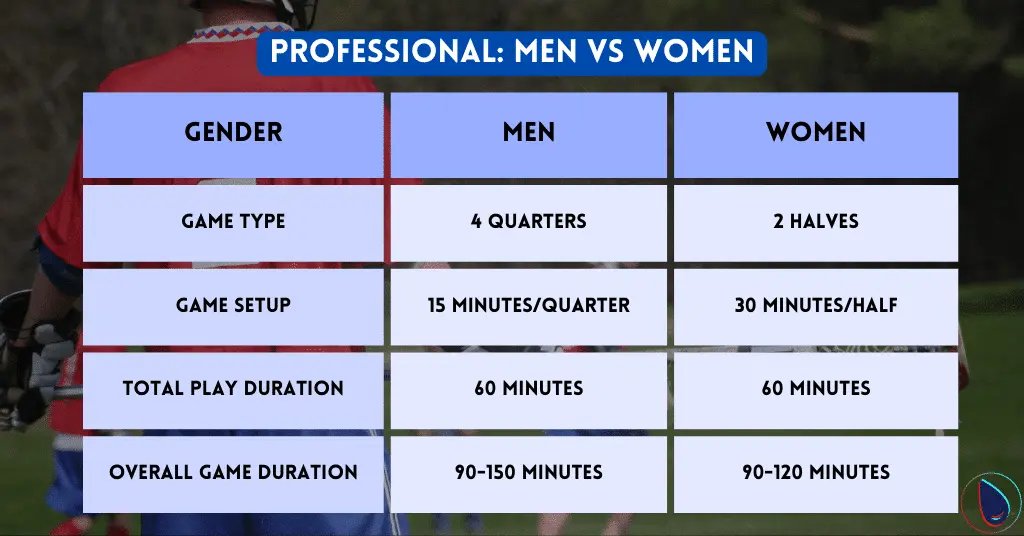
In men’s lacrosse, at the professional level and the highest levels of college play, the game is typically divided into four 15-minute quarters. This means the main playing time before any stoppages is an hour. However, this hour is far from the total time you might spend at the game. Think about it like a school day, there are class periods and then there are breaks. Men’s game also includes stoppage in time that increase the duration of the game.
Here is a simple breakdown for you to understand it better:
- Standard Quarters: 4 quarters, each lasting 15 minutes.
- Total Playing Time: 60 minutes (4 x 15 minutes).
Women’s Lacrosse Game Length
Women’s lacrosse follows a slightly different time structure. At the highest level, games are divided into two 30-minute halves. Notice that the game is not divided in 4 quarters like in men’s game, rather into two halves, and those halves are longer than quarters in Men’s game. This gives a total of 60 minutes of playing time also, the same as men’s games. However, the clock rules can cause the game to take longer than men’s games. This is because the clock does not stop on out of bounds unlike men’s games, this means that players are expected to take advantage of dead ball situations to perform substitutions, therefore there are stoppages. It depends on the level of play but we’ll address it in details below.
Here is a simple breakdown for you to understand it better:
- Standard Halves: 2 halves, each lasting 30 minutes.
- Total Playing Time: 60 minutes (2 x 30 minutes).
Age and Level Adjustments
The lengths of quarters or halves change significantly depending on the age and level of play. For younger players, the periods are shorter to accommodate their physical abilities and attention spans. It’s like making a smaller portion of a meal for a kid. The overall aim here is to provide them with valuable lacrosse experience without exhausting them.
Youth Lacrosse Time Structure
For youth lacrosse, the game times are considerably reduced. Here’s a typical example:
U8 and U10: Might have four 10-minute quarters. This is a general standard and can slightly vary depending on the organization and league. Total playing time would be 40 minutes.
U12 and U14: Often have four 12-minute quarters, this is again a general standard. This makes the total playing time 48 minutes.
These adjustments are important so that young players can learn and enjoy the game without tiring themselves out too quickly.
High School and Collegiate Play
As players move up to high school, you start to see the rules becoming more aligned with adult rules. Games are typically four 12-minute quarters for men’s high school teams, and this might be slightly different depending on the state and particular leagues. For women’s high school, you are going to have 2 halves that are 25 minutes each. This adjustment provides high school players with more experience in the adult game structure, but also makes it a good transition to higher level of play.
At the collegiate level, you’ll see men’s lacrosse adopt the standard four 15-minute quarters. For women’s collegiate lacrosse, it’s two 30-minute halves. This is consistent with the professional level rules. At this level, players are getting ready to compete with the pros.
Here’s a quick table summarizing the variations:
| Level | Men’s Lacrosse | Women’s Lacrosse |
|---|---|---|
| Youth (U8-U10) | 4 x 10-minute quarters | Not applicable |
| Youth (U12-U14) | 4 x 12-minute quarters | Not applicable |
| High School | 4 x 12-minute quarters (typically) | 2 x 25-minute halves (typically) |
| College/Professional | 4 x 15-minute quarters | 2 x 30-minute halves |
The Impact of Time-Outs
Time-outs are another element that contributes to the overall length of a lacrosse game. A time-out is usually taken by the team to discuss a specific strategy, take a rest, or even to ice the kicker at the end of a game. Each team is allowed a certain number of timeouts per game, and these timeouts pause the game clock. So, it’s an additional time that will contribute to the total length of the game. The rules regarding timeouts are different for both men’s and women’s games.
Men’s Lacrosse Time-Outs
In men’s lacrosse, each team is allowed three timeouts per game. They usually last around 60 seconds or 1 minute long, but they can sometimes go a little bit longer. If you take three timeouts per game, this will add an additional three minutes of clock time to the game length. These extra minutes, when added to the quarter length and halftime can significantly increase the length of the game.
Women’s Lacrosse Time-Outs
In women’s lacrosse, each team is typically allowed two timeouts per game, which again typically last for 60 seconds. Women’s games are different when it comes to timeouts. Teams also have the option of taking a timeout at any time in the game, however, they can’t call more than two in the entire game. If a team takes both timeouts, this means they will add a total of 2 minutes of stoppage to the total game time.
Halftime Breaks
Halftime breaks are another key component to game duration. These breaks can vary slightly, but generally they give players some time to rest, regroup with their coaches, and take a break from the intensity of the game. Halftime is not only a break for the players but a good chance for the fans to catch a breather or visit concession stands.
Halftime in Men’s Lacrosse
In men’s lacrosse, the halftime break is usually between 10 to 15 minutes. This break helps players recover before the second half. It allows the coaches to discuss the strategies and make necessary adjustments to the team’s play.
Halftime in Women’s Lacrosse
For women’s lacrosse, halftime is usually also around 10 to 15 minutes, again to allow players and coaches to regroup. Because there are only two halves in a women’s game, the halftime break may be slightly longer to prepare for the final half. This break ensures players have ample time to rest and plan for the remaining part of the game.
The Impact of Penalties and Stoppages
Penalties and other game stoppages can have a significant effect on the overall time of a lacrosse game. When a penalty happens, the game clock will stop. The time will not start again until the ball is back in play. These pauses can add to the overall duration of the game, making it longer than the basic playing time.
How Penalties Extend Game Time
When a player commits a foul, the referee will call a penalty. Depending on the nature of the penalty, this might result in:
Man-down situations: If a player has committed a penalty, that player will have to leave the game for a specific amount of time. In this time, the team without the penalty will have a man advantage, therefore more options in terms of creating plays. These pauses to put the player in the penalty box are also going to add to the game time.
Free Position: In Women’s game, a foul often results in a free position start. These positions often take a short period to set up and the clock is stopped during these situations.
Injury stoppages: If a player has been injured, there will be a pause to assist the player. This is especially common in contact sports and while it is essential, it adds to the total time.
These stoppages are inevitable and can really add to the total length of the game.
Other Factors Affecting Game Length
Besides the stoppages due to penalties, some other factors may also play a role in increasing the time of the game:
- Out-of-bounds: In men’s lacrosse, the clock will stop when the ball goes out of bounds. This allows for substitutions, and clock does not resume until the ball is back in play. Women’s lacrosse is different, clock will only stop on out of bounds in the last two minutes of the game.
- Equipment issues: If there is any equipment related issue, for example if a stick breaks or the goalkeeper’s equipment fails, then the game clock is going to stop.
- Official reviews: Sometimes the officials will review a play, which can take a few minutes depending on the situation.
Different Game Types
The above examples refer to the standard lacrosse game, but other variations exist that can further affect the game duration.
Box Lacrosse Time
Box lacrosse is a game played in an enclosed rink. The rules are different and games are typically three 20 minute periods with a total play time of 60 minutes, similar to field lacrosse, but the clock will only stop for the last 2 minutes of each period, this means that the game takes around 2 hours with timeouts and halftime break included.
Indoor Lacrosse
Indoor lacrosse is another variation that has differences in length. While it can resemble box lacrosse, it can often follow similar rules to field lacrosse. There are different rules, based on the association or league. Each league can be different and you have to check rules before the game.
Putting It All Together
So, how long is a lax game? Well, it’s not a simple answer but here is what you can expect:
Standard men’s game (four 15-minute quarters): Expect the game to last around 1 hour and 45 minutes to 2 hours, including timeouts and halftime. Remember, stoppages due to penalties can make the game longer.
Standard women’s game (two 30-minute halves): Expect the game to last around 1 hour and 30 minutes to 1 hour and 45 minutes, accounting for halftime and any stoppages. It is important to keep in mind that the game clock will run in all stoppages except in the last two minutes of each half, therefore women’s game tend to be shorter in terms of total duration.
Youth games: These are much shorter, generally lasting around 1 hour to 1 hour 30 minutes, including breaks. This depends on the playing time per period and length of breaks.
High school games: High school games will last around 1 hour 30 minutes to 1 hour 45 minutes.
Understanding these factors will help you to better plan your schedule and make the most of your lacrosse experience, whether you are playing or just watching the game. The total game time is influenced by factors such as playing time, timeouts, penalties, halftime, and any unusual stoppages. Lacrosse games are often exciting because there are a lot of changes in the game, so you’ll be sure to enjoy your game!
In conclusion, while the basic playing time for a lacrosse game might seem straightforward, numerous elements contribute to its overall length. From age-related adjustments to the impact of time-outs and penalties, it’s clear that game duration can fluctuate. Being mindful of these nuances enriches the spectator experience, whether you’re watching a youth game or a professional match. The dynamic nature of lacrosse, with its stops and starts, adds to its excitement and keeps both players and fans on their toes.
Hit him so hard it snapped his stick😳 #pll #lacrosse #lax #unreal #highlights #mustwatch
Final Thoughts
Lax games have varying durations depending on the level. Typically, youth games consist of shorter periods. High school and college lacrosse matches often run for a full hour or more.
Professional lacrosse games, such as those in the PLL or NLL, may extend even further, including stoppages. Therefore, ‘how long are lax games’ depends significantly on the specific league and age group. This information is useful when planning to attend a game.

