
Lacrosse games typically last 60 minutes, divided into four 15-minute quarters.
Ever wondered about the clock during those intense lacrosse matches? The fast-paced action often leaves spectators curious, about how long do lacrosse games last. It’s a common question, especially for newcomers to the sport.
This quick guide will clear up any confusion about game duration. We’ll explore the standard timing, and what to expect during a typical game.

How Long Do Lacrosse Games Last?
Okay, so you’re curious about how long a lacrosse game takes? That’s a great question! It’s not as simple as saying “exactly one hour” because the game length can change depending on a few things. Let’s explore all the different factors that affect how long you’ll be sitting in the stands or playing on the field. We will go through the game length for different levels from youth to professional, and we’ll also talk about what happens when a game gets tied!
Understanding the Basic Structure of a Lacrosse Game
First things first, lacrosse isn’t like a continuous flow of play like in soccer. It’s broken into shorter periods, or quarters. This helps the players catch their breath and allows the coaches to make changes to their game plan. So, let’s look at how these periods are structured.
The Standard Game Clock
In most lacrosse games, the clock counts down continuously during the period. Just like in basketball or hockey, the clock only stops for specific reasons, such as when a goal is scored, a penalty is called, or the ball goes out of bounds. This can make a game take longer than just the total time of the quarters because those stops add up! It’s important to understand that the total game time can vary from game to game, depending on how many stoppages happen.
Quarters, Halves and Timeouts
Instead of halves, most lacrosse games are split into quarters. This means that a 60-minute game isn’t played in two 30-minute sections but in four 15-minute sections. This helps to distribute breaks throughout the game. The number of timeouts each team gets also varies, contributing to the overall length of the game. There are also breaks between each quarter for the players to rest, regroup, and for coaches to give important instructions. The breaks are often shorter than you see in other sports but still contribute to the overall time spent at the field.
How Game Length Differs Across Lacrosse Levels
Now, here’s where things get interesting. The exact length of a lacrosse game is not the same at every level. It changes depending on the age and skill level of the players. This is done to make sure the game is appropriate for the physical abilities of the athletes. Let’s dive into the specifics.
Youth Lacrosse Game Duration
When young kids are first learning to play lacrosse, the games are shorter. This is because they might not have the stamina to play a full hour of running! Usually, for the youngest players, like in the U8 or U10 leagues, game length is often split into shorter quarters, sometimes only eight to ten minutes long. The focus is on skill development and fun, not long periods of play. Also, the clock might run a bit differently, sometimes stopping less often than in older leagues.
- U8-U10 Leagues: Typically, 8-10 minute quarters, adding up to about 32-40 minutes of total play.
- U12 Leagues: Often 10-12 minute quarters, total play time could be about 40-48 minutes.
High School Lacrosse Game Duration
At the high school level, the games become longer and more standardized. High school lacrosse usually features four quarters, typically around 12 minutes each, resulting in a total playing time of 48 minutes. The clock rules are also stricter, meaning the clock stops more often than in youth leagues, which makes the overall game length stretch closer to 1.5 to 2 hours, including the breaks.
College Lacrosse Game Duration
College lacrosse games are usually similar to high school in terms of the number of quarters, but the length of each quarter is typically 15 minutes. This results in 60 minutes of total play time. Because of clock stoppages and timeouts, these games can easily last from 2 to 2.5 hours. These games are fast-paced, high-energy, and require immense skill. College games include more timeouts, and the clock can stop for longer periods of time depending on the situation of the game, leading to longer overall game times.
Professional Lacrosse Game Duration
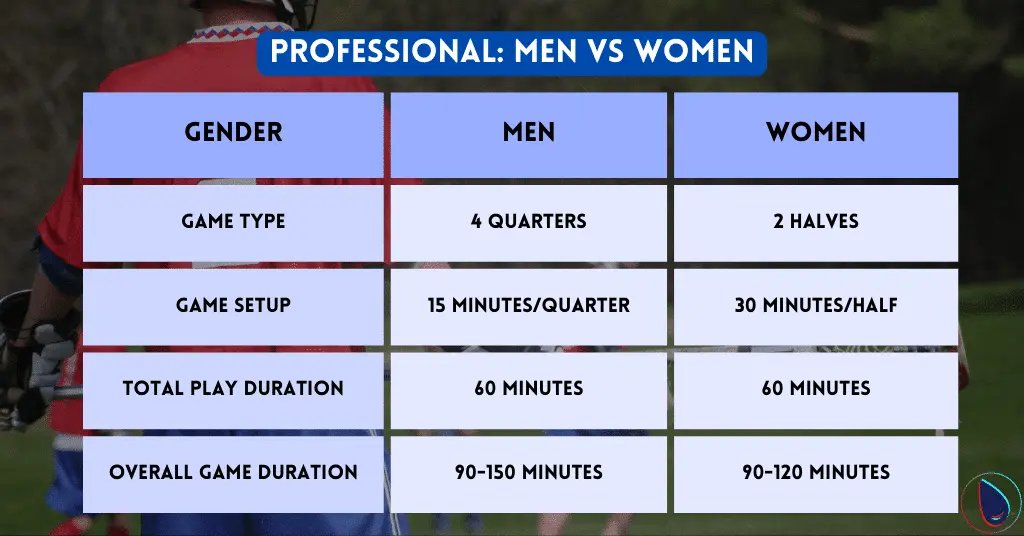
Professional lacrosse games, whether in the National Lacrosse League (NLL, which is indoor box lacrosse) or Major League Lacrosse (MLL) or Premier Lacrosse League (PLL, which is field lacrosse), generally have the longest game times. NLL games feature 60 minutes of playing time, just like college, but this can often extend beyond 2.5 hours due to frequent stoppages for penalties and scoring. The PLL also has 60 minutes of playing time spread out across four 15-minute quarters, leading to similar overall durations. The pace of professional lacrosse is incredibly fast, and the games are often very high-scoring. The number of stoppages tends to be higher due to the skill level of the athletes, leading to overall game times that can easily reach 2 to 3 hours.
The Impact of Clock Stoppages on Game Length
Okay, we’ve looked at the official lengths of each period at different levels, but we still haven’t covered a very significant element that affects how long a lacrosse game takes – the stops in the play. Here’s a closer look at all the things that make the clock stop.
Timeouts
Timeouts are breaks that each team can take during the game. Coaches use them to discuss strategies, change formations, or simply to give their players a chance to rest. Each team usually gets a certain number of timeouts per game, and these timeouts can last a minute or so, adding to the total time of the game. In close games, teams might strategically use timeouts towards the end, extending the overall game. The number of timeouts varies between the different levels of the sport, but regardless, they will add a bit of time to the game.
Penalties
When players break the rules, penalties are called. Some penalties stop the clock, particularly if a player is being removed from the field. Penalties can also cause delays if a discussion with the referee is needed. Also, after some penalties, a team can gain a man-up advantage or power-play, which is a major moment in the game. These moments require the ref to explain the penalties to the teams, which leads to the game stopping for longer time.
Scoring
Whenever a goal is scored, the game clock usually stops momentarily. This allows the referee to confirm the goal, players to get back to the center of the field, and the play to restart. In a high-scoring game, these brief stops can add a noticeable chunk of time to the overall game duration.
Injuries
If a player is injured during the game, the clock is stopped. Depending on the severity of the injury, the stoppage can range from a few seconds to several minutes. Sometimes, an injured player needs to be taken off the field. All of this adds up to game time. The safety of the players is always a top priority, which means the clock is stopped for as long as it’s needed.
Out of Bounds
When the lacrosse ball goes out of bounds, the clock usually stops. Then, the referee has to determine which team gets possession of the ball. Then the game starts again. While these stops are generally brief, the cumulative effect during the entire game can add some time.
What Happens When the Game Is Tied?
Sometimes, even after all four quarters have been played, the score might still be tied! So what happens then? It depends on the level of play. Here’s how overtime rules typically work.
Overtime in Lacrosse
In many lacrosse leagues, a tied game will move into overtime periods. Overtime rules can vary but usually include some form of sudden victory. This means that the first team to score a goal during the overtime period wins the game. Usually, the overtime is only a short period, and this is why it’s called sudden victory. But they also have a special rule called “golden goal.”
Golden Goal
“Golden Goal” is another name for sudden victory overtime. The first goal scored wins the game. This can add suspense to the game, as it could end suddenly at any time. Golden goal overtime periods can be very short or take a few more minutes depending on the play and how many shots each team is taking.
Multiple Overtime Periods
If no team scores in the first overtime period, some leagues play multiple overtime periods. In certain playoff scenarios or high-level games, the game continues until a winner is determined. This can sometimes extend the total game time significantly. The exact rules of multiple overtimes can vary between different organizations.
How To Estimate the Total Game Time?
Okay, so we’ve covered everything that impacts game length, from quarter times to penalties and overtime. But how can you estimate the total game time for a game you’re planning to watch? Here’s a quick guide:
Factors to Consider
Level of Play: Remember that youth games will be shorter than high school games, which will be shorter than college and professional games.
Game Pace: Some games have a lot of scoring and penalties, while others have fewer. High-scoring games usually have more stoppages.
Closeness of the Game: A close game with a tight score often means more timeouts and tactical play, which stretches out the game.
Overtime Potential: Is this a game where a tie is possible? If so, factor in the potential for overtime, which could increase game time.
General Estimates
Youth Games: Typically last between 45 minutes to 1.5 hours, including pre and post-game routines.
High School Games: Usually range from 1.5 to 2 hours in total.
College Games: Can run from 2 to 2.5 hours.
Professional Games: Usually 2.5 to 3 hours, sometimes longer.
To recap, while the playing time might be 48 or 60 minutes, the actual time you spend watching can be much longer due to all these various reasons.
So, there you have it! The answer to ‘how long do lacrosse games last’ isn’t as simple as just the total number of minutes in the quarters, it involves different game levels, clock stoppages, and overtime. Hopefully, this comprehensive guide has given you a better understanding of what to expect when attending a lacrosse game. Whether you’re a player, a coach, or a spectator, knowing the time factors helps everyone plan better. It’s always a great experience to enjoy a fast-paced and exciting game of lacrosse.
The Rules of Lacrosse (Updated 2021)
Final Thoughts
Lacrosse game duration varies; high school games usually last around 48 minutes, split into four 12-minute quarters. College lacrosse games also use quarters but often extend to 60 minutes. Professional leagues, like the PLL, can have different timings, and this includes overtime.
So, ‘how long do lacrosse games last’ is answered by understanding the level of play. The game clock stops frequently for penalties and other stoppages. Therefore, the total time spent at the field may extend beyond the regular game length.

