
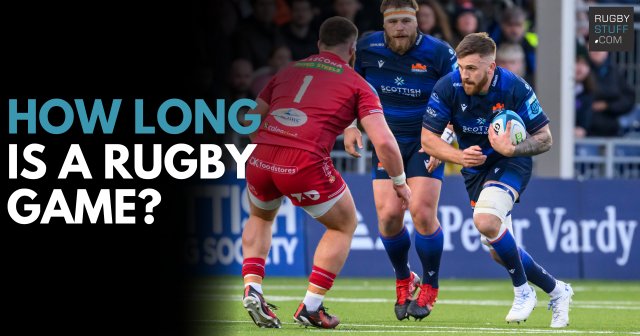
A standard rugby match lasts 80 minutes, divided into two 40-minute halves, with a brief halftime interval.
Ever wondered about the duration of those thrilling rugby clashes? People often ask, “how long is a game of rugby?” It’s a great question, especially if you’re new to the sport.
The answer isn’t simply a single number because stoppages can extend the play. Understanding the game’s structure helps in enjoying the intense action.

How Long Is a Game of Rugby?
Okay, let’s talk about how long you’ll be watching (or playing!) a rugby match. It’s not as straightforward as saying “exactly 60 minutes” or “always 90 minutes.” There are different types of rugby, and the length of a game can change depending on who’s playing, where they’re playing, and even what age group they belong to. So, let’s dive deep and understand all the details.
The Standard Rugby Match Length
For a typical, adult-level rugby union match, like you might see in a major tournament or professional league, the game is 80 minutes long. But here’s the catch: that 80 minutes doesn’t include all the stoppages! We’re talking about 80 minutes of actual game time.
Breaking Down the 80 Minutes
The standard 80 minutes is split into two halves. Each half is 40 minutes long. Between these two halves, there is a half-time break, typically lasting about 10 to 15 minutes. This is when players get a breather, coaches give their pep talks, and fans can grab a snack. Think of it like a pit stop in a race!
- First Half: 40 minutes of playing time.
- Half-time Break: 10 to 15 minutes.
- Second Half: 40 minutes of playing time.
So, if you add it all up, the actual game time is always 80 minutes, but the entire experience including half-time can easily last almost 100 minutes, or even longer, because of the time added on.
Understanding Injury Time and Stoppages
This is where things get a little more interesting. Just like in soccer, rugby games can have added time. This extra time, often called “injury time” or “stoppage time,” is added at the end of each half to make up for time lost during the game. This time might include injuries, scrum resets, and video replays. Let’s look closer.
How Stoppages Affect Game Length
Many things cause the clock to stop. If a player gets injured, play stops, and the clock stops. If the ball goes out of bounds for a lineout, the clock stops. Sometimes, the clock might stop for a video replay to check for a try or if a player did something they shouldn’t have done. Each time the clock stops, it adds a bit more to the total time it takes to finish the game. So, the actual time a rugby match can take might often be more than 90-100 minutes.
- Injuries: When a player needs medical attention, the clock stops.
- Lineouts & Scrums: Setting up for these can use up time.
- Video Replays: These can cause longer delays to make sure the refs get it right.
- Other Delays: Any other pauses that happen during play also get factored into stoppage time.
It’s important to remember that the referee is the one who decides how much extra time is added, and it can vary from match to match. There’s no set time limit for how long the injury time can be, although often, it is only a few minutes.
Variations in Rugby Game Length
Now, let’s look at how game length varies across different forms of rugby. While the 80-minute match is the standard for adult rugby union, things change with other formats.
Rugby Sevens: A Shorter, Faster Game
Rugby Sevens is a faster version of the game with only seven players on each team instead of the usual 15. The game is much shorter, which makes it very exciting to watch. Here’s how the time breaks down for rugby sevens:
- Standard Matches: Two halves of 7 minutes each, with a one- or two-minute half-time break.
- Finals Matches: Two halves of 10 minutes each, with a two-minute half-time break.
Because the game is shorter, it is also more action packed, with lots of running and scoring in shorter periods. Games of rugby sevens usually finish within 20 to 30 minutes, making it a fun version to watch and play for everyone.
Youth Rugby: Adjusting for Age
When kids play rugby, the length of the game is often shorter to make it appropriate for their age and physical ability. There are no universal rules for every age group, but here’s how youth rugby game lengths are commonly adjusted:
Under-7 and Under-8 Rugby
These are very young players. The matches are usually shorter, maybe two 10-minute halves, so a total of 20 minutes.
Under-9 and Under-10 Rugby
At this age, the games might be two 15-minute halves or around that length, making about 30 minutes long games.
Under-11 and Under-12 Rugby
Games might be made up of two 20-minute halves, or around that length, totalling about 40 minutes of game play.
Under-13 to Under-18 Rugby
By the time they get to Under-13, game lengths are closer to the full adult length. They can vary between two 25 or 30 minute halves depending on the level of competition and any local regulations that might be in place.
These lengths can vary by region, organization, and sometimes, by the level of competition. But the idea is always to make it safe and fun for young players.
Rugby League: Another Variation
Rugby League is another popular form of rugby that has different rules than rugby union. Here’s how the match time breaks down in Rugby League:
- Full Time Rugby League Match: Usually two halves of 40 minutes each with a half time break of 10-15 minutes, making 80 minutes of play time. Just like rugby union.
In Rugby League the clock will often be stopped for stoppages, and extra time added on at the end of each half for these stoppages. So, the total match time can again be around the 90 to 100 minute mark like rugby union games.
Factors That Can Lengthen a Rugby Game
Apart from injury time and stoppages, several other factors can sometimes make a rugby game last longer than expected.
Weather Delays
Bad weather can sometimes slow down a game. Very strong winds or heavy rain can make it difficult for the players to play safely, and the referee might have to pause the game. Sometimes games might be delayed to let a storm pass, or the match might even need to be called off, and finished later, which means that it will take longer for the game to finish.
Lengthy TMO Reviews
The TMO (Television Match Official) is used to review key decisions. It can be a crucial part of the game, but lengthy reviews can also add time to a match. If a try is very close, a ref will want to get it right, but this can take time, adding more time to the match.
Serious Injuries
Sadly, serious injuries can happen during games. When they do, medical staff will need time to attend to an injured player, which is obviously very important. This kind of delay will extend the total time of the match significantly.
Why Understanding Game Length Matters
Knowing how long a rugby game usually takes is useful in many different ways. It helps you make plans if you are attending or watching on TV. It helps coaches and players to plan their training and rest. Also, for fans, it means you can plan how much time you will spend watching the game. It is good to have a sense of what to expect so you can have the best experience watching a match.
Quick Recap: How Long Is a Rugby Game?
So, let’s recap the typical game lengths:
- Standard Adult Rugby Union: 80 minutes of play (two 40-minute halves) plus a half-time break and possible stoppage time.
- Rugby Sevens: 14-20 minutes of play plus a shorter break and possible stoppage time (for standard and finals, respectively).
- Youth Rugby: Varies greatly by age group, usually shorter, ranging from 20 to 70 minutes of play time.
- Rugby League: 80 minutes of play (two 40 minute halves) plus a half-time break and stoppage time.
Keep in mind the additional time that can be added due to injuries, reviews, and other delays. Always plan for a longer experience than the base time!
Knowing all these details ensures that when you go to watch your favorite rugby match you know when to expect it to start and finish, and you can have a great time at the game!
How to Play Rugby
Final Thoughts
A standard rugby match runs for 80 minutes, split into two 40-minute halves. There is a halftime break, usually around 10-15 minutes long. Time stoppages for injuries or other reasons add to the total duration.
Therefore, if you ask the question, “how long is a game of rugby?”, the answer is approximately 90-100 minutes, taking into account stoppages. These added minutes are essential for fair play and injury management. The total time provides an action-packed experience.

