
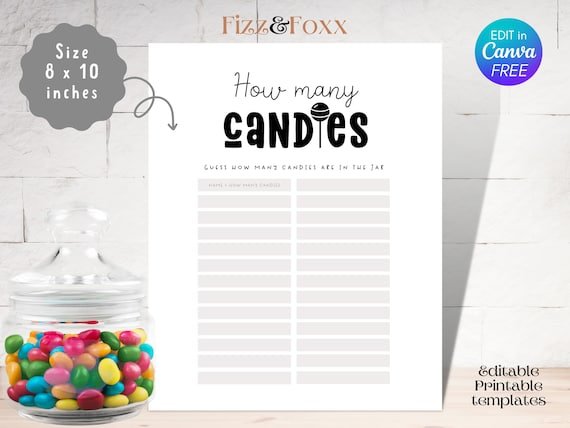
The goal of the game is to guess how many candies are inside the jar.
Ever found yourself staring at a jar full of colorful treats, wondering just how many candies are inside? That’s the essence of how many candies in the jar game, a classic activity that brings out everyone’s inner estimator. It’s a simple concept, yet it can be surprisingly challenging and fun for all ages.
The game isn’t just about random guesses; it encourages observation and logical thinking. People often try to visually break down the jar, estimating layers or using the size of the candy to guide their predictions. It creates an engaging experience.

How Many Candies in the Jar Game: A Sweet Dive into Estimation
The “how many candies in the jar” game is a classic, beloved by kids and adults alike. It’s simple, fun, and surprisingly educational. But what makes this game so appealing? Let’s explore the exciting world of guessing games, focusing on how to play, the best ways to win, and why it’s a fantastic activity for all ages. It’s more than just guessing a number; it’s about practicing important thinking skills and having a good time!
The Basics of the Candy Guessing Game
At its heart, this game is about estimation. You’re trying to guess how many individual candies are packed into a container, usually a clear jar, but sometimes a bowl, box, or other vessel. The person organizing the game fills the container with the candy, counting them beforehand, and then participants take turns writing down their guesses. The person who gets closest to the actual number wins the prize!
What you need to play
A clear container (a jar, plastic container, etc.)
Lots of candies (any kind will do!)
Paper slips or a notepad for writing guesses
Pens or pencils
A prize (optional, but makes it more fun!)
Someone to organize and count the candies
How to Play the Candy Jar Game
1. Fill the Jar: The game organizer chooses the container and fills it with candies. It’s important to count them carefully! Record the exact number and keep it secret.
2. Show the Jar: The organizer shows the filled jar to the participants. Let everyone look at it closely.
3. Make Guesses: Each player writes their guess on a slip of paper with their name.
4. Collect Guesses: The organizer gathers all the guesses.
5. Reveal the Answer: The organizer announces the actual number of candies in the jar.
6. Declare the Winner: The player who guessed the closest to the actual number wins the game. In case of ties, you can have a tie-breaker, or simply give the prize to both.
Strategies for Smarter Guessing
While it might seem like random guessing, there are ways to make your candy estimate more accurate. It’s all about observation and thinking through the problem.
Visual Estimation
This is where your eyes become your best tool. Take a careful look at the jar.
Layer by Layer: Try to imagine the candy in layers. How many candies are in one layer? How many layers do you see?
Divide and Conquer: Mentally divide the jar into sections. Try to estimate how many candies are in each section and then add those numbers up.
Shape Matters: Note the shape of the jar. Tall, skinny jars will hold fewer than short, wide jars. Take this into account.
Candy Size: Are the candies small and plentiful, like jelly beans? Or are they big and bulky, like chocolate candies? This will affect how many fit into the jar.
Using Math for Better Guesses
Yes, even math can help in a candy guessing game!
Volume Estimation: Try to estimate how much space the jar takes up, if you know a approximate volume of a similar object, that will help.
Reference Point: Look at a single layer of candies, how many in a row. Use that as a reference point to multiply to all the levels.
Think in Groups: Imagine if you could take out the candy and arrange them in groups of ten, how many groups you would have.
Reasonable Range: If the jar looks like it holds a lot, don’t guess 20. If the jar looks small, don’t guess 500. Look for an approximate range.
Other Helpful Hints
Compare: If you’ve played this game before, think about other jars you’ve seen. Use those past experiences to help with your guess.
Don’t Overthink: Sometimes the first guess is the best! Don’t get too caught up in trying to find the perfect answer.
Look Closely: Pay close attention to how the candies are packed. Are they loose or tightly packed? This matters.
Practice Makes Perfect: The more you play the “how many candies in the jar” game, the better you’ll get at guessing.
Variations and Creative Twists
The basic game is fun, but it can also be adapted to make it even more interesting!
Themed Jars
Holiday Fun: Fill jars with candy corn for Halloween, red and green candies for Christmas, or pastel colors for Easter.
Color Coordination: Use candies of a single color, or create patterns with different colors.
Favorite Candies: Ask the participants which candies they love and try to include some of their favorites in the jar.
Different Containers
Boxes and Bags: Use different sizes and shapes of containers other than jars to mix things up.
Unusual Containers: Try using a decorative bowl, a vase, or even a large measuring cup.
Multiple Containers: Have several smaller jars instead of one big one, each with a different type of candy.
Number of Items
Beyond Candies: You can guess the number of other small items in a jar, such as marbles, buttons, beads, or even small toys.
Mixed Items: Include multiple different objects in the jar and have players guess the number of each.
Weight Guess: Instead of guessing the count, have players guess the total weight of the items in the container.
Adding Extra Challenges
Blind Guess: Let people make a guess just by touching the jar without seeing it.
Limited Time: Set a timer to make guesses even faster, increasing the excitement.
Team Guessing: Put players into small teams and let each team submit only one guess.
Closest Over: Instead of closest guess, the winner is the closest guess that is over the number.
Calculated Guess: Ask player to show their work on how they calculated their guess.
Why This Game is More Than Just Fun
It’s easy to see that the “how many candies in the jar” game is fun, but did you know it also has some great educational benefits?
Developing Estimation Skills
This game is a fun way to get kids (and adults!) thinking about estimation, a crucial life skill. It helps develop:
Number Sense: Understanding the magnitude of numbers
Visual Skills: Being able to observe and analyze visual data
Problem-Solving: Using logical reasoning to make decisions
Critical Thinking: Applying different strategies to get a better answer
Learning Math in a Fun Way
Many of these skills involve early math ideas such as volume, spatial recognition and grouping, all skills used in more advanced math.
Real-Life Math: Shows how math is used in everyday situations.
Practical Application: Makes math concepts more tangible.
Positive Learning: Makes learning feel like a fun activity instead of a chore.
Social Skills and Interaction
The game is a fantastic way to get everyone involved and talking.
Friendly Competition: Provides a positive opportunity for friendly competition.
Social Interaction: Encourages interaction and communication among participants.
Inclusive Activity: Suitable for people of all ages and abilities.
Tips for Organizers
If you’re planning to host the “how many candies in the jar” game, here are a few tips to make it a success.
Choosing the Right Container
Clear is Best: A clear container lets everyone see the candies clearly.
Appropriate Size: Choose a container that fits the number of candies you have available.
Interesting Shape: An unusual container can make the guessing more challenging.
Selecting the Candies
Variety is Fun: Different types of candies can make the game more interesting.
Quantity Matters: Make sure you have enough candies to fill the container.
Consider Size: Think about how the size of the candy will affect the overall estimate.
Setting Clear Rules
Explain Clearly: Make sure everyone understands the rules of the game.
Fair Play: Ensure that the competition is fair for all participants.
Fun Environment: Keep the atmosphere light and enjoyable for all involved.
Managing the Guesses
Organize Guesses: Keep the guesses in an organized way to make it easy to determine the winner.
Clear Winner: Make sure the winner is very clear.
Keep it Fair: Make sure no one cheats in making their guess, and also double check your count.
Making it Extra Special
Presentation is Key: Make the jar look appealing.
Themed Decorations: If using a specific theme, use coordinating decorations.
Prizes: Give out fun prizes to the winner(s), and maybe a smaller prize for runner ups, or every participants.
The “how many candies in the jar” game is an engaging activity that combines fun with education. It’s a wonderful way to bring people together, develop important estimation skills, and enjoy a little friendly competition. Whether you’re organizing a party, a classroom event, or just a fun family night, this simple game is sure to be a hit. With a little planning and creativity, you can make your own candy jar game unforgettable.
With its blend of simplicity and strategy, the ‘how many candies in the jar’ game will continue to be a beloved pastime for generations to come, offering not just entertainment, but a gentle and engaging introduction to valuable life skills.
How many M&Ms are in this jar?
Final Thoughts
The core of winning the “how many candies in the jar game” lies in employing good estimation skills. Observe the jar closely, consider its shape, and make an educated guess based on visible candies. Avoid purely random numbers.
Practice regularly; this increases your accuracy over time. Break down the estimation problem, and think about layers within the jar. Remember, it’s about making a reasonably close estimate, not pinpointing the exact count.

