
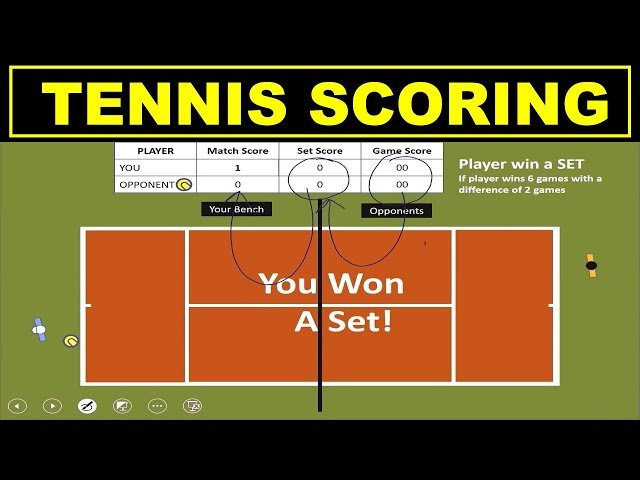
A tennis match consists of a variable number of games, determined by sets; a player needs to win at least six games to win a set, and typically two or three sets to win the entire match.
Ever found yourself watching a tennis match and wondering, just how many games are in a tennis match? It’s a common question for those new to the sport. The structure, with its sets and games, can feel a bit confusing at first glance.
Figuring out the exact number isn’t quite as simple as just adding things up, because it all depends on the number of sets played. Each set requires a minimum of six games to win.
The rules governing how many games are needed to claim a match victory add another layer of complexity that we will explore further.

How Many Games Are in a Tennis Match?
Okay, let’s dive into the exciting world of tennis and figure out just how many games make up a match. It’s not always as simple as saying “it’s this number every time!” There’s actually a bit more to it, and the answer depends on a few things. We’re going to explore all of that today, so you can understand the rules of the game like a pro. It’s like learning a secret code that makes watching and playing tennis even more fun.
Understanding Sets and Games
Before we talk about the total number of games, we first need to understand the relationship between “sets” and “games” in tennis. Think of a set as a larger group of games, like a chapter in a book. And the games? Those are the individual pages within that chapter. A tennis match is made up of sets, and each set is made up of games.
What is a Game in Tennis?
A game in tennis is the smallest unit of scoring. To win a game, a player needs to score at least four points, and they need to win by at least two points. The scoring in a game goes like this:
0 points is called “love.”
1 point is called “15.”
2 points is called “30.”
3 points is called “40.”
4 points wins the game, unless there is a “deuce.”
If both players reach 40 points, it’s called “deuce.” After deuce, a player has to win two points in a row to win the game. The first point after deuce is called “advantage” for the player who won it. If that player wins the next point, they win the game. But if they lose the next point, the score goes back to deuce. This keeps going until one player wins two points in a row. It might sound a little complicated, but it’s really fun once you get the hang of it!
What is a Set in Tennis?
Now that we know what a game is, we can talk about sets. To win a set, a player needs to win at least six games, but there is another rule. They also must win the set by two games. So, a set can end 6-0, 6-1, 6-2, 6-3, or 6-4. If the score becomes 5-5, then the player that wins the set needs to win by 2 games. That is 7-5. And if the set reaches 6-6, then there will be something called a tie-break. This is where things can change very much. We will get to that soon.
Different Match Formats
The total number of games in a tennis match changes depending on how many sets are needed to win the match. These are called the match format. Different tournaments and levels of play use different formats. Let’s look at the common ones.
Best-of-Three Sets
This format is the most common, especially in women’s tennis and in some men’s tournaments. In a best-of-three sets match, a player needs to win two sets to win the match.
So, if a player wins the first two sets, the match is over.
If each player wins a set, then they play a third set, and whoever wins that third set, wins the match.
Games in a Best-of-Three Set Match
Figuring out the number of games in this format is where things get interesting. There isn’t a fixed number. Here’s why:
Minimum Games: The minimum number of games in a best-of-three sets match is 12 games if one player wins two sets in a row with a score of 6-0, 6-0.
More Typical Scenario: It’s more likely that one or both sets will go to a score like 6-3, 6-4, or even a tight 7-5.
Maximum Games: If the match goes to three sets, and all three sets are very close, we will see a higher number of games. For example: 7-6, 6-7, 7-6 is a very close three set match.
Let’s look at some examples:
Match 1: Player A wins 6-2, 6-3: This is a short match of 17 games (6+2+6+3).
Match 2: Player B wins 6-4, Player A wins 6-4, Player B wins 6-2: This is a match with 34 games (6+4+6+4+6+2).
Match 3: Player A wins 7-6, Player B wins 6-7, Player A wins 7-5: A very long and intense match with 44 games (7+6+6+7+7+5).
Best-of-Five Sets
This format is commonly used in men’s Grand Slam tournaments like Wimbledon, the US Open, the Australian Open, and the French Open. In a best-of-five sets match, a player must win three sets to win the match.
So, if a player wins the first three sets, the match is over.
If players split sets, the match continues until a player has won three sets.
Games in a Best-of-Five Set Match
Just like with best-of-three sets, the number of games in a best-of-five sets match can vary quite a bit.
Minimum Games: The minimum number of games in this format is 18. For example, if one player wins three sets with a score of 6-0, 6-0, 6-0.
Likely Scenarios: It’s common to see matches with scores like 6-3, 6-4, 6-2, or very tight sets that go to a tie break.
Maximum Games: When matches go all the way to five sets, and many of the sets are close, there can be a very high number of games played.
Here are some examples:
Match 1: Player A wins 6-1, 6-2, 6-3: A short match with 24 games.
Match 2: Player B wins 6-4, Player A wins 7-5, Player B wins 6-3, Player A wins 6-2, Player B wins 6-4: A very long and tight match with 54 games.
Match 3: Player A wins 7-6, 6-7, 7-6, 6-7, 7-5: A marathon match with 78 games!
The Tie-Break
We mentioned the tie-break earlier, and now it’s time to discuss it in detail. Tie-breaks are special games that take place when the score in a set reaches 6-6. Instead of continuing to try and win by two games, the tie-break decides the set.
How a Tie-Break Works
The tie-break works differently than a regular game. Here’s how it works:
The first player to reach 7 points wins the tie-break, but they also must win by at least two points.
The scoring in a tie-break goes up by one point each time. So, it’s 0, 1, 2, 3, 4, and so on.
Players alternate serving every two points.
If the score reaches 6-6 in the tie-break, then the players keep going until one player wins by two points. For example, a tie-break can be 7-5, 8-6, or even 12-10.
Why We Have Tie-Breaks
Tie-breaks were introduced to prevent sets from going on forever. Before tie-breaks, there could be sets that would reach scores like 14-12, which takes a very long time to complete! Tie-breaks add some excitement and make sure that matches do not become too long. They also mean the end of a set is quick, and then the match can continue.
Variations in Game and Set Rules
While the rules we’ve discussed are standard, there can sometimes be slight differences depending on the type of tennis being played.
Short Sets
In some amateur tennis or practice settings, you might see something called short sets. Instead of needing to win six games to win a set, players might only need to win four games. If the score reaches 3-3 in a short set, there can be a tie break to decide the set. These kinds of sets are usually used to make matches quicker and easier to play. For example, when someone is new to the game.
Pro Sets
Pro Sets are a bit different as well. In this format, a player has to win a certain number of games – for example, 8 or 10 – without playing multiple sets. When the game score is 8-8, they will play a tie-break to 10 points, or when the score is 10-10 they play a tie-break to 7 points. This format is not commonly seen in top-level tournaments but could be used in some local tennis leagues.
Factors Affecting the Number of Games
There are many reasons that make the number of games in a tennis match change, here are a few:
Player Skill Level: If two players are very close in skill level, they are likely to have many more games, as both players will keep winning games, and maybe sets too. If one player is very much better than another player, the match may end quickly with the better player winning all the games and sets.
Playing Style: Some players are aggressive and go for quick points, which may lead to matches with fewer games. Others are more patient and have long rallies, which can lead to more games being played.
Court Surface: The surface can change the speed of the game. For example, a grass court is a much faster surface and often makes for quicker matches. But clay courts are slower, and often the matches go for longer.
Player Form: If one of the players is having an off day and is not playing well, the match might be shorter. But when both players are playing well, the match is more likely to be longer.
Weather Conditions: Weather can make a big difference too. Wind and rain can affect how the ball bounces and can mean that players struggle with their shots, and therefore the matches may be longer.
Why Understanding Games in Tennis Is Important
Knowing the number of games in a match is helpful for so many things.
For Players: When you’re playing tennis, it’s useful to know how the scoring works so you can work out a game plan and know how much effort you need to put in. It is also helpful to know how many games you might need to play in a best-of-three match and how many you might need to play in a best-of-five match.
For Spectators: When you’re watching tennis, understanding how many games are in a match makes the game so much more interesting. You know what to expect and when to cheer, and it can add to your understanding and enjoyment of the game.
For Coaches: Coaches need to understand how many games in a match can be impacted by many factors. They can then help their players become better prepared for each game and match.
So, the next time you hear about a tennis match, you’ll be able to understand how long it might be based on the match format and how games are played. It’s a fun thing to keep in mind as you enjoy the game.
In conclusion, the number of games in a tennis match is not set in stone. It depends on the format of the match, whether it is best-of-three sets or best-of-five sets, and also the way the players are competing. A best-of-three set match can have as few as 12 games or as many as 40 or more. A best-of-five set match can have as few as 18 games or more than 70 games. Understanding this makes watching and playing tennis even more interesting and enjoyable. It shows how the game is full of strategy and skill, not just about hitting the ball.
The Rules of Tennis – EXPLAINED!
Final Thoughts
Therefore, the number of games within a tennis match varies. A set requires a player to win at least six games, with a two-game margin. Tie-breaks influence game counts when scores reach 6-6 within a set.
Ultimately, how many games are in a tennis match depends on the specific score and the rules. Generally, winning enough games to secure multiple sets, leads to match victory.

