
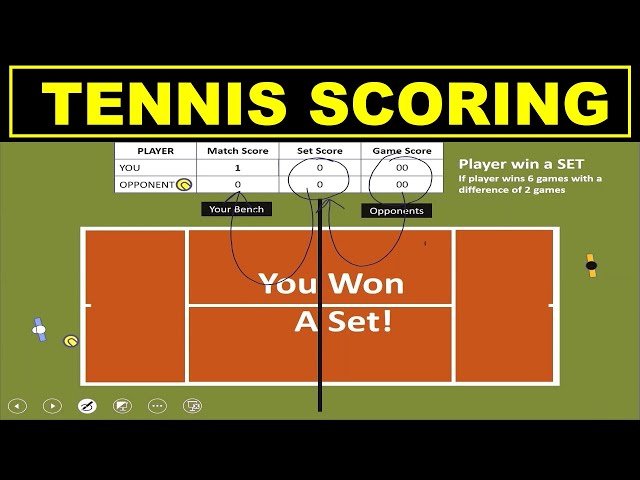
A standard set of tennis requires a player to win at least six games, with a two-game advantage needed, except in the case of a tie-break.
Ever wondered exactly how many games are in one set of tennis? It’s a common question for those new to the sport. The rules can seem a bit complicated at first, especially when you consider tie-breaks.
Generally, a player must win six games to secure a set. However, just winning six isn’t always enough. A player must also win by a margin of at least two games, if the score has been close. Otherwise, if the game reaches 6-6, a tie-break usually decides the set.

How Many Games Are in One Set of Tennis?
Okay, let’s talk tennis! You might be watching a match and wondering, “How many games do they need to win a set?” It’s a really important question, and the answer isn’t always super straightforward. It depends on the situation! The basic idea is that a player needs to win a certain number of games to win a set, but there are a few different ways that can happen. We’ll break it all down so you understand how many games you need to see before a set is finished.
The Basics of a Tennis Set
Before we dive into the exact numbers, let’s cover the basic idea of what a “set” is in tennis. Think of a set as a mini-match within the larger match. A match is usually made up of multiple sets, and the player who wins a certain number of sets wins the whole match. Each set is composed of a certain number of games, which is where the real action and scoring takes place.
What is a Game in Tennis?
A “game” is the most basic unit of scoring in tennis. To win a game, a player has to score four points, but there’s a little twist. The points aren’t counted one, two, three, four. Instead, the scoring is love (zero), 15, 30, and 40. If both players reach 40, it’s called “deuce.” Then, one player has to win two points in a row to win the game. The first point after deuce is called “advantage.” if the same player who wins advantage wins the following point, then that player will win the game. But if that player loses the next point after winning advantage, then again score will go back to deuce. It’s a back-and-forth battle until someone finally wins that crucial last point.
Standard Scoring: The 6-Game Set
The most common way to win a set is by being the first player to win six games, but with a catch! You have to win by a margin of at least two games. Let’s take a closer look:
- Winning by 6-0: This is a total blowout! One player wins all six games.
- Winning by 6-1: One player wins six games, and the other player wins just one game.
- Winning by 6-2: A pretty decisive win where one player only gets two games.
- Winning by 6-3: One player is playing better than the other, still a comfortable win.
- Winning by 6-4: A closer set, but one player still wins with six games to four.
Now, what happens when the score gets close? What happens when the score is 5-5?
The Importance of Winning by Two Games
Let’s say that two players are battling hard, and both win five games, making the score 5-5. If the score is 5-5, one player can’t just win one more game to win the set. Instead, that player needs to win two more games in a row to clinch it. So, if the score is 5-5, the set continues until one of the following happens:
- A player wins 7-5: This is the most common way to win a set when the score has been tied at 5-5.
- The score becomes 6-6: If the score reaches six games each, things get really interesting because a tie-break is needed to decide who wins the set, and that’s where the second rule comes in!
So, a set is either won with a score of 6-0, 6-1, 6-2, 6-3, 6-4 or 7-5, as long as one player is ahead by a minimum of 2 games.
The Tie-Break: When Things Get to 6-6
Okay, so what happens when both players are playing so well that they reach 6-6 in a set? This is where the tie-break comes into play! A tie-break is like a mini-game used to quickly decide who wins the set when both players are tied at 6-6. It’s like a special, exciting game where every point counts even more. Imagine it as a way to avoid a set going on forever.
How a Tie-Break Works
A tie-break is a game where the goal is to reach seven points, but again, with a margin of at least two points. Here are the basics:
- First to 7 Points: The first player to reach seven points wins the tie-break.
- Winning by Two: Just like in a regular set, a player must win by at least two points.
- Tie-Break Serves: The serve changes every two points (except for the first serve). For the first point of tie-break, one of the players will serve, then the second player will serve for next two points, and then after every two point the serve is given to different player.
For example, If the score in a tie-break is 6-6, the tie-break will not end until someone has a two-point lead, so it could be 8-6, 10-8, etc.
Quick Summary of Tie-break : Tie-break is when both the players are tie at 6-6 in a set. The first player to score seven points with a margin of two points, wins the set. It’s usually a very exciting way to conclude a set.
Different Scenarios and Variations
While the standard scoring system (best of 6 games with a tie-break at 6-6) is the most common, you might find some variations, especially at different levels of play or in some special tournaments. Let’s explore a few of them.
Advantages Sets
In some cases, particularly in the final sets of some tournaments or at lower-level matches, they might use “advantage sets” instead of tie-breaks. In this format, if the score reaches 6-6, play continues until one player has won by two games. This means that a set could go to 8-6, 10-8, or even further if the players keep going back and forth. It makes sets much longer than the tie-break format and is not very common in professional tennis anymore but it is used in some club matches or amateur matches.
Example: if both players have score of 6-6, in advantage sets, play will continue, until one player won 8-6, 10-8 or whatever it takes to have a two-game margin. This format can really test the stamina of the players.
Short Sets and Other Formats
You might also see “short sets” or other special scoring formats, particularly in practice matches, junior tournaments, or special events. These variations often have a smaller target number of games and could also include shorter tie-breaks as well. Such variations can help speed up the matches and make the game more accessible to the new players.
- Short Set: A short set might be the first to four games with a tie-break at 4-4.
- No-Ad Scoring: In some situations, “no-ad scoring” might be used in a game. This means that if the score reaches deuce, the next point wins the game, instead of having to win by two points. This is used for speed and also can create surprising moments.
Why Different Formats Exist?
Why do these different rules and formats exist? Well, they all serve different purposes. Here are a few reasons:
- Different levels of Play: The rules are changed to match the level of play. Professional tennis typically follows the traditional system with tie-breaks, while amateur matches might use other variations for quicker matches or as per requirements.
- Time Constraints: Sometimes organizers are working with a time schedule, and they might use shorter sets or tie-breaks to avoid long matches.
- Different Tournament Rules: Every tournament might have slightly different rules and these rules are set to keep things competitive and to ensure smooth running of the competition.
Understanding Tennis Scoring: A Summary
Okay, let’s do a quick review of the key ideas. Understanding tennis scoring is fundamental to enjoying the sport:
- A Game: A game is won by scoring four points (15, 30, 40), with a win by two-point margin after reaching deuce.
- A Set: A set is usually won by being the first player to win six games with a margin of at least two games. If the score reaches 6-6, a tie-break decides the winner.
- A Tie-Break: A tie-break is played when the set score is 6-6, where the first player to reach seven points, with a two-point lead, wins the set.
- Advantage Sets: An alternative to tie-breaks, where the play continues when the score reaches 6-6, until one player wins by a margin of two games.
The traditional method of six games per set, with a tie-break when required, is the most used method in high level tennis. But other formats exist for different situations, like shorter sets, advantage sets, and no-ad scoring.
Understanding how the game points convert to game win and how games convert to set win is crucial for the player as well as for the viewer. It may seems complicated to new audience but if explained in a simple way, it’s easy to grasp, and that will help you to follow the matches better. So now you have the full information about how many games are in one set of tennis.
How Many Games Are in One Set of Tennis? – The Racket Xpert
Final Thoughts
To summarize, a standard tennis set requires a player to win at least six games. However, there’s a crucial caveat: a player must also win by a margin of at least two games.
If the score reaches 6-5, then the set continues until one player achieves a two-game lead. This highlights the dynamic nature of ‘how many games are in one set of tennis’. Tiebreaks come into play at 6-6.

