
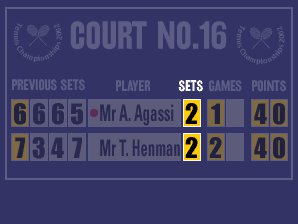
In tennis, you typically need to win six games to win a set, but with a margin of at least two games.
Ever found yourself glued to a tennis match, wondering exactly how many games to win a set? It can be a bit confusing, especially with tie-breaks sometimes coming into play. Knowing the rule is fundamental to following the action.
The basic idea is that the player who first reaches six games wins the set. But what happens when the score is 6-5? In that scenario, the set will continue until one player has a two-game advantage.
Sometimes it goes to a tie-break, which adds another layer of excitement to the game. That tie-break happens when the score in the set reaches six games all.

How Many Games to Win a Set?
The world of tennis can sometimes seem a little confusing with all its rules and scoring. But one of the most fundamental parts of the game is understanding how a set is won. Let’s break it down in a simple and easy-to-understand way. To win a set, you usually need to win a certain number of games before your opponent does. But, this number isn’t always the same, and there are a few different ways this can play out. Let’s explore the exciting world of tennis scoring!
The Basics: Winning by Six Games
The most common way to win a set is by being the first player to reach six games. Seems simple enough, right? However, there’s a crucial twist. You also need to win by a margin of at least two games. What does this mean?
The Two-Game Advantage
Imagine the score is 5-4. One player has won five games, and their opponent has won four. The player with five games needs to win just one more to get to six. However, that one more game wouldn’t be enough to win the set. They need to get a two-game lead. So, they would have to win the next game to make it 6-4. That is what we call “winning by two”
What if the player with four games wins the next one? Now, the score becomes 5-5. This leads us to an important point – the score can keep going back and forth until someone gets that crucial two-game lead, or goes into tie-break if reached 6-6.
What Happens at 6-6? The Tie-Break
Okay, so what happens when both players are really good and neither can get that two-game lead? When the score reaches 6-6, that is when we have a tie-break. Think of it as a mini-game to decide who wins the set. This usually happens in a normal set, also known as an advantage set.
How a Tie-Break Works
In a tie-break, you score by points, not games. The goal is to be the first to reach seven points. Similar to the idea of winning a normal set, you must win by at least two points. It’s like a sprint to the finish line after a long, back-and-forth battle.
- You need to win 7 points.
- You have to win by 2 clear points.
So, if the score in the tie-break reaches 6-6, the players continue until someone achieves a two-point lead, like 8-6, or 9-7 and so on. This helps in determining the winner of the set, so the game can continue.
Serving in a Tie-Break
The player who would have been next to serve starts the tie-break by serving the first point. Then the opponent serves the next two points. After that, each player takes turns serving two points each until someone wins the tie-break. Serving order is a crucial part of the game of tennis, and helps in ensuring fairness during the competition.
Tie-break winner
The player who wins the tie-break is declared the winner of the set with a score of 7-6.
Different Formats and Rules
While the most common way to win a set is with six games and a tie-break at 6-6, there are some other formats you might come across.
Advantage Set
The “advantage set” is the format we’ve talked about so far, where there is a tie-break at 6-6. If there is no tie break at 6-6, and players keep playing until someone wins by 2 clear games, then it’s called advantage set.
This is how most professional tennis matches are played, like in Grand Slam tournaments, but there is a difference for the final set in some tournaments.
No-Advantage Set
In some competitions, particularly doubles and some lower-level tournaments, you might find a “no-advantage set”. This means that there’s no tie-break at 6-6. Players keep playing until one player gets a two-game lead. This means you could see a set where the score is something like 8-6 or even 10-8.
This format can lead to some really long sets, especially if the players are evenly matched. It creates a little different strategy as players have to keep battling until the two-game margin is reached.
Short Sets
Sometimes, especially in practice or some exhibition matches, you might see something called short sets. Instead of the usual six games, players will play with a set winner by being the first to win just four games, with a tie-break at 4-4. This format is helpful to make tennis matches faster.
How Does This Apply to Matches?
Now that we know about winning a set, let’s talk about matches. Most tennis matches are the best of three or best of five sets, the difference usually depends on gender, and the level of competition.
Best of Three Sets
This is the standard for women’s singles and doubles matches, and the best of three sets is also common in many men’s tennis events. This means you need to win two sets to win the whole match. So, you will have to win six games in two sets (or winning the tie-breaks) to win the match. The score may be 2-0 or 2-1, that depends on how the sets were played.
Best of Five Sets
This is typically used in men’s singles matches in Grand Slam tournaments and some other higher level tournaments. Here, a player must win three sets to win the match. So, the final score may be 3-0, 3-1 or 3-2, depending on how the matches went.
Matches with five sets are usually considered to be longer, and they can really test a player’s endurance and skill, as they have to win more sets than the best of three sets.
The Importance of the Set Win
Winning a set is not just about getting one step closer to winning the match, it can greatly change the momentum of the match as well, which is also why it’s so important. A well-played set can give a player the confidence they need to keep on pushing for the win, and also demoralize the opponent.
- Winning a set can boost player’s confidence.
- It can affect the opponent’s attitude in the match.
Key Terms in Tennis Scoring
To fully understand how many games it takes to win a set, it’s helpful to know some of the important terms:
- Game: A unit of tennis scoring, composed of points.
- Set: A collection of games, where the first player to win 6 games with 2 games margin, or 7 games with a tie-break, wins the set.
- Match: A series of sets.
- Tie-break: A special game played when a set reaches 6-6, used to decide the set winner.
Strategies for Winning a Set
Understanding the number of games required to win a set is one thing, but using that knowledge strategically is another. Players often adjust their game plan based on the score.
- If a player gets a big lead in the set, they might try to play more aggressively and finish it fast.
- If player’s are tied in a set or close in score, they may focus more on consistency and reduce mistakes, to get the lead and win the set.
- When reaching a tie-break, players will need to be extra focused on every point, as tie-breaks are close matches that are decided by a very few points.
The strategy used can depend on many things, including player’s strengths, opponent’s weaknesses, the current score, and also whether it’s the first set or the last set.
How Many Games Are Typically Played in a Set?
While 6 games is the number required to win a set (with a margin), the total games in a set can vary a lot. Here are the possibilities you may see:
- The Fastest Set: If one player wins 6 games, and other player wins zero games, then only 6 games are played. The score will be 6-0.
- Close Set, but with no Tie-break: The score could be something like 6-4, 6-3, or 7-5 in favor of one player. That is because player had to win 6 games, and won with 2 game margin. So the games played in the set will be 10 games, 9 games and 12 games, respectively.
- Set with a Tie-break: When the score reaches 6-6, at least 13 games are played to determine the winner, that is 12 games plus the tie-break. If we have a no-advantage set, which can happen in many lower level games, then the set can even go to 14 games or more, until there is a 2 games margin.
So, the number of games played can change a lot, depending on how close the players are in skills and how consistent they are in that set.
Impact of Different Surfaces on Game Length
The surface on which the tennis match is played can also affect how many games are played in a set, or how long the set could last. Here’s how different surfaces might affect game duration:
- Grass Courts: On grass courts, the ball tends to bounce faster and lower, which is why points usually finish quickly. Because points are fast, games may also finish faster, which leads to faster sets.
- Hard Courts: Hard courts provide a more medium-paced bounce, with players having to work hard for each point, that’s why games and sets could take a bit longer.
- Clay Courts: Clay courts are the slowest surfaces, as the ball tends to bounce higher. On clay, players have to win points through longer rallies, which makes games longer and sets potentially longer, as well.
So, if a match is played on a clay court, you are more likely to see a set with a lot of games in it, unlike grass courts, which are fast.
Mental Game and Winning a Set
The mental side of tennis plays a major role in how sets unfold. A player’s mindset can affect how they perform and how many games they win. For example, a player who is mentally strong will be able to handle close games and pressure situations, which will in turn increase their chances to win the set.
Likewise, if a player loses a set, it doesn’t mean the match is over. They need to have a strong mental game to be able to bounce back and keep competing, which is what makes tennis so exciting.
In conclusion, winning a set in tennis usually involves reaching six games with a two-game margin, or taking a tie-break when the score is tied at 6-6. Different rules and surfaces can affect the number of games and the duration of a set. The mental game of a player is also very important in the game. Understanding these rules and strategies help in understanding the game better.
Tennis for dummies video | Tennis Scoring Explained
Final Thoughts
In standard tennis, a player must win at least six games to secure a set. The winning player also needs a margin of two games; therefore, if the score reaches 6-5, play continues until one player leads by two. A tie-break happens when the set reaches 6-6.
Understanding how many games to win a set is essential. It varies based on different formats, but the most common rule remains the same: win six games with a two-game difference. Therefore, keep the ‘six with two’ rule in mind.

