
The standard duration of a soccer game is 90 minutes, not including any added stoppage time.
Ever wondered how long you’ll be glued to your screen or cheering from the stands during a soccer match? It’s a common question, especially for new fans. Knowing the duration is crucial to planning your viewing experience.
So, how many minutes is in a soccer game? A full match is structured around two 45-minute halves, separated by a short intermission. This forms the core playing time.

How Many Minutes is in a Soccer Game?
Okay, so you’re wondering how long a soccer game lasts? That’s a great question! It’s not as simple as just one number because the length of a soccer match can change depending on different factors. But, don’t worry, we’re going to break it all down for you, so you become a soccer time expert! Let’s dive into the exciting world of soccer timing.
The Standard Soccer Game Length: 90 Minutes
For most professional and adult-level soccer games, a full match is 90 minutes long. That’s broken down into two halves of 45 minutes each. Between these two halves, there’s a break known as halftime.
What Happens During Halftime?
Halftime is a short rest period, usually 15 minutes long. It allows players to catch their breath, grab some water, and for coaches to give them instructions. Think of it as a mini-reset button for the players.
Why Two 45-Minute Halves?
This two-half format has become a standard in soccer for many years. This allows for an equal playing time and gives both teams opportunities to attack and defend. Also, with this kind of break, the players get some well deserved rest.
Extra Time and Stoppage Time
Sometimes, a soccer game isn’t exactly 90 minutes. This is because of “extra time” and “stoppage time,” which can add minutes to the game.
Stoppage Time (Added Time)
You’ll often hear the term “stoppage time” or “added time” during a match. This is the time added to the end of each half to make up for any pauses in the game. Why these pauses happen? let’s see:
- Injuries: If a player gets hurt and needs medical attention, the clock stops.
- Substitutions: When a player is swapped for another, time is taken to complete this process.
- Time-Wasting: If a team is intentionally delaying the game, the referee might add time for it.
The referee decides how much time to add based on what happened in the match. Sometimes, it can be just a minute or two, and sometimes it can be several minutes.
Extra Time (Overtime)
In some important games, like in tournaments or playoffs, the game has to have a clear winner. If the score is tied after 90 minutes (plus stoppage time), the teams might go into extra time or sometimes called overtime. Usually, extra time consists of two periods of 15 minutes each. There is a short break between these extra time periods.
The Golden Goal/Silver Goal Rule
In the past, soccer had some interesting rules for extra time, called ‘Golden Goal’ and ‘Silver Goal’. Under the ‘Golden Goal’ rule, the first team that scores in extra time would win, and game ends right after that goal. The ‘Silver Goal’ rule, meant that if a team scored in the first period of extra time, the other team would have to score in that same period to avoid a loss, if they couldn’t the game ended.
These rules have mostly been replaced now. The current format sees both periods of extra time played, even if one team scores early.
What Happens If Still Tied After Extra Time?
If the game is still tied after extra time, then what happens? Well, most of the times there are penalty shootouts. Each team gets turns to kick the ball from a set spot. The team that scores the most penalties wins!
Game Length for Younger Players
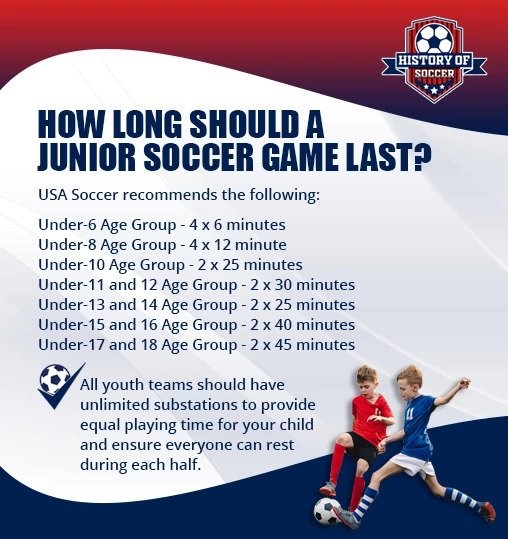
The game length is different for young soccer players. It isn’t a good idea to make little kids play 90 minutes; they would get tired too fast! Usually, the younger the players are, the shorter the games. Let’s check out a typical format:
Typical Game Times for Different Age Groups:
- Under 6: Typically, 4 x 10-minute quarters, or 2 x 20 minute halves with short breaks, totaling around 40 minutes.
- Under 8: Usually, two 25-minute halves or four 15 minute quarters, totaling about 50 minutes.
- Under 10: Two 30-minute halves, making it an hour-long game.
- Under 12: Two 35-minute halves, which makes up to 70 minutes.
- Under 14: Two 40-minute halves, making up a total of 80 minutes.
- Under 16 and older: Usually, two 45-minute halves (90-minute games, the same as adults).
These are just typical formats, and the exact times can be different based on the league or tournament rules. Always check with the organizers for the official game times.
Factors Affecting the Length of a Soccer Game
Several things can influence the overall length of a soccer game, even if we start with a set number of minutes.
Weather Conditions
Sometimes the weather can affect the length of a game. In very hot or humid conditions, the referee might allow for short water breaks. These can lead to a few added minutes on the clock. Severe weather, like heavy rain or lightning, can cause delays or even the game to be postponed.
Tournament Rules
Rules can be different in various tournaments. Some might have shorter extra time periods, or even choose not to use extra time at all. All these changes affect how long the game actually lasts.
Level of Play
Professional games tend to have stricter rules around stoppage time and following the clock very closely. In friendly games or smaller leagues, there can sometimes be a little more flexibility. It’s not unusual to see more added time in high level games.
The Referee’s Decisions
The referee is the main authority in the game. How they manage the time, how they deal with stoppages, and how much added time they give will affect the final duration. They’re responsible for ensuring fair play and also making sure the game is managed correctly in terms of time.
The Flow of the Game
If there are a lot of injuries, substitutions or other delays, the game can take longer overall. A game with fewer interruptions will likely take less time than a game with lots of stops and starts.
Keeping Track of Time in Soccer
Unlike some sports where the clock stops for almost everything, in soccer, the game clock mostly runs continuously. The referee will keep track of the time in most cases, and they are responsible for stopping the clock only for specific reasons.
How the Ref Keeps Time
The referee usually has a watch with a timer to track the time for each half, and for extra time, as needed. Referees have to use their judgment to decide on the amount of added time for each half. They must also be aware of the stoppages and take notes. They will then signal for the end of each period with a whistle.
No Running Clock on a Scoreboard
In most cases, soccer matches don’t have a countdown clock like what you might see in a basketball game. This means that the clock keeps ticking even when the ball is not in play. This can make the last few minutes of a close game very exciting because nobody knows exactly how much time is left.
Summary of Soccer Game Lengths
To put it all together, here’s a little overview:
| Game Type | Halves | Half Length | Total Playing Time | Typical Break |
|---|---|---|---|---|
| Adult/Professional | 2 | 45 minutes | 90 minutes | 15 minutes |
| Extra Time | 2 | 15 minutes | 30 minutes | Short Break |
| Under 6 | 4 or 2 | 10 or 20 minutes | 40 minutes | Short Breaks |
| Under 8 | 2 | 25 minutes | 50 minutes | Short Break |
| Under 10 | 2 | 30 minutes | 60 minutes | Short Break |
| Under 12 | 2 | 35 minutes | 70 minutes | Short Break |
| Under 14 | 2 | 40 minutes | 80 minutes | Short Break |
| Under 16 and Older | 2 | 45 minutes | 90 minutes | 15 minutes |
So, remember, a typical adult soccer game is 90 minutes long with a 15-minute halftime break, but extra time and added time can change the overall duration. For younger players, the game times are much shorter. Hope this clears up everything you need to know about the length of a soccer match! Now you can enjoy the next soccer match being a time expert!
The length of a soccer match, while typically 90 minutes, is not always set in stone. The addition of stoppage time, extra time, or changes for youth leagues can mean that the actual duration can vary. Understanding these different elements adds to your appreciation of the game and its rules. So, now you’re well-versed in the timing of a soccer match, you can confidently watch and enjoy every minute.
Here's how stoppage time works at the end of soccer games
Final Thoughts
A standard soccer game lasts 90 minutes. This time is split into two 45-minute halves. There is also a halftime break typically lasting 15 minutes.
Keep in mind that extra time can be added due to stoppages. This additional time compensates for injuries or other delays. Therefore, how many minutes is in a soccer game can exceed the standard 90.

