
The number of sets in a game of tennis depends on the match type. In most men’s matches, the winner needs to secure three sets. Women’s matches, however, typically require winning only two sets.
Ever wondered about the structure of a tennis match? Understanding how many sets in a game of tennis is fundamental to appreciating the sport. The format can change between men’s and women’s competitions, this difference creates varied strategies.
It is quite important to know this basic rule for following along with the match. This simple difference plays a big part in the game. Let’s explore this further in detail in this blog post.

How Many Sets in a Game of Tennis?
Okay, let’s dive into the exciting world of tennis and figure out just how many sets you need to win a match. It’s not as simple as saying “three” or “five” – there’s a bit more to it than that! The number of sets depends on a few things, mainly what kind of match you’re watching or playing. Think of it like different lengths for races – a sprint is short, but a marathon is long.
Understanding the Basics: Sets, Games, and Points
Before we talk about set numbers, let’s make sure we all understand the basics. Tennis is made up of points, games, and sets. You win a point by hitting the ball over the net and making it land in bounds, and your opponent fails to return it. If you win a certain number of points, you win a game. Then, when you win enough games, you win a set. It’s like building a tower with Lego blocks – each point is a block, each game is a small tower of blocks, and each set is an even bigger tower made of all the little game towers.
How to win a Game
To win a game, a player needs to score at least four points, but that’s not the end of the story. There is also a very important rule, to win a game a player needs to win by two points margin. If both players are tied at 40 (also known as deuce), then the player that wins the next point has advantage, if the same player wins again he/she wins the game. If the opponent wins the next point then the game again comes back at deuce and this process continues until one player wins two points in a row.
- 0 points – Love
- 1 point – 15
- 2 points – 30
- 3 points – 40
- 4 points – Game
How to win a Set
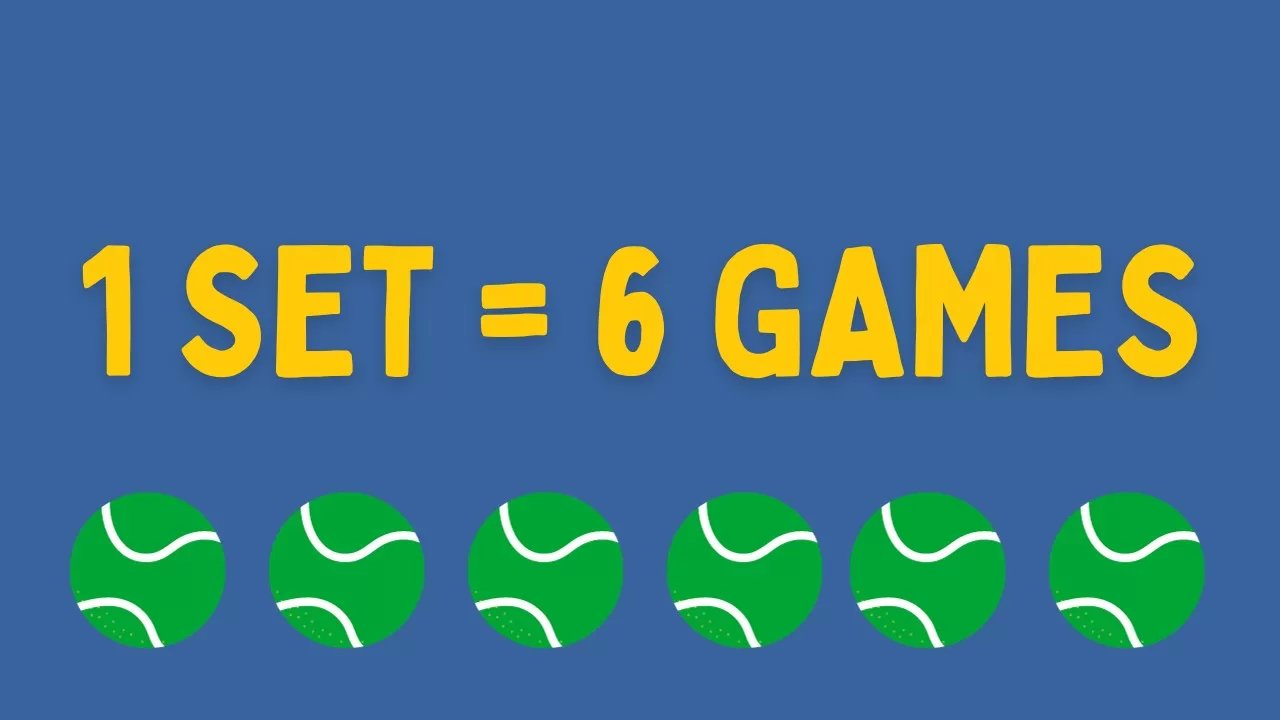
When it comes to winning a set, there are again some basic rules. Usually, to win a set, a player needs to win at least six games, but again, there’s that important rule – win by two. If the score is 6-5, then the set continues until one player leads by two games (for example 7-5). However, when the score reaches 6-6 in some cases a tie-break is played to decide the set. We will explore tie-breaks later in this article.
Best-of-Three Sets: The Standard for Many Matches
Most of the time, when you are playing a casual game of tennis, or watching a lower-level professional match, you’ll hear about best-of-three sets. This means that the first person to win two sets wins the match. It’s kind of like a mini-tournament – the best of three rounds wins. This is the format that’s very commonly used in women’s tennis, junior tournaments, and at the earlier stages of most tennis tournaments.
Here’s a quick breakdown of how it works:
- Scenario 1: Player A wins the first set, and player B wins the second set. They would then play a third set. Player A wins this set, and wins the whole match because player A has won two sets.
- Scenario 2: Player A wins the first set and the second set. The match is finished, player A has won the match because they have won two sets
- Scenario 3: Player B wins the first set and the second set. The match is finished, player B has won the match because they have won two sets.
Think of it like a best of three round in a game that you might play. Each set is one round and in the best-of-three format, you need to win two rounds to win the match.
Best-of-Five Sets: The Grand Slam Format
Now, things change when you get to the biggest tournaments in tennis, called the Grand Slams. These are the Australian Open, the French Open, Wimbledon, and the US Open. In these famous tournaments, the men’s singles matches are played as best-of-five sets. It means that the first person to win three sets wins the whole match. These matches are really epic, sometimes taking 4 or 5 hours to complete. Because of the length these kind of matches require very high levels of fitness and strategy. Players need to manage their energy levels, focus and stay resilient throughout the match. These kinds of matches are considered to be the ultimate test of a players stamina.
Here is a look at how this works:
- Scenario 1: Player A wins the first set, player B wins the second set, player A wins the third set, player B wins the fourth set, then player A wins the fifth set. Player A wins the match because they have won three sets.
- Scenario 2: Player A wins the first three sets. The match is complete, as player A has won three sets, and has won the match.
- Scenario 3: Player B wins the first three sets. The match is complete, as player B has won three sets, and has won the match.
Best-of-five set matches are usually considered to be a test of a players strength and stamina. Only the very best players are able to win these kinds of matches, showcasing their athletic talent and mental toughness.
Tie-Breaks: When Sets Get Too Close
Sometimes, a set can get really close, with each player winning about the same number of games. So what happens when the score in a set reaches 6-6? It’s time for a tie-break! A tie-break is like a mini-game, designed to quickly decide who wins the set. It keeps the match moving and stops the sets from going on forever.
How a Tie-Break Works
A tie-break is played differently to a normal game. Instead of being won by a player achieving a margin of two points after reaching 4 points, a tie break is played to 7 points, but still needs to be won by two points margin. This means a player must win 7 points to win a tie break, but if the tie break score becomes 6-6 then the tie break continues until a player has a margin of two points. The winner of the tie-break wins the set with a score of 7-6. The set score will appear as 7-6 on the scoreboard with the tie break score appearing in brackets after the 7-6 score. For example 7-6 (7-3) means that player won the set 7-6, and won the tie-break by a score of 7-3.
Here are the basic rules for a tie-break:
- The first player to reach 7 points (with a two-point lead) wins the tie-break and the set.
- Players change ends after every six points in a tie-break.
- The player who served first at the start of the tie-break receives first in the next game of the following set.
The Exception: The Final Set at Wimbledon (and previously in some other tournaments)
There used to be a special exception to the tie-break rule at some major tennis tournaments, but especially at Wimbledon. For a long time, the final set of a best-of-five set match at Wimbledon didn’t have a tie-break. This meant that the set would continue until one player had a lead of two games. This could lead to extremely long sets, which was exciting for many fans, but sometimes exhausting for the players involved. The longest game on record was the first round of Wimbledon match between John Isner and Nicolas Mahut. The match took 3 days to complete, and included a fifth set that lasted 8 hours and 11 minutes. The set was eventually won by Isner 70-68. However, in 2019 it was decided that from 2019 onward, all the grand slam tournaments would use a tie-break in the final set at 12-12. Now, the Wimbledon final set uses a tie-break at 6-6 and the other grand slam tournaments all use a tie-break at 6-6 in the final set.
It’s worth noting that you may still occasionally see some lower-level tournaments not play a tie-break in the final set, or they might play a “champions tie-break” to 10 points instead of a regular tie-break. It’s always a good idea to look into the local tournament rules before you start, to understand what the requirements are.
Why Do Set Numbers Vary?
You might be wondering why there is a difference between best-of-three and best-of-five set matches. It basically comes down to tradition and time. Best-of-five matches are seen as the ultimate test, requiring incredible stamina and mental strength. They provide great drama, which is what fans of grand slam tournaments look forward to watching. Best-of-three matches are more common as they are shorter, which is preferable for events that have many players or less time. It ensures that tournaments can continue to move through the various rounds at a reasonable speed.
Keeping Track of Sets
Okay, so now that you know all about the various set numbers you might see in a tennis match, it might seem a bit complex, especially if you are new to the sport. Here are some handy tips to help you keep track of sets. It’s best to try to do this to get used to watching and understanding tennis.
- Watch the Scoreboard: Most tennis matches will have an electronic scoreboard, which will clearly display the score of the sets. It will show how many sets each player has won and how many games have been played in the current set.
- Listen to the Commentators: If you are watching a professional tennis match, the commentators will usually keep you updated on the score. They are the experts and will let you know the score. They will also point out the number of sets that are required for a player to win the match.
- Use your fingers: If you are playing, and you are having difficulty keeping track of sets, a simple technique is to use your fingers to count the sets.
Once you get the hang of it, it will become second nature, and you won’t even need to think about it!
Summary Table of Set Formats
Here is a summary of different set formats.
| Format | Sets Needed to Win Match | Typical Usage |
|---|---|---|
| Best-of-Three Sets | 2 | Most women’s matches, junior events, early rounds of smaller tournaments, casual games. |
| Best-of-Five Sets | 3 | Men’s singles matches at Grand Slam tournaments. |
Why Understanding Set Numbers is Important
Understanding how many sets there are in tennis is important for many reasons. For players, knowing the format helps with strategy and pacing. Players need to conserve their energy, especially in a best of five set match. They have to strategize to win the match and sometimes not winning the first or second set is fine if they still believe they can come back to win the remaining sets. For viewers, understanding the set format helps understand how far along the match is. It helps you understand the implications of the current score, and the potential implications on how the rest of the match may unfold. This understanding allows a fan to really enjoy watching and following the match.
Also, understanding set numbers is vital if you are thinking of betting on tennis. You need to know the format of the match before you make a bet. For example, if you bet that a player will win at least one set, you should be aware of how many sets the match will be played to. It is essential for fans and players alike to be fully aware of the rules of tennis.
So, now you know all about the different set numbers in a tennis match. Whether it’s best-of-three or best-of-five, understanding these basic rules is key to enjoying tennis, whether you’re playing or just watching! So, get out there, enjoy the games, and keep practicing.
Tennis for dummies video | Tennis Scoring Explained
Final Thoughts
The number of sets required to win a tennis match depends on the specific competition. In men’s grand slam tournaments, players must win three sets to claim victory. However, women’s matches, including grand slams, are best of three sets. Therefore, the format makes the crucial difference.
To clarify, a game of tennis always requires a player to win a specific number of sets to be declared winner of the entire match. So, how many sets in a game of tennis depends on this. This essential detail determines the match’s length.

