
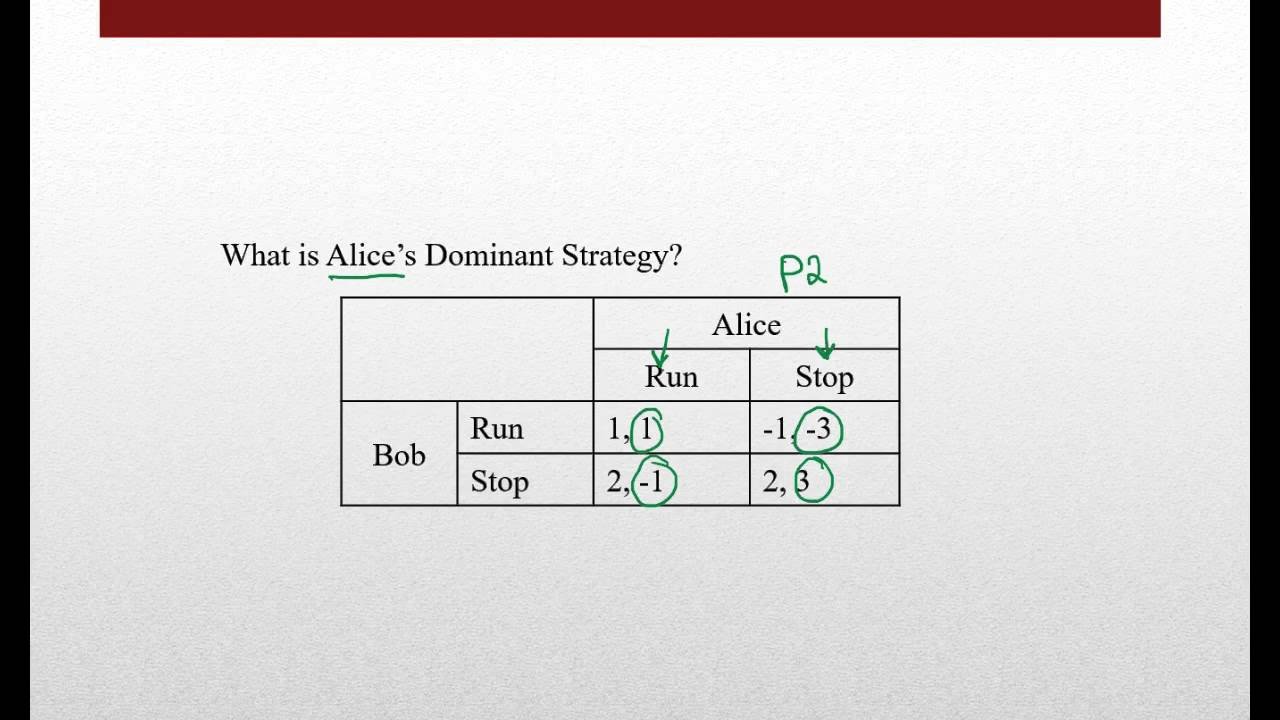
To find dominant strategy game theory, compare each player’s payoffs for every possible action, identifying if one action consistently yields a higher payoff regardless of the other players’ choices.
Ever wondered how to anticipate the best move in a strategic situation? Game theory provides a framework, and understanding how to find dominant strategy game theory is key. This concept involves analyzing payoffs to pinpoint actions that consistently offer the highest reward for an individual player. It’s like having a secret weapon for decision-making.
By systematically evaluating each player’s options and their corresponding outcomes, you can determine if a dominant strategy exists. When such a strategy is present, it simplifies decision making. A player, irrespective of other’s actions, would always choose this action.

How to Find Dominant Strategy in Game Theory
Have you ever played a game where you just knew what the best move was, no matter what your opponent did? That, my friends, is the magic of a dominant strategy in game theory. It’s like having a secret weapon that always gives you an edge. Game theory is all about how people (or even companies!) make decisions when they know their choices affect others. And finding a dominant strategy? That’s like finding the winning cheat code!
Understanding the Basics of Game Theory
Before we dive into finding dominant strategies, let’s quickly chat about what game theory is all about. Imagine a game – it could be anything from a simple card game to a complex business negotiation. Game theory provides us with a way to analyze these situations by looking at the possible choices each person (or ‘player’) can make, and how those choices affect the outcome for everyone.
Here are a few key ideas in game theory:
- Players: These are the people or groups making decisions.
- Strategies: These are the actions that each player can take.
- Payoffs: These are the results or rewards each player gets based on everyone’s choices. Payoffs can be things like money, points, or even just satisfaction.
Game theory uses these ideas to figure out what people might do and how they can make the best possible decisions.
What Exactly is a Dominant Strategy?
Okay, so what’s the big deal about a dominant strategy? A dominant strategy is simply the best move for a player, no matter what the other players decide to do. It’s like a superhero move that always works! Think of it this way: if you have a dominant strategy, you can play it every single time and you are always going to end up doing as well as or better than you would have with any other choice you could have made. You don’t have to worry about what anyone else is thinking or planning.
Let’s illustrate with a simple example. Suppose you are playing rock-paper-scissors, a simple game where two players simultaneously make hand gestures of rock, paper or scissors. If both players show the same sign, then the round results in a draw. If one player makes a rock gesture, and another makes a paper gesture, the player showing paper wins the round, while if one player makes a scissors gesture, and another makes a rock gesture, the player showing rock wins the round. Finally, If one player makes a paper gesture, and another makes a scissors gesture, the player showing scissors wins the round. If you have an opportunity to see in advance what your opponent will pick, and you pick your best choice accordingly, that would be a dominant strategy. For example, if you know for sure that your opponent will play rock, then you will always pick paper to win. However, in rock-paper-scissors, players generally pick their choices simultaneously, so this game has no dominant strategy for either player.
How to Identify a Dominant Strategy: Step-by-Step
Now for the main event! Let’s break down how to actually find a dominant strategy. It’s like detective work, but with numbers and logic.
Step 1: Setting Up the Game Matrix
The first step is to create a “game matrix”. Think of it as a table that shows all the possible choices each player can make and the outcomes (payoffs) for each scenario. Here’s what a typical game matrix looks like:
| Player 2: Option A | Player 2: Option B | |
|---|---|---|
| Player 1: Option A | Payoff for Player 1, Payoff for Player 2 | Payoff for Player 1, Payoff for Player 2 |
| Player 1: Option B | Payoff for Player 1, Payoff for Player 2 | Payoff for Player 1, Payoff for Player 2 |
Let’s make this less abstract by using an actual example. We’ll use a common scenario called the Prisoner’s Dilemma, which is a classic in game theory.
Step 2: Understanding the Prisoner’s Dilemma
Imagine two friends are arrested for a crime. The police don’t have enough evidence to convict them on the main charge, but they have enough to put them both away for a year on a lesser charge. The police make each friend an offer. They can either stay silent (‘Cooperate’ with each other) or betray their friend (‘Defect’).
Here’s how the payoffs look, using years in prison:
- If both cooperate (stay silent), they each get 1 year in prison.
- If one betrays and the other cooperates, the betrayer goes free and the other gets 3 years.
- If both betray, they each get 2 years in prison.
Here’s the game matrix for the Prisoner’s Dilemma:
| Prisoner 2: Cooperate (Stay Silent) | Prisoner 2: Defect (Betray) | |
|---|---|---|
| Prisoner 1: Cooperate (Stay Silent) | -1, -1 | -3, 0 |
| Prisoner 1: Defect (Betray) | 0, -3 | -2, -2 |
Remember, negative numbers here mean years in prison (a bad outcome). Player 1’s payoffs are shown first, and Player 2’s payoffs are second in the pairs.
Step 3: Comparing Payoffs Row by Row (for Player 1)
Now, let’s start looking for a dominant strategy for Player 1. We compare the outcomes of each of Player 1’s choices, given each possible choice by Player 2. First, we’ll assume that player 2 picks the option to cooperate.
- If Player 1 chooses to cooperate, the payoff is -1 (1 year in prison).
- If Player 1 chooses to defect, the payoff is 0 (goes free).
So, if Player 2 Cooperates, Player 1 is better off Defecting.
Next, we need to compare the outcomes of Player 1’s choices given Player 2 defects:
- If Player 1 chooses to cooperate, the payoff is -3 (3 years in prison).
- If Player 1 chooses to defect, the payoff is -2 (2 years in prison).
Therefore, If Player 2 Defects, Player 1 is still better off Defecting.
Step 4: Determining if a Dominant Strategy Exists
So what does this all mean? We now see that for Prisoner 1, defection gives a better payoff than cooperation regardless of what Prisoner 2 does. If Prisoner 2 cooperates, then Player 1 gets a better payoff of 0 (freedom) if he defects versus -1(one year in prison) if he cooperates. Similarly, if Prisoner 2 defects, then Player 1 gets a better payoff of -2 (2 year prison sentence) if he defects, versus -3 (3 years in prison) if he cooperates. That means, for Player 1, defecting is a dominant strategy, as it always gives a better payoff.
To see if a dominant strategy exists, we must repeat the steps of comparing all of the potential choices with the choices for the other player. We then see whether or not that strategy generates better outcomes irrespective of what the other player picks.
Step 5: Repeating the Process for Other Players
Now that we’ve found a dominant strategy for Player 1, let’s see if Player 2 also has one. If we repeat the process of comparing the two options for Player 2, we will see that Player 2 also finds that defecting is a dominant strategy, just as Player 1 did.
The Outcome of Dominant Strategies: Nash Equilibrium
When both players in a game have a dominant strategy, the result is called a Nash Equilibrium. In the Prisoner’s Dilemma, this means that both prisoners betray each other and both end up with a 2-year prison sentence (even though, if they had both stayed quiet, they would have only gotten a 1-year sentence each).
A Nash Equilibrium describes a situation in which no individual player has any motivation to change his or her strategy. That is because every player will be playing a strategy which provides the best possible outcome for themselves, given the choice of strategies of all other players. The Nash equilibrium is named after the game theorist John Nash.
When Dominant Strategies Don’t Exist
It’s important to note that not all games have dominant strategies. Sometimes, the best strategy for a player depends entirely on what the other players are doing. In those situations, things can get a lot more complicated.
Example: A Simple Game Without Dominant Strategy
Let’s look at another simple example to demonstrate a game without any dominant strategies. Imagine that two friends, Adam and Bob, go for lunch. Both Adam and Bob love both Japanese and Italian food. However, Adam prefers Italian food, while Bob prefers Japanese food. If Adam and Bob both go to the same type of restaurant, they will both enjoy their meal, and obtain a payoff of 1. If they go to different types of restaurants, then they will obtain a payoff of zero. In this game, therefore, the goal of each player is to coordinate on picking the same type of restaurant.
| Bob: Italian | Bob: Japanese | |
|---|---|---|
| Adam: Italian | 1, 1 | 0, 0 |
| Adam: Japanese | 0, 0 | 1, 1 |
Let’s examine whether a dominant strategy exists in this game for each player. First let’s examine Player 1, Adam’s strategies. If Bob chooses to go to the Italian restaurant, then Adam would also pick to go to the Italian restaurant, for a payoff of 1, instead of zero. However, if Bob chooses to go to the Japanese restaurant, then Adam would want to go to the Japanese restaurant, also for a payoff of 1 instead of zero. This means that the best strategy for Adam is dependent on what Bob picks. Therefore, Adam does not have a dominant strategy. We will find, if we repeat the exercise for Bob, that Bob also does not have a dominant strategy. In this game, neither player has a dominant strategy.
Real-World Applications of Dominant Strategies
Game theory and dominant strategies are not just abstract ideas in books. They are used in all sorts of places every single day, such as:
- Business: Businesses use game theory when they try to price their products or when they are thinking about entering a new market. They want to figure out how their competitors might respond.
- Politics: Politicians use game theory to figure out how to get more votes and make decisions that will affect their supporters.
- Economics: Economists apply game theory to study different markets and how people make choices about money.
- Everyday Life: Even you, without knowing it, might use game theory when you’re deciding whether to go to the movies or hang out with your friends.
Looking for dominant strategies in these scenarios can really help individuals and businesses to make smarter choices.
Tips for Finding Dominant Strategies
Here are some useful tips to use while you’re learning how to locate dominant strategies:
- Always create a game matrix. It keeps everything organized and helps you see all the options clearly.
- Look at each player’s options separately. Don’t try to solve everything at once.
- Compare payoffs carefully. Pay attention to the numbers (or values), and make sure you are using the appropriate payoff for each choice.
- Remember that sometimes dominant strategies don’t exist. If you can’t find one, that’s totally okay, and it may mean the game is more complex.
- Practice makes perfect. The more you try, the better you’ll get at recognizing dominant strategies. Try creating your own game scenarios and see if you can find them.
So, there you have it! Finding a dominant strategy in game theory isn’t about being the smartest person in the room; it’s about carefully looking at all the options and making the best choice, regardless of what others do. It’s like having a superpower in a world full of decision making!
Understanding how to spot these dominant strategies isn’t just a cool trick; it can improve how you approach different situations in life, whether it’s in a game, at work, or simply making everyday decisions. Remember, the key is to carefully examine all possible choices and payoffs, one player at a time, to see if one particular option always comes out on top. With a little practice, you will become better at finding these secret advantages and applying them in real life.
Dominant Strategy, Nash Equilibrium & Dominant Strategy Equilibrium in Simultaneous Move Games
Final Thoughts
To find a dominant strategy, compare each player’s payoffs for all possible actions. A dominant strategy exists when one action always yields a better outcome for a player, regardless of the other players’ choices. This process involves careful examination of the payoff matrix for every player’s options.
If a player has a dominant strategy, they should always choose it. The key is identifying if a single option consistently provides the highest payoff. Understanding how to find dominant strategy game theory is crucial for predicting player behavior.

