
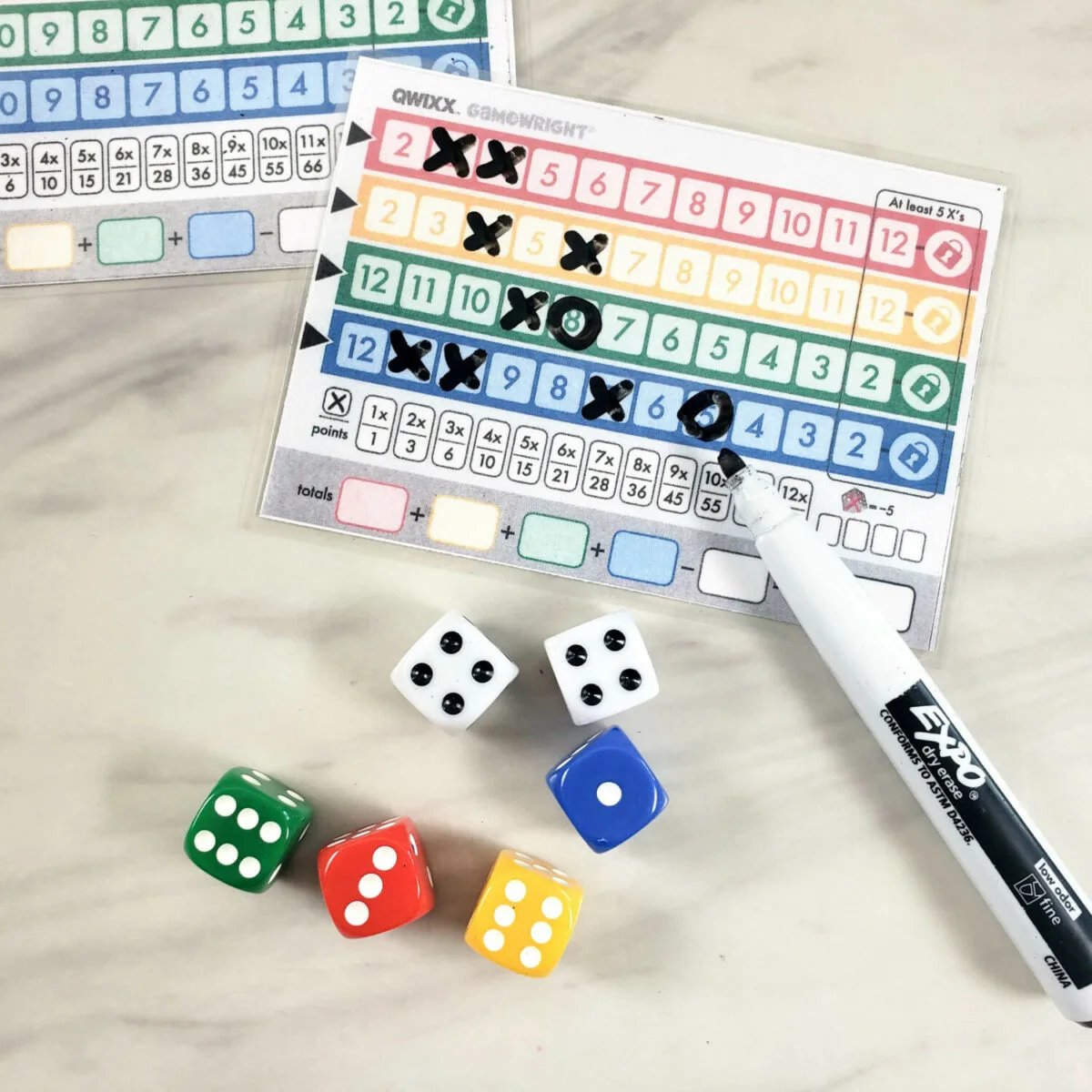
Playing Qwixx involves rolling dice, then marking numbers on your score sheet. You mark numbers on a row by either taking the sum of white dice with colored dice or just the sum of two white dice. You aim to get as many rows closed as possible.
Ever wanted a quick, engaging dice game that’s easy to learn but provides strategic depth? Then, you should try out Qwixx! This game is all about making smart choices with the numbers you roll and deciding when to take a chance. It’s not hard, and the rules are pretty simple.
So, let’s get right into how to play Qwixx dice game. You’ll find it’s a great little game to pass some time with friends and family. Grab your dice and let’s begin.

How to Play Qwixx Dice Game
Alright, let’s dive into the exciting world of Qwixx! This isn’t just any dice game; it’s a fast-paced, strategic challenge where you’ll be marking numbers and trying to score big. Don’t worry, it’s easy to learn, and once you get the hang of it, you’ll want to play again and again. We’re going to break down everything, so you’ll be a Qwixx pro in no time!
The Basics of Qwixx: What You Need
Before you start rolling, let’s gather our supplies. Qwixx is simple to set up. Here’s what you’ll need:
- Qwixx Score Sheets: Each player gets their own score sheet. These sheets have four rows of numbers in different colors (red, yellow, green, and blue).
- Six Dice: You’ll have four regular dice (white with numbers 1-6) and two colored dice (one red, one yellow, one green, and one blue). These colored dice match the rows on the score sheet.
- A Pencil or Pen: You’ll need something to mark off numbers on your score sheet.
That’s it! Simple enough, right? Now let’s look at how the game actually works.
Setting Up the Game
Setting up Qwixx is super easy. First, give each player a score sheet and a pencil or pen. Make sure the dice are all together, ready for rolling. Decide who goes first – maybe the youngest player, or the person who rolled the highest number with one die. Once you pick the first player, you’re ready to jump into action!
Understanding the Qwixx Score Sheet
The score sheet looks a little intimidating at first glance, but don’t worry, it’s simple when you know what to look for. Here’s a breakdown:
- The Four Rows: The sheet has four rows, each a different color (red, yellow, green, and blue). These colors match the dice.
- Number Sequence: Each row has a sequence of numbers. The red and yellow rows go from 2 to 12, in ascending order. The green and blue rows go from 12 to 2, in descending order.
- Lock Boxes: At the end of each row, there’s a special box known as the ‘lock’ box. We’ll discuss their importance later on.
- Penalty Boxes: At the bottom, there is a space for you to mark penalty boxes which impact your final score, so be careful not to get too many!
How to Mark Numbers
The main goal is to cross off as many numbers on your sheet as possible. But you can’t mark numbers randomly; there are rules. You have to mark the numbers in each row from left to right, moving from a lower number to a higher number (for red/yellow). And from higher number to lower number (for green/blue). You can only mark a number if it’s equal to or greater than the last number you marked in that same row (red/yellow). For Green and Blue, each mark you place must be equal to or lower then the previous mark in the same row. You can skip numbers (but you cannot then go back to the skipped number later in the row.
For example, if you have already marked a 5 in the yellow row, you can only mark 5, or a higher number such as 6, 7, 8, 9, 10, 11, or 12 on a later turn. You cannot mark any lower number. If you mark the 10, you can only then mark 10, 11, or 12 later on in the yellow row. This rule adds an important element of strategy to the game. In the descending rows for green/blue, the same principle applies but with moving from a larger number to a smaller number.
The Gameplay: Rolling and Marking
Okay, now for the real fun – actually playing the game! Here’s how a typical turn goes:
The Active Player’s Turn
- Roll the Dice: The active player rolls all six dice. This includes four white dice and the two colored dice.
- Use the White Dice: First, everyone, including the active player, can use the two white dice to mark numbers.
- Adding the White Dice: Look at the two white dice. Add their values together. For example, if you rolled a 3 and a 2, the total is 5.
- Marking a Number: If you want, you may mark the number on any colored row that matches the total of the white dice. For example if the total is 5, you could mark the number 5 in any color row.
- No Mark Needed: You don’t have to mark a number if you don’t want to, or if you are unable to. You can’t undo a mark on the score sheet.
- The Active Player’s Colored Dice Option: After everyone has the option of marking a number based on the white dice, the active player has an additional turn of action.
- Combining Dice: The active player chooses one colored die along with one white die. They add these two dice together.
- Marking a Number: They can then mark that number on their own score sheet in the corresponding colored row. For example, if they rolled a red 2 and a white 3, they can add those for a total of 5. They can then mark the number 5 in the red row on their score sheet, assuming it is a valid move.
- No Mark Option: If the active player cannot or does not wish to use this combination of dice, they don’t have to mark a number.
Example Turn
Let’s say it’s your turn. You roll the dice and get the following results: a white 3, a white 1, a red 2, a yellow 5, a green 4, and a blue 6.
- White Dice Option: The sum of the white dice is 4. Everyone can choose to mark the number 4 on any row they want, if it is a valid move in the row as explained earlier.
- Active Player Colored Dice Option: As the active player you have a chance to combine one colored die with one white die. You could combine the red 2 with the white 3 for a total of 5, and mark the number 5 in the red row. Or, you could combine the red 2 with the white 1 for a total of 3, and mark the number 3 in the red row. Or, you could chose any other white dice and color dice combination. If none of the combinations are useful for you this turn, you do not have to mark anything.
Locking Rows and Ending the Game
Now let’s talk about locking rows and ending the game. This is where some strategy comes into play.
Locking Rows
- The Lock Box: Remember the “lock box” at the end of each row? It’s very important.
- Marking the Last Number: If you mark the last number in any row (12 for red/yellow, 2 for green/blue) you have the option to lock that row. You must have at least 5 numbers marked in that row before you can lock the row. When you mark the last number and lock a row, you mark a x in the lock box at the end of the row.
- Removing the Matching Die: When a row is locked, the corresponding colored die is removed from the game. This means it cannot be used in future turns.
- Fewer Dice Available: As the game progresses, there will be fewer dice to roll, which will bring the game to a conclusion
Ending the Game
There are two ways the game can end:
- Two Rows Locked: If two rows are locked then the game ends immediately.
- Four Penalty Boxes: When a player marks their fourth penalty box then the game ends immediately.
Penalty Boxes
If you can’t mark any numbers on your score sheet after the white dice are rolled, and also can’t mark any numbers as the active player, you must mark a penalty box. Penalties can add up so you want to avoid this if you can!
Scoring Qwixx
Alright, the game is over, and it’s time to see who won! Scoring Qwixx is pretty simple. Here’s what you need to do:
- Points Per Row: For each row where you marked at least one number, you score points based on how many numbers you marked. You will add these numbers up based on the table below.
- Locked Row Bonus: If you locked a row, it counts toward your score (the points are included based on the number of X marks in the row).
- Penalty Points: Then, deduct points for any penalty boxes you marked, you’ll subtract 5 points for each penalty box that was marked.
- Total Score: Add up all the points and subtract your penalty points to get your final score!
Qwixx Scoring Chart
The points for each row are counted based on how many x marks are present in each row. Here is the scoring chart to see the points you scored in each row:
| X’s Marked | Score |
|---|---|
| 1 | 1 |
| 2 | 3 |
| 3 | 6 |
| 4 | 10 |
| 5 | 15 |
| 6 | 21 |
| 7 | 28 |
| 8 | 36 |
| 9 | 45 |
| 10 | 55 |
| 11 | 66 |
| 12 | 78 |
The player with the highest total score wins the game!
Tips and Strategies for Qwixx
Here are some tips and strategies to help you win at Qwixx.
- Focus on One or Two Rows: Rather than spreading your marks all over the sheet, try to focus on filling one or two rows early on. This will help you to lock rows.
- Watch the Dice: Be aware of which dice are being rolled and think about which numbers might be useful to you. Don’t just mark numbers randomly, try to plan ahead.
- Consider the Alternatives: Sometimes, it’s better to take a penalty than mark a number that blocks you in a row, or leaves limited choices for future numbers.
- Don’t Chase Lock Boxes: While locking a row is great, if you cannot add a few extra x marks in that row you may be better off avoiding the last numbers. Sometimes, it is better to have marks in 2 rows than to lock a single row for the sake of it.
By following these tips and playing strategically, you’ll be able to improve your Qwixx game quickly! Remember, practice makes perfect, so keep playing!
Qwixx is all about making smart choices and planning ahead. It’s a great game for people of all ages. Now that you know how to play, gather your friends and family and get ready for some fun. Remember to look at the dice, think about your next move, and always try to get the most points! Enjoy playing Qwixx.
How to play Qwixx
Final Thoughts
To play Qwixx, roll dice and choose matching number/color pairs. Mark off numbers in rows. You can score more points by completing rows faster. The key is to optimize your choices.
Failed rolls add penalty points, so strategic marking matters. Players must close rows before they reach 13. The game ends when two rows close or one player gets four penalties. This is how to play qwixx dice game effectively.

