
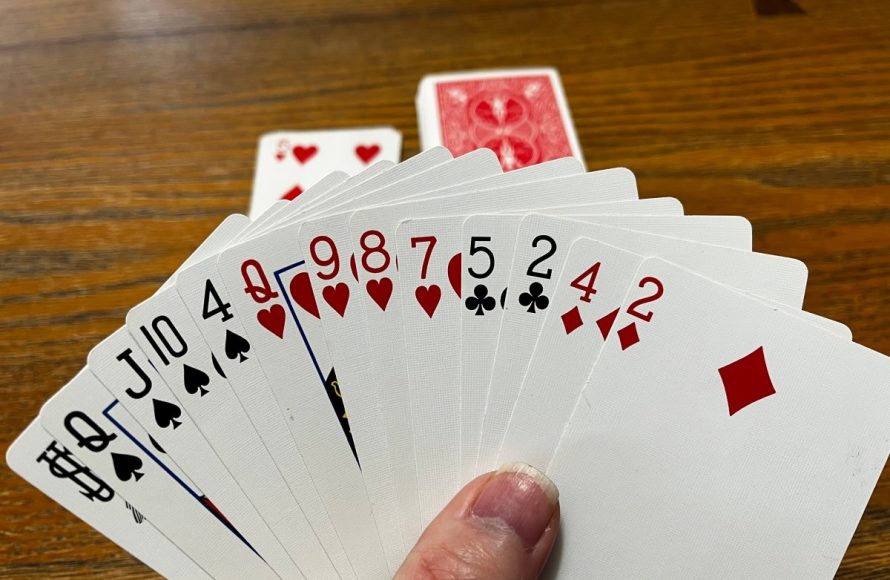
To play the card game Shanghai, you aim to complete a series of specific melds (sets and runs) each round, progressing through them in order, and the first player to finish all melds wins.
Have you ever wanted to pick up a fast-paced, exciting card game that’s easy to learn but provides a good challenge? Well, learning how to play the card game Shanghai is simpler than you might think. It’s a rummy-style game that provides a fun experience for all skill levels.
The game involves a series of rounds, where players must achieve specific goals with their cards before moving on to the next round. You’ll start by trying to create two sets, and then move onto two runs, and so on. Each round offers a fresh set of strategic decisions.

How to Play the Card Game Shanghai
Shanghai is a fun and exciting card game that’s perfect for families and friends. It’s a game where you try to get rid of all your cards by creating sets and runs. If you enjoy games like Rummy or Canasta, you’ll probably love Shanghai. Let’s dive into how you can play this engaging game.
Understanding the Basics of Shanghai
Before we get into the nitty-gritty of playing, let’s cover some core concepts. Shanghai is a game played using one or two standard 52-card decks, and the number of players can be anywhere from two to eight, though four to six players is generally considered ideal. The goal is to be the first person to complete all the required combinations of cards in each round and get rid of all your cards.
The Objective
The primary objective in Shanghai is to be the first player to go “out” in each hand by forming the required combination of sets and runs and then getting rid of any remaining cards. A player goes out by melding, or laying down, cards that meet specific criteria and then discarding their final card. This is repeated across several rounds, with the requirements changing each round.
Card Values
In Shanghai, the face value of the cards matters. Numbered cards are worth their face value. Jacks, Queens, and Kings are all worth 10 points. An Ace can be worth either 1 or 11 points depending on how you use it in a run or set.
The Deal
To begin, each player receives a specific number of cards, which changes as the game progresses. In the first round, players usually receive 10 cards each. The remaining cards are placed face down in the center of the playing area to form the stock pile. The top card of the stock pile is turned face up and placed beside it to begin the discard pile. This discard pile is essential as players will draw from and discard to it throughout each round.
The Play: Step-by-Step
Now that we know the basics, let’s see how a round of Shanghai actually plays out:
Drawing and Discarding
Each player’s turn starts with drawing a card. They can choose to draw the top card from the stock pile or the top card from the discard pile. After drawing, they’ll check their hand to see if they can create any sets or runs, which we’ll discuss in detail below. After melding, or laying down their combination if possible, and any other cards they can play on others sets and runs, the player must discard one card to the discard pile face up, thus ending their turn. Players must always draw a card then discard a card each turn.
Creating Sets and Runs
The heart of Shanghai lies in making sets and runs. Let’s see what these are:
- Sets: A set is a group of three or four cards of the same rank. For example, three 7s or four Kings are a set. Suits do not matter when creating a set.
- Runs: A run, also known as a sequence, is a group of three or more consecutive cards of the same suit. For instance, the 5, 6, and 7 of Hearts is a run, or the 9, 10, Jack and Queen of Clubs would also be a run. An Ace can be either high or low in a run (A-2-3 or Q-K-A), but can not create a run wrapping around from king to Ace (K-A-2), the run must be consecutive, in ascending or descending order.
Melding
When a player has created a set or a run, they can lay these cards face up on the table in front of them. This is called melding. A player does not need a full hand of all sets and runs to begin to meld. Once you meld you must continue to do so each turn, when possible.
Playing on Existing Melds
After a player has begun to meld, during their turn they can also play cards on existing melds, whether they’re their own or another player’s. This is called laying off. For example: If a player previously melded the set of three 8s, and another player holds a fourth 8, they can play that on the existing set. Likewise, if there is a run of the 4, 5, 6 of Diamonds melded, another player holding the 3 or 7 of Diamonds can play it. However, you can only play one card on the existing melds after your initial melds.
Going Out
When a player has melded all of their hand, and they have one remaining card, they must discard that remaining card. If they do so and there are no additional plays to be made by another player, the round ends. The player who discards the final card is declared the winner of that round.
The Different Rounds of Shanghai
Shanghai isn’t just one round of play. It’s actually multiple rounds, each with different card combinations that must be made to go out. Here’s the typical round structure:
| Round | Cards Dealt | Required Combination |
|---|---|---|
| Round 1 | 10 | Two sets of three cards. |
| Round 2 | 10 | One set of three cards and one run of four cards. |
| Round 3 | 10 | Two runs of four cards. |
| Round 4 | 11 | Three sets of three cards. |
| Round 5 | 11 | Two sets of three cards and one run of four cards. |
| Round 6 | 11 | One set of three cards and two runs of four cards. |
| Round 7 | 12 | Three runs of four cards. |
| Round 8 | 12 | One set of three cards and one run of seven cards. |
| Round 9 | 12 | All of the same suit, no sets. All must be in runs. |
| Round 10 | 13 | Four sets of three cards. |
Each round, the number of cards dealt increases, and the combinations you need to make to “go out” become more challenging. Remember, the goal each round is to get rid of all your cards by melding and then discarding one card first.
Scoring Shanghai
After each round, if a player goes out first, the other players must count the value of their remaining cards to get a final score. They are given penalty points according to the cards in their hands.
- Number cards are face value
- Jacks, Queens, and Kings are worth 10 points
- Aces are worth 11 points
The player with the lowest score at the end of all the rounds wins the game. A running total is kept of points from each round.
Tips and Strategies for Shanghai
Here are some tips to become a better Shanghai player:
- Pay attention to what others are discarding: This will give you clues about what cards they might be collecting.
- Don’t be afraid to discard high-value cards: If you can’t use them, they’re better off in the discard pile than in your hand at the end of the round.
- Be flexible: Don’t get too attached to one strategy. If you see a better opportunity, take it.
- Keep an eye on what’s available in the discard pile: It might hold a card that completes your set or run.
- Don’t hold on to pairs and trips: It’s good to have one or two to meld, but don’t hang on to many pairs, they are hard to make into sets.
- Be observant: Be aware of what other players have melded. It helps to be able to lay off a card or two in each round.
Variations of Shanghai
Like many popular card games, Shanghai has several variations. Some common variations include changing the specific combination requirements for each round. Some versions only play up to Round 7. Another common variation is to allow players to play multiple cards on existing melds during their turn. Feel free to experiment with different variations to keep the game interesting and challenging.
Another very popular variation of the game is called “California Rummy” or “Michigan Rummy”. They are all very similar to each other. The variations and differences are small, and many have found it easiest to choose a favorite set of rules. They all use the same basic rules. Some rule variations may include using different combinations, different points for cards, or changing the number of rounds.
Shanghai is a game that requires planning, observation, and a little bit of luck. It is an engaging game that will quickly become a favorite for any family game night! Give it a try today and you might just find yourself hooked on this strategic card game!
How to Play Shanghai Rummy | Game Rules | Card Games
Final Thoughts
Shanghai requires players to collect sets of cards, starting with a single set of three. Players draw cards and discard until they achieve the needed set for the round. The sets increase in difficulty each round.
The first player to complete all assigned rounds wins. You must play strategically, deciding when to try completing your set or disrupt an opponent. Learning how to play the card game shanghai involves understanding set requirements for each round.

