
Scoring a golf game involves counting the number of strokes you take on each hole and adding them together at the end of the round.
Have you ever stood on the first tee, feeling excited but also slightly confused about how to keep track of your progress? Many new golfers find themselves wondering how to score a golf game accurately. It’s a vital skill and knowing it greatly improves the experience.
Basically, you count every swing, even if you accidentally knock the ball sideways, these all add to your score per hole. Then, once you’ve completed all holes, you tally the score to see how well you have performed on the course. It may seem basic, but it is quite important.

How to Score a Golf Game
Okay, so you’re ready to hit the golf course, but knowing how to actually keep score can sometimes feel trickier than sinking a 20-foot putt! Don’t worry, we’re here to make it super simple. Learning how to score in golf is like learning the rules of any game – once you know them, it becomes way more fun and easy to play. This isn’t just about knowing who won; it’s about understanding the game, tracking your progress, and maybe even bragging a little bit to your friends later on (in a friendly way, of course!). This guide will walk you through all the basics, from counting strokes to understanding more complex scoring systems. So, grab your scorecard and a pencil, and let’s get started!
The Basics of Golf Scoring: Counting Your Strokes
At its heart, golf scoring is all about counting your strokes. A “stroke” is anytime you swing at the ball and try to move it forward. Every swing, even if you miss the ball completely or send it into the woods, counts as a stroke! Here’s how it works:
- Each Hole is Different: Golf courses have 18 holes, and each one has a number called “par.” Par is the number of strokes a good golfer should take to get the ball from the tee (where you start) into the hole.
- Par 3s, 4s, and 5s: Par is usually 3, 4, or 5. Par 3s are short holes, meaning you should reach the green in one stroke and then putt twice to get it into the hole. Par 4s are longer, usually requiring two shots to reach the green, and then two putts. And Par 5s are the longest, meaning three shots to reach the green, and two putts.
- Counting Each Swing: You’ll keep track of every swing you take to get the ball into the hole. Don’t forget to count those practice swings or air-swings. Only swings that actually contact the ball count as a stroke.
- Adding Up the Strokes: After you finish the hole, write down the total number of strokes you took on your scorecard.
Remember, the goal is to get the ball into the hole with the fewest number of strokes possible! So, if you took five strokes on a par 4 hole, then your score for that hole is 5.
Understanding “Over Par” and “Under Par”
Golf scores are usually talked about in relation to par. Here’s what those terms mean:
- Over Par: If you take more strokes than the par for a hole, you are “over par”. For example, if a hole is a par 4 and you take 5 strokes, you are 1 over par for that hole. This is often called a “bogey.” Two over par is a “double bogey,” and so on.
- Under Par: If you take fewer strokes than par for a hole, you are “under par.” For example, if you take 3 strokes on a par 4 hole, you are 1 under par for that hole. This is called a “birdie.” Two under par is an “eagle,” and three under par is an “albatross.” Getting an albatross is very hard and very rare!
- Even Par: If you finish a hole in the exact number of strokes that matches the par for the hole, you are at “even par”.
Keeping track of your scores in relation to par helps you understand how well you are playing on each hole. The less strokes you have compared to par, the better you did.
Using a Golf Scorecard
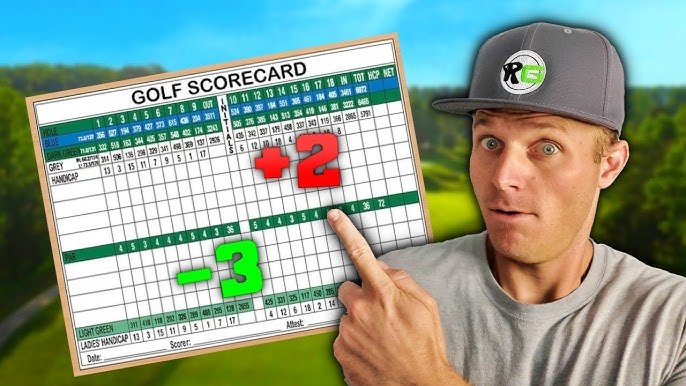
A golf scorecard is your trusty tool for recording your scores. It’s usually a small piece of cardstock with rows and columns. Let’s take a look at what you might see on a typical scorecard:
- Hole Numbers: Each hole on the course will be labeled with a number (1 to 18). These are listed down the side or across the top of the card.
- Par: Next to each hole number, you’ll see the par for that hole (3, 4, or 5). This is the standard number of strokes a skilled player should take.
- Handicap: Some scorecards include a handicap rating for each hole. This helps in determining the difficulty of each hole compared to the course’s average.
- Player Names: There are usually spaces to write the names of the golfers playing in your group.
- Score Rows: Rows are provided for each player to record their strokes on each hole.
Here is a sample of how a typical scorecard looks:
| Hole | Par | Player 1 | Player 2 |
|---|---|---|---|
| 1 | 4 | 5 | 4 |
| 2 | 3 | 3 | 4 |
| 3 | 5 | 6 | 5 |
| 4 | 4 | 4 | 3 |
The table above represents how a golf scorecard would look. Each row represents a golf hole and it’s corresponding information. For example, in the first row, we can see that player 1 took 5 strokes on hole 1 which has a par of 4. Player 2 took 4 strokes on the same hole.
Filling Out Your Scorecard
When you’re on the course, you need to keep your score, and fill out your scorecard. Here’s how it usually goes:
- After Each Hole: After you finish playing a hole, count the total number of strokes you took.
- Write Your Score: Find the row for the current hole and the column for your name, and write the number of strokes you took in the box.
- Be Clear and Accurate: Write your scores clearly so that you and others can read them without any confusion.
- Total at the End: Once you have finished all 18 holes, add up all your scores and write the total at the bottom of your column. This is your total score for the game.
Always double-check your scores before moving on to the next hole to avoid any mistakes!
Different Ways to Keep Score in Golf
There are different ways to keep score in golf, beyond just counting the total strokes. Some of the most common types of scorekeeping are:
Stroke Play
This is the most common way to keep score. You simply add up all the strokes you take throughout the round. At the end, the player with the lowest total score wins. If two or more players have the same score, it is called a “tie” and they either decide to play again or share the win. This is the most common method used in professional golf and most amateur tournaments.
In stroke play, every single stroke matters. It rewards consistent and accurate play across the entire 18 holes. This is a great way to keep score if you are trying to improve your overall game or are playing in a serious competition.
Match Play
Match play is a different type of scoring where the game is not about the total number of strokes. It’s based on winning individual holes. In match play you are matched against an opponent (either one-on-one or in teams), and the goal is to win more holes than your opponent. Here’s how it works:
- Winning a Hole: You win a hole if you use fewer strokes than your opponent on that hole.
- Tieing a Hole: if you use the same number of strokes as your opponent, then no one wins the hole and it is called “halved”.
- Winning the Match: The player who wins more holes by the end of the 18 holes is the winner of the match.
- All Square: If both players have won the same number of holes, it is called “all square”.
Match Play is more about head-to-head competition and is often used in team events or casual games among friends. If you win a match, it’s not as important how many strokes you took overall. You need to beat your opponent on each hole.
Stableford Scoring
Stableford is a modified scoring system that awards points based on your score in relation to the par of the hole. Instead of adding up your strokes directly, you earn points for your performance. It is designed to make the game more enjoyable for players of all skill levels. Here’s how it works:
- Points for Scores: For each hole, you get a certain number of points based on your score relative to par. For example, you usually get 2 points for par, 1 point for bogey, and so on.
- Adjusted for Handicaps: In some cases, your score may be adjusted based on your handicap level.
- Total Points Win: At the end of the round, the player with the most points wins.
Stableford scoring can help speed up play, especially if you have a very bad hole and don’t want to keep adding more strokes. It’s common to see Stableford in tournaments with many players, as it keeps things moving and helps even the playing field. A simple chart is below for common stableford scoring:
| Score Relative to Par | Points Earned |
|---|---|
| Albatross (3 under par) | 5 |
| Eagle (2 under par) | 4 |
| Birdie (1 under par) | 3 |
| Par | 2 |
| Bogey (1 over par) | 1 |
| Double Bogey or Worse (2 over par or worse) | 0 |
Handicaps and Adjusting Scores
Sometimes golfers have different skill levels, which can make scoring a game tricky. That’s where handicaps come in! A “handicap” is a number that represents your playing ability. It helps to level the playing field so golfers of all skill levels can play together and still have fun.
A lower handicap means you are a better golfer, and higher means you are a newer golfer, or not as good at the sport.
How Handicaps Work
Your handicap is a number that is adjusted based on the scores you’ve played in previous rounds.
If you are new to the game, you won’t have a handicap.
You will need to play a few rounds first before you can establish an official handicap for yourself.
- Adjusting Your Score: At the end of a round, you’ll subtract your handicap from your total gross score to get a “net score”. The net score is what is used to determine who wins the game, not your actual score for the day.
- Leveling the Playing Field: Using handicaps allows golfers of all levels to compete fairly, since a beginner can play with an experienced golfer and both players have a chance to win.
- Having Fun: This system can make the game much more exciting because a newcomer to golf is not always at a disadvantage.
Tips for Accurate Golf Scoring
Keeping score accurately is really important if you want to track your progress and play with others. It helps maintain fairness during your game, and it also helps track your improvement over time. Here are a few tips to make sure you’re scoring well:
- Be Consistent: Always count every stroke, even when the ball is in the sand or water.
- Double-Check: Make sure that the numbers you are writing are clear and accurate. It’s a good idea to compare scores with the other players before moving on to the next hole.
- Take your time: Make sure you have the total correct before you move on. Taking just a few extra moments will save you from possible errors later in the game.
- Be Honest: If you are not accurate and honest with your scoring, you will not be able to accurately assess your improvement over time. Honesty in scoring is a part of the game.
- Use an app: There are some mobile phone apps for golf which can help keep track of your scores for you.
Common Golf Scoring Terms
Like all games, golf has its own lingo and terms. Here are some common terms you’ll hear that are related to scoring:
- Par: The standard number of strokes a skilled player should take to complete a hole.
- Birdie: When a player completes a hole one stroke under par.
- Eagle: When a player completes a hole two strokes under par.
- Bogey: When a player completes a hole one stroke over par.
- Double Bogey: When a player completes a hole two strokes over par.
- Albatross: When a player completes a hole three strokes under par.
- Hole-in-One: When a player sinks the ball into the hole on their first swing from the tee box.
- Gross Score: Your total number of strokes in a round before any handicap adjustments.
- Net Score: Your score after your handicap has been subtracted.
The Importance of Fair Play
Golf is not just about playing the game, it’s about the integrity of the sport. This includes keeping accurate scores and following the rules. It’s all about showing respect for the game, your fellow golfers, and yourself. Remember, the best rounds of golf are the ones where you have fun and play fair. So, keep those scores honest, and keep enjoying the game!
Rules of GOLF : How To PLAY GOLF : Golf Rules For Beginners EXPLAINED
Final Thoughts
To score, count each stroke you take on each hole. Add penalty strokes for lost balls or out-of-bounds shots to your hole score. Your total score for 18 holes is the sum of all individual hole scores.
Keep track of your score on a scorecard, noting the strokes per hole. Accurately recording your score is key for tracking progress. how to score a golf game requires simple addition and attention to detail.

