
Scoring in dominoes involves summing the pips (dots) on the open ends of the domino chain and then awarding points based on reaching a predetermined total, typically when a player has played all their dominoes.
Have you ever felt the thrill of placing that final domino, yet wondered if you actually won? Understanding how to score dominoes game can sometimes feel like a puzzle in itself, but it’s actually quite straightforward once you grasp the basic principle. The core idea revolves around the pips on exposed ends of the domino line, and how those pips contribute towards achieving the points needed to win a round.

How to Score a Dominoes Game
So, you’re ready to play dominoes! That’s fantastic. But, winning isn’t just about having the right tiles; it’s also about knowing how to score those points. This might seem tricky at first, but don’t worry! It’s actually quite simple once you get the hang of it. Let’s explore the different ways we can keep track of scores in dominoes and become a pro at the game.
Understanding the Basics of Domino Scoring
Before we dive into specific scoring rules, let’s cover the foundational ideas. In most domino games, the goal is to be the first player to reach a certain number of points, or to have the lowest score when the game ends. Points are generally earned in two main ways:
- Making Matches (Layout Scoring): This is probably the most common way to score. When you make a match that meets certain rules, you get points based on the value of the dominoes at the ends of the layout. The specific rules will depend on the game variant you play.
- Going Out (Ending the Round): In many games, the player who uses all of their dominoes first earns bonus points from the total values of the dominoes left in other player’s hands.
The most important thing to remember is that each domino has its own value which you have to count to determine the scores. Each half of the domino has pips (dots), and each pip represents one point. So, a domino with 5 pips on one side and 2 pips on the other is worth a total of 7 points (5 + 2). Understanding these basic values will be very useful in scoring the points during domino games.
Common Domino Scoring Systems
There are many kinds of domino games, each with its own unique scoring system. Some games are more complicated than others, so let’s look at a few common ways of scoring.
Block Dominoes Scoring
Block dominoes is a simple game that’s perfect for beginners. In this version, scoring happens only when a round ends. Here’s how it works:
- The Goal: The aim is to be the first player to get rid of all their dominoes.
- Scoring:
- If a player goes out (uses all their dominoes), they win the round.
- The winner gets the sum of all the pips on the dominoes left in other players’ hands.
For example: if other players have total 15 pips in their hand, the winner of the round will receive 15 points.
- No Points during Play: In this game, you don’t earn any points just for making matches during the round. Points are only given when a player goes out.
- Ending the Game: The game ends when a player reaches a target score, usually 100 or 200 points.
Draw Dominoes Scoring
Draw dominoes is similar to Block Dominoes but has a few extra rules. The biggest difference is that, when a player cannot play a domino in draw dominoes, they can draw a domino from the boneyard (the extra dominoes placed at the starting of game, generally, faced down) whereas in block dominoes they cannot draw the domino and they have to pass. This game also gives points when players goes out:
- The Goal: Same as Block Dominoes – be the first player to use all your dominoes.
- Scoring:
- The player who goes out receives the total sum of pips on the dominoes left in other players’ hands, similar to Block Dominoes.
- Drawing from the Boneyard: If you can’t make a match on the ends of the layout, you draw a domino from the boneyard until you have a match, or the boneyard is empty.
- Ending the Game: Just like Block Dominoes, the game ends when a player reaches the target score.
Muggins (All Fives) Scoring
Muggins, also called All Fives, is a more complicated domino game. In this version, you earn points during gameplay, not just when someone goes out. It is more exciting for players to have the continuous chance of scoring points during the game.
- The Goal: Again, the first to reach a target score wins.
- Scoring:
- Scoring Fives: The main way to score is by making the total value of the open ends of the domino layout add up to a multiple of five. If the total pips on both ends of the layout adds to 5, 10, 15, etc., you get that many points.
- Example: if both ends of the layout dominoes have a total of 10 pips, then you score 10 points.
- Going Out: The player who goes out receives additional points for the sum of pips left in other players’ hands. This is same as Block and Draw Dominoes game
- “Muggins”: If you fail to claim points you were entitled to, any other player can steal your points by saying “Muggins!”. It is a type of penalty for not identifying the potential points.
- Ending the Game: The game ends when someone hits the predetermined score, often 150 or 250.
Specific Rules to Consider
While these are the most common scoring methods, there are a few details that can change based on the specific rules of the game:
The Spinner
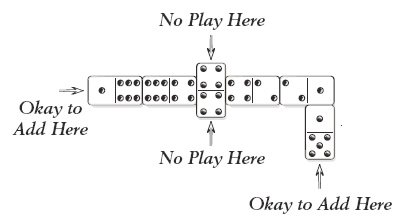
In some versions, the double domino that is played at the beginning of the game, is called “spinner.” After the spinner is played, it is open to play on each end, as well as the two sides, making four lines for play. In these cases the players should know if the spinner has points as it will affect the total calculation. In some scoring rules the spinner does not count for any points and in some rule sets it counts like the other open ends of the layout. It should be clarified before the start of the game.
The Boneyard
In some variations, a player may be penalized for having leftover dominoes after the boneyard is empty. This penalty can either be added to the winner’s score or deducted from the losing players’ total score. It is always advisable to know beforehand these minor rules for smooth gaming experience.
Using a Score Sheet
Keep track of scores correctly by using a score sheet or a piece of paper. Create columns for the names of each player and then note the points after each round. Some people prefer to use tally marks instead of numbers, this is purely up to the player’s convenience. This process helps to ensure transparency and prevents errors.
How to Keep Score: Step-by-Step
Let’s break down exactly how to keep score during a round of dominoes:
- Start the Round: Ensure everyone has their dominoes and that the boneyard is prepared correctly.
- Play Dominoes: Players take turns playing dominoes according to the rules of the particular game.
- Score Points (if applicable):
- For “All Fives,” remember to calculate the totals of the open ends after each play.
- For “Block” or “Draw” dominoes, no points are earned during the round.
- End the Round: A round ends when one player has used all their dominoes or when no further plays are possible.
- Calculate the Scores:
- If someone “goes out,” tally up the value of the dominoes left in other players’ hands.
- Add up the points for the round (if any) and add them to each player’s current scores.
- Record Scores: Write the new scores on the score sheet.
- Start the Next Round: Begin the next round as described above.
Tips for Accurate Domino Scoring
Here are some practical tips to ensure you’re scoring correctly and fairly:
- Double-Check Calculations: Always check your scores to prevent any mistake, especially when playing Muggins. It is very easy to miss the fives multiples while concentrating on playing a good move.
- Designated Scorer: To avoid confusion, it’s useful to appoint a single person to keep track of scores. This individual will focus on scoring, while others can concentrate on their strategies.
- Clear Rules: Make sure everyone understands the specific scoring rules being used before the game begins. This helps prevent arguments later.
- Stay Focused: Pay attention to the game, and always double check the layout for scoring potentials, this helps you get an edge over the other players.
- Don’t Rush: Take your time and make correct calculations. It’s better to be correct than fast.
Remember, dominoes is a fun game, so don’t worry too much about minor scoring errors in the beginning. With practice, you’ll become a whiz at scoring! It may take a couple of tries before you have a strong understanding of the scoring rules, so make sure you keep trying and enjoy your time with your family and friends playing this interesting game. There are many websites and videos that can be really helpful for learning the scoring techniques. Try to use them and practice again and again.
Understanding how to score dominoes is fundamental to enjoying and succeeding in the game. From the straightforward scoring of Block Dominoes to the more complex methods of Muggins, knowing the rules thoroughly will significantly improve your gameplay. So, pick your favorite variation, practice scoring, and soon you will be playing like a seasoned pro! Now that you’ve learned about scoring, you are well on your way to becoming a dominoes master. So, gather your friends, pick a version of game you like and have great time playing dominos.
How to Score in Dominoes all Fives – Learn the Secret to Scoring Big in Dominoes! Part 1
Final Thoughts
Scoring in dominoes involves adding the pip values on exposed ends when you go out or match ends. If no player goes out, the player with the lowest combined pip count wins and scores the difference. Remember, a double is its value twice.
Understanding how to score dominoes game is vital for accurate play. Keep track of the points carefully as it determines the overall winner. Proper scoring ensures fair and enjoyable games.

