
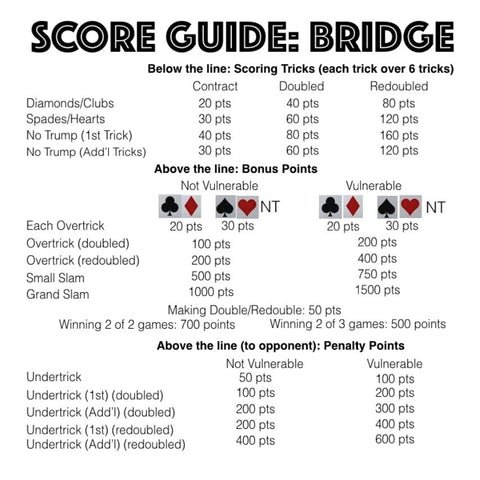
Scoring in bridge involves tallying points based on the number of tricks taken above six, with extra points for making the contract, slam bonuses, and penalties for failing to fulfil the contract.
Ever found yourself lost in the complex world of bridge, especially when it comes to figuring out the final count? Knowing how to score in bridge card game is essential to really enjoying the game. Many players find this part a bit daunting but it really isn’t as difficult as it first appears.
We will break down the essential elements of scoring, making it much simpler to grasp. This guide will focus on the basics of scoring tricks and the associated point values. We will leave out the complexities of complicated bonuses.

How to Score in Bridge Card Game
Okay, let’s dive into the heart of bridge: scoring! It might seem a little complicated at first, but once you get the hang of it, it’s actually quite logical. Scoring in bridge isn’t just about counting tricks; it’s about bidding, making contracts, and even strategic failures. Understanding the scoring system is crucial to becoming a better player. It guides your bidding, influences your card play, and determines whether you win or lose. Let’s break it down step by step so you can confidently add up those points.
Understanding the Basics: Tricks, Contracts, and Vulnerability
Before we can calculate any scores, we need to understand some core concepts. These are the building blocks of bridge scoring.
Tricks
A trick is when each of the four players plays a card, one after the other. The player who plays the highest card in the suit that was led wins that trick. In bridge, you’re always trying to win tricks, but the number of tricks you need to win depends on your contract.
Contracts
A contract is a promise made during the bidding phase. You and your partner, as a pair, try to predict how many tricks you can win. This prediction is your contract. You will need to declare which suit is trumps (if any) or whether you are bidding in Notrump. A contract has two parts: the level (how many tricks you intend to take above six), and the denomination (suit or notrump).
For example, a contract of “3 Hearts” means you promise to win 9 tricks (6 plus the 3 from the contract level), with hearts as trumps. Similarly, “4 Spades” means you are promising to take ten tricks with spades as trump. “2 Notrump” means you are aiming to win 8 tricks without a trump suit.
Vulnerability
Vulnerability is a critical factor in scoring. It represents the risk you and your partner are taking. One pair is vulnerable and one pair is not vulnerable at any time. A vulnerable pair gains or loses more points, which motivates riskier bidding when not vulnerable to gain a better score.
Vulnerability rotates each deal. You become vulnerable after you or your opponents win a game. For example, in rubber bridge, the first pair to two games is a winner, and vulnerability increases risk. In duplicate bridge, vulnerability is pre-set for each deal. We will talk about rubber and duplicate bridge later.
Key Takeaway: Winning tricks is important, but winning the right number of tricks, as promised in a contract, is how you get points. Vulnerability multiplies those points, making bidding even more strategic.
The Building Blocks: Scoring Points for Tricks
Okay, so you’ve bid a contract, and you’ve played out the hand. How do you turn those tricks into points? Here’s a look at how to score points for tricks made and for overtricks (extra tricks above the contract level). Remember that in bridge scoring, points are only awarded when you fulfill the contract. If the pair wins a trick or a trick above the contract but doesn’t fulfill the contract, that goes to the opponents.
Trick Points
Each trick you take in a suit or notrump is worth a certain number of points. The trick points are only scored if you make your contract. The values are:
- Clubs: 20 points per trick
- Diamonds: 20 points per trick
- Hearts: 30 points per trick
- Spades: 30 points per trick
- Notrump: 40 points for the first trick and 30 points for each subsequent trick
Let’s say you successfully bid and make 3 Hearts. You win 9 tricks in total (6 + 3), so you score 3 tricks times 30 points per trick, for a total of 90 trick points.
Overtricks
What happens if you win even more tricks than you promised? Those are called overtricks, and they also add to your score. You will get a set point of overtricks but only if your contract was successful. The scoring for overtricks is identical to the trick points listed above.
For example, imagine you bid and make 3 Spades, but end up winning 10 tricks (4 over your contract). You get 90 points for the contract, plus another 30 for each of the two overtricks for a total of 150 points, before any bonuses.
Undertricks
Now, what if you don’t make your contract? This is where the points go to your opponents. If you fail your contract, you will be penalized. If you do not make your contract, each trick you fall short of your contract is called an undertrick. The number of undertricks determines how many points your opponents get.
The scoring for undertricks is as follows:
- When not vulnerable, opponents score 50 points for each undertrick.
- When vulnerable, opponents score 100 points for the first undertrick, and 200 points for each subsequent undertrick.
For instance, if you bid 4 Hearts (10 tricks), but you only win 8 tricks. You are down 2 tricks. If you are not vulnerable, your opponents score 100 points (50 points x 2). However, if you are vulnerable, your opponents score 300 points (100 points + 200 points x 1).
Key Takeaway: Making your contract earns you trick points and overtrick points. Failing your contract gives undertrick points to your opponents, and the vulnerability adds another level of risk.
Game, Slam and Bonus Points
Beyond trick points, there are several bonus points that can dramatically increase your score. These are usually awarded for making ambitious contracts, taking extra high levels of tricks, and so on.
Game Bonuses
Once you accumulate at least 100 trick points in a given auction, you achieve a “game”. In a rubber bridge, game points do not carry over. Game points in duplicate bridge are counted. When you declare and achieve game, you get an additional bonus.
The bonuses for making a game contract are:
- When not vulnerable: 300 bonus points
- When vulnerable: 500 bonus points
For example, if you bid and make 3 Notrump and are not vulnerable, your score will be 100 trick points(40 +30 + 30) + 300 bonus game points, for a total of 400 points.
Slam Bonuses
Slam bonuses are even bigger than game bonuses. A small slam is won when you take 12 tricks (6 level contract), and a grand slam is won when you take 13 tricks (7 level contract). Slam bonuses are awarded on top of game points, when achieved.
The bonuses for making a slam contract are:
- Small slam:
- When not vulnerable: 500 bonus points
- When vulnerable: 750 bonus points
- Grand slam:
- When not vulnerable: 1000 bonus points
- When vulnerable: 1500 bonus points
For instance, if you bid and make 6 Spades and are vulnerable, you will score the trick points (180, 6×30) plus 500 bonus game points plus 750 bonus small slam points for a total score of 1430 points! Slam points are a big deal.
Partscore Bonuses
Contracts that result in less than 100 trick points are called part scores. You don’t get a game bonus, but if you win a part score, you do receive a bonus of 50 points. This motivates players to bid aggressively even when aiming for small contracts, because a successful part score plus a bonus can lead to winning a rubber.
Key Takeaway: Aim for games and slams for those big bonus points! Part scores are also helpful, as those 50 points make a difference.
Doubled and Redoubled Contracts
Now, let’s discuss the situation when someone “doubles” a contract and what happens when someone “redoubles” a doubled contract. Doubling and redoubling adds excitement to the game and greatly increases the stakes.
What is Doubling?
When an opponent believes that your side will not make the contract that you have bid, they can say ‘double’. When a contract is doubled, the scores of that contract are affected. If the doubled contract is successful, the score for the trick points is increased. If the contract fails, the doubled contract’s undertrick penalty is much higher than if there was no double.
Doubled Trick Points
If you successfully fulfill your doubled contract, you will receive double the points that the trick points are usually worth. If it’s a game contract, you also get your game bonus. In addition to the trick points and game bonuses, a successful doubled contract adds a bonus of 50 points which is called an insult bonus.
For example, if you declare a successful doubled contract of 2 Diamonds, your trick points will be 80 points(2×40), plus an extra 50 points for making a doubled contract, for a total of 130 points.
Doubled Undertricks
On the other hand, if you fail a doubled contract, your opponents receive a much higher penalty for each undertrick.
- When not vulnerable, opponents score 100 points for each undertrick.
- When vulnerable, opponents score 200 points for each undertrick.
If you are not vulnerable and you declare and fail a doubled contract by 1 trick, your opponents score 100 points. If you fail a doubled contract by 3 tricks, your opponents score 300 points. When vulnerable, the penalty is even harsher: if you declare and fail a doubled contract by 1 trick your opponents score 200 points, and by 3 tricks, 600 points.
Redoubled Contracts
After an opponent doubles your contract, your side can “redouble.” Redoubling adds even more to both the reward and the risk. If you make a redoubled contract, the trick points and game bonuses will be worth 4 times the trick point values, with the 50 insult bonus multiplied by 2 for a total of 100 points.
If you fail a redoubled contract, you face the following penalties:
- When not vulnerable, opponents score 200 points for the first undertrick, and 300 points for subsequent undertricks.
- When vulnerable, opponents score 400 points for the first undertrick and 600 points for each subsequent undertrick.
Key Takeaway: Doubling and redoubling can greatly increase the potential scores – both for making a contract and failing it. Use it wisely!
Scoring in Rubber Bridge and Duplicate Bridge
There are two main formats for playing bridge. The main difference in the way to score are the accumulation of scores, specifically, what carries over from one auction to the next. Here is how they differ.
Rubber Bridge Scoring
Rubber bridge is a more casual format and generally played in social settings. In rubber bridge, the pair that wins two games wins the rubber. The game points do not carry over and reset after each hand. When you obtain two games, you get an additional 700 bonus points if the opponents won no games, or 500 bonus points if the opponents won a game.
The first pair to win a rubber gets all the points accumulated in the previous hands, plus the rubber bonus, and the other team does not receive any of the points.
Duplicate Bridge Scoring
Duplicate bridge is a more structured form of the game used in competitions. In duplicate bridge, all pairs play the same hand and scoring is based on comparison. The game is generally scored using matchpoints. Each pair earns a matchpoint for each pair they outscore and half a matchpoint for each pair they tie with. The matchpoints are totaled over the entire session and this determines the winners of that session. There are many forms of duplicate scoring, including IMP (International Match Points), which we will not cover here.
Key Takeaway: Rubber Bridge is game oriented while duplicate bridge is about comparison.
Practical Examples of Bridge Scoring
Let’s walk through some examples to see how all of these rules come together:
Example 1: Making a Simple Game Contract
You and your partner bid and make 4 Hearts (10 tricks), and you are not vulnerable. This is a game, so the score is:
- Trick Points: 4 30 = 120 points
- Game Bonus: 300 points
- Total Score: 120 + 300 = 420 points
Example 2: Making an Overtrick
You and your partner bid 3 Notrump (9 tricks), but you take 10 tricks. You are vulnerable. The score is:
- Trick Points: 40 + 30 + 30 = 100 points
- Overtrick: 30 points
- Game Bonus: 500 points
- Total Score: 100 + 30 + 500 = 630 points
Example 3: Failing a Doubled Contract
You and your partner bid 3 Spades, and you take 7 tricks. You are vulnerable. Your opponents doubled. The score for your opponents is:
- Undertrick Penalty: 200 points (for the first undertrick), plus 200 points for the second undertrick = 400 points.
Example 4: Making a Redoubled Contract
You and your partner bid 2 Hearts. Your opponents double, and you redouble. You win 9 tricks, which is one overtrick, and you are not vulnerable. The score is:
- Trick points: 2 x 30 = 60
- Multiplied By 4: 60 x 4 = 240
- Overtrick points: 30 x 4 = 120
- Insult Bonus: 100 points
- Total Score: 240 + 120 + 100 = 460
Key Takeaway: These examples show how trick points, bonuses, and penalties are applied in real scenarios. It demonstrates the importance of contract bidding and how much the vulnerability matters.
As you can see, scoring in bridge involves more than just adding up tricks. Understanding vulnerability, bonuses, and penalties for doubling and redoubling is very important to maximizing your score. Remember, practice makes perfect, so keep playing and practicing!
How Bridge Scoring Works
Final Thoughts
Scoring in bridge involves tricks won and contract fulfillment. Each trick over six bids gains points; different suit bids have varied point values. A successful contract gives you bonus points, while failing incurs penalties.
Understand vulnerability; it affects scoring significantly. Vulnerable teams gain and lose more. Knowing how to score in bridge card game is crucial for effective play. Proper counting ensures accurate results.

