
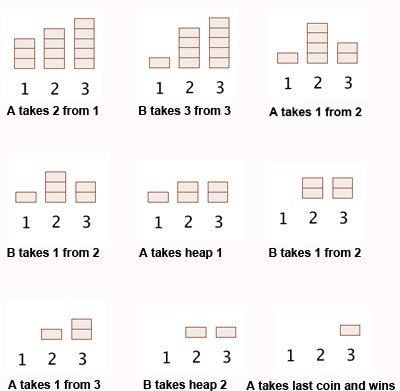
To win Nim game, always aim to leave your opponent with a Nim-sum of zero after your turn.
Have you ever been stumped by a seemingly simple game of matches? Nim can be that game. It appears random, yet a clever strategy always exists. Let’s explore how to win nim game. This strategic game has an underlying logic that makes winning predictable.
The core concept is the “Nim-sum,” which involves a bitwise XOR operation. Understanding this mathematical principle is crucial. Once you grasp the Nim-sum, you control the game’s outcome.

How to Win Nim Game
Okay, let’s talk about the Nim game. It might look simple at first with just piles of objects, but there’s a clever trick to winning every time! This isn’t about luck; it’s about using some cool math. Don’t worry, it’s not super hard math, and we’ll walk through it step by step. We will break down the strategy for you so that you can become a Nim champion!
Understanding the Basics of Nim
Before we get into the winning strategy, let’s make sure we all know the rules of Nim. It’s a game played with multiple piles of objects (like coins, stones, or even cookies!). Here’s how it works:
- Set Up: You start with a few piles of objects. Each pile can have any number of objects you want.
- Taking Turns: Players take turns removing objects. During your turn, you must choose one pile and remove one or more objects from that pile. You can’t take from more than one pile during a turn.
- The Goal: The goal depends on the variation. In the most common version, the player who takes the very last object wins. In another version, the player who takes the last object loses. We’ll focus on the “last object wins” version for now because it’s the most commonly played variation.
Let’s consider an example. Imagine we start with three piles:
- Pile 1: 3 objects
- Pile 2: 5 objects
- Pile 3: 2 objects
The game goes back and forth between the players, each taking objects from a single pile until all are gone, with the player taking the final object winning. It sounds pretty simple, right? It is, until you start trying to figure out how to always win.
The Secret: Binary Numbers and XOR
Now, here’s where the math magic comes in! To win at Nim consistently, you need to understand something called “binary numbers” and a mathematical operation called “XOR.” Don’t worry, it’s simpler than it sounds. Think of it as a secret code for winning!
What Are Binary Numbers?
We usually count in what’s called “decimal” or base-10, where we use the digits 0 through 9. Binary numbers use only two digits: 0 and 1. Computers use binary because it’s easy for them to represent “on” (1) and “off” (0). Here’s how some decimal numbers look in binary:
| Decimal | Binary |
|---|---|
| 0 | 0 |
| 1 | 1 |
| 2 | 10 |
| 3 | 11 |
| 4 | 100 |
| 5 | 101 |
| 6 | 110 |
| 7 | 111 |
| 8 | 1000 |
| 9 | 1001 |
It’s like a different way of counting. Each place in a binary number represents a power of 2. (Right most is 2 to the power of 0, and the next left one is 2 to the power of 1, and so on)
What is XOR?
XOR, or “exclusive or”, is a special operation with binary numbers. It works like this:
- If the two numbers being compared have the same digit (both 0 or both 1), the result is 0.
- If the two numbers being compared have different digits (one 0 and one 1), the result is 1.
Here’s an example:
Let’s XOR two binary numbers, 101 and 011.
- Start by lining the numbers up to make sure each position lines up.
- First, the right-most digits: 1 and 1, because they are both the same, the result is 0
- Next, the middle digits: 0 and 1, because they are different the result is 1.
- Finally, the left-most digits: 1 and 0, because they are different the result is 1.
So, 101 XOR 011 equals 110.
The Nim-Sum: Your Winning Tool
The cool thing is when you XOR the binary representations of each pile’s size in the game, you calculate the “Nim-sum”. This sum is the key to winning. Here’s how it works:
- Convert the size of each pile into its binary representation.
- XOR all the binary numbers together. This gives you the Nim-sum.
- If the Nim-sum is zero, you’re in a losing position (if it’s your turn).
- If the Nim-sum is not zero, you’re in a winning position.
Let’s work through an example. Remember our three piles with 3, 5, and 2 objects?
- Pile 1: 3 objects = 11 in binary
- Pile 2: 5 objects = 101 in binary
- Pile 3: 2 objects = 10 in binary
Now, we will use the XOR operation:
First, we’ll need to line up our binary numbers. Make sure you add leading zeros to any numbers with less digits so that all digits line up.
011
101
010
Now, XOR each column:
- Right-most digits: 1 XOR 1 XOR 0 = 0
- Middle digits: 1 XOR 0 XOR 1 = 0
- Left-most digits: 0 XOR 1 XOR 0 = 1
The Nim-sum is 100 in binary, which is 4 in decimal. This is a non-zero number, so the first player has a winning advantage!
Winning Strategy: Making the Nim-Sum Zero
Okay, so you are in the position where the nim-sum is not zero. How do you use this information to win? The goal is to make the Nim-sum zero every time after your turn. Here’s how:
- Calculate the current Nim-sum.
- Choose a pile: Find a pile where, if you remove some objects, the new Nim-sum will be zero.
- How to find such a pile: Calculate the XOR operation between the nim-sum and each pile size. The pile that results in a smaller number than its original size, is the pile to use. Remove enough objects from it to make it the new size.
Let’s take an example again. Imagine we have three piles of 7, 5, and 3. Let’s go through the steps:
- Pile 1: 7 = 111
- Pile 2: 5 = 101
- Pile 3: 3 = 011
The current Nim-sum is:
111
101
011
= 001 (1 in decimal)
Since the Nim-sum is not zero we are in a winning position! Here’s how to find which pile to change, so that after our change, the new Nim-sum will be zero.
- XOR the Nim-sum (001) with the first pile (111) = 110 (6 in decimal) , which is less than 7. Pile 1 is a potential candidate.
- XOR the Nim-sum (001) with the second pile (101) = 100 (4 in decimal), which is less than 5. Pile 2 is a potential candidate.
- XOR the Nim-sum (001) with the third pile (011) = 010 (2 in decimal), which is less than 3. Pile 3 is a potential candidate.
Any of these piles are viable options, lets work with the first pile. Since the result of the XOR operation was 6, we have to change the pile with 7 objects to have 6 objects instead, so we must take 1 object from the first pile. Now let’s check the new nim-sum:
- Pile 1: 6 = 110
- Pile 2: 5 = 101
- Pile 3: 3 = 011
The new Nim-sum:
110
101
011
= 000 (0 in decimal)
The Nim-sum is now zero! No matter what your opponent does, you should be able to make the Nim-sum zero on your next turn, until the game ends. This allows you to force the win!
The Losing Position
If the Nim-sum is zero when it is your turn, then no matter what move you do, you are unable to make the Nim-sum zero. Your opponent can then play optimally and make the Nim-sum zero each time on their turn until they win. This puts you in a losing position. The key, therefore, is to try to leave your opponent with a Nim-sum of zero before their turn begins.
Special Cases: Single Pile and Two Piles
Let’s look at two special cases: when you have just one pile and when you have two piles.
Single Pile
If there’s only one pile, the player whose turn it is simply takes all of the remaining objects. They win! This is the simplest winning situation you can have.
Two Piles
If you have two piles of equal size, then whoever goes first always loses, as they will inevitably make the two piles unequal, and their opponent will equalise on their turn. The best course of action in this situation is to always take the number of objects to equalize the two piles. If they were unequal, the first player can simply remove objects from the bigger pile to make them equal, and then equalise again on their next turn and win!
Practice Makes Perfect
Like any skill, winning at Nim takes practice! Here are a few ways you can get better:
- Play Against a Friend: Try using small objects like buttons or paper clips. This is the best way to practice.
- Use Online Tools: There are online Nim games you can play. This allows you to play against an AI, which may be more skilled and more challenging.
- Start Small: Begin with smaller numbers of piles and objects to get a feel for the Nim-sum, then slowly increase complexity.
Advanced Strategies and Variations
Once you are comfortable with the basics, you can explore some more complex strategies and different game variations. For example:
Misère Nim
In this version, the goal is to avoid taking the last object. The winning strategy is the same, except that if you are left with all piles of size 1 you must take a move that leaves an odd number of 1s. If you do not do this, you will be unable to make the nim sum equal to zero on your next turn, resulting in a loss.
More Complex Pile Arrangements
Try playing Nim with lots of piles of varying sizes. This will really test your abilities. You can also change things like adding extra rules, or different winning/losing conditions, to challenge you even further!
Nim might seem simple on the surface, but with a bit of practice, you will become able to beat almost anyone! Using the binary number system and the XOR operation will allow you to become a master of this game. Remember, the key to winning Nim is to manipulate the nim-sum so that it is equal to zero at the start of your opponent’s turn. Once you can do this consistently, victory will be yours!
The Game of Nim – a math game of strategy using matchsticks!
Final Thoughts
To win Nim, calculate the XOR sum of all pile sizes. If the sum is zero, you are in a losing position. The key is to leave your opponent with a zero XOR sum on their turn.
Choose a pile and remove stones to achieve this zero sum after your move. A bit of practice helps recognize patterns and makes achieving this goal easier.
This strategy ensures you consistently create positions that lead to your victory. The approach demonstrates how to win nim game, by leaving opponents with a losing position.

