
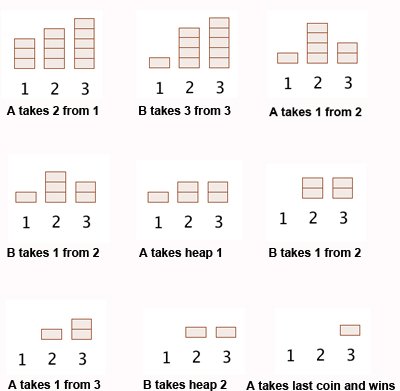
To win the Nim game, calculate the XOR sum of the number of objects in each pile. If this XOR sum is zero, you are in a losing position, otherwise a winning position. Make a move that results in a zero XOR sum for your opponent.
Ever played a game that seems simple but hides a clever strategy? That’s Nim. It’s a mathematical game of removing objects from piles, and understanding the core principle is key if you want to learn how to win the Nim game.
It might appear to be pure luck, but there is indeed a method. The secret revolves around something called the XOR operation, which we’ll break down simply. It’s about more than just chance, it’s about calculations.

How to Win the Nim Game: A Simple Guide to Strategic Play
Nim might sound like a funny word, but it’s actually the name of a super cool math game. Don’t let the “math” part scare you, though! It’s really all about patterns and strategy. This article will show you how to play Nim like a pro, using simple tricks to guarantee you win every time. We will talk about the basic rules, the secret behind winning, and how to apply this secret to always be the champion. So, get ready to become a Nim master!
Understanding the Basics of Nim
Before we dive into winning strategies, let’s make sure we all know how the game works. Nim is played with rows of objects. These objects can be anything – coins, pebbles, matchsticks, you name it. The important thing is that you have several rows, each with a different number of items.
Here’s how a typical game might look:
Row 1: 5 coins
Row 2: 3 coins
Row 3: 1 coin
The goal of the game is simple: avoid taking the last object. Two players take turns removing items. On your turn, you can pick any row and take away as many objects as you want from that row, from just one object to all of them, it is completely up to you how many items you want to take. The player who takes the very last item loses the game.
Example of a Nim Turn
Let’s look at our example.
Player 1 could take 2 coins from Row 1, leaving 3 coins there.
Player 2 could take 1 coin from Row 2, leaving 2 coins.
And so on, the players will continue to play.
Remember, you have to choose only one row for taking object in each turn. You can’t take coins from two different rows in a single turn. It’s that easy!
The Secret to Winning: Binary Numbers and XOR
Okay, here is the magical part. To win at Nim, you need to understand something called “binary” numbers and the “XOR” operation. Don’t worry, it sounds way more complicated than it is!
Binary Numbers Explained
Normally, we use numbers based on ten (like 1, 2, 3, 10, etc.). That’s called base ten, or decimal. Binary is base two, meaning it only uses 0 and 1. In binary, the numbers are represented differently:
0 is still 0
1 is still 1
2 is 10 (which is 1 two and 0 ones)
3 is 11 (which is 1 two and 1 one)
4 is 100 (which is 1 four, 0 twos, and 0 ones)
5 is 101 (which is 1 four, 0 twos, and 1 one)
6 is 110 (which is 1 four, 1 two, and 0 ones)
7 is 111 (which is 1 four, 1 two, and 1 one)
8 is 1000 (which is 1 eight, 0 fours, 0 twos, and 0 ones)
Do you see the pattern? It’s like a secret code! You can find plenty of online binary calculators if you need help converting between our everyday numbers and binary numbers.
Understanding the XOR Operation
XOR is a special operation between two binary numbers. Here’s how it works:
If the bits (that’s the 0s and 1s) are the same (both 0 or both 1), the XOR result is 0.
If the bits are different (one 0 and one 1), the XOR result is 1.
Here’s a table for a quick reference:
| Bit 1 | Bit 2 | XOR Result |
|—|—|—|
| 0 | 0 | 0 |
| 0 | 1 | 1 |
| 1 | 0 | 1 |
| 1 | 1 | 0 |
We will XOR all rows values to find nim-sum.
Nim-Sum: The Key to Winning
Okay, this is where the magic happens! Here’s the secret to winning at Nim:
1. Convert the number of objects in each row to binary.
2. XOR all of the binary numbers together, just as discussed before. This result is called the “nim-sum”.
3. If the nim-sum is zero, it means that you are in a losing position in nim. It also means that if your opponent takes the last coin, then this is a winning state for the opponent.
4. If the nim-sum is not zero, it means you are in a winning position, you just have to play correctly.
The goal is always to make the nim-sum zero at the end of your turn. If you do this every time, you’ll force your opponent into a losing position and ultimately win the game!
Putting the Strategy Into Practice
Let’s go through some examples.
Example 1: A Losing Position
Let’s say you have the following:
Row 1: 3 coins
Row 2: 2 coins
Row 3: 1 coin
1. Convert to Binary:
3 is 11
2 is 10
1 is 01
2. XOR them together:
11 (3)
10 (2)
01 (1)
—
00 (nim sum)
3. The nim-sum is 0, that means you are in a losing position. It doesn’t matter what move you make, if you are not playing against a beginner, you will ultimately lose.
Example 2: A Winning Position
Let’s say the game looks like this:
Row 1: 5 coins
Row 2: 3 coins
Row 3: 1 coin
1. Convert to Binary:
5 is 101
3 is 011
1 is 001
2. XOR them together:
101 (5)
011 (3)
001 (1)
—
111 (7)
3. The nim-sum is 7, which is not zero. This means you have a winning chance. What you need to do is to find a move that will force the nim-sum to zero.
Finding The Winning Move
So, how do you find that magic move that will turn the nim-sum into zero? It’s not that difficult!
1. Check each row. Look at the binary representation of each row.
2. XOR the current nim-sum with each row individually . If the result of that XOR is less than the current number of objects in that row, then that is your winning row to change.
3. Subtract the objects required to obtain the XOR result.
Let’s go back to the previous example:
Current nim-sum is 7 (111)
Rows:
Row 1: 5 (101)
Row 2: 3 (011)
Row 3: 1 (001)
Let’s go through each row, checking if we can make a winning move:
Row 1 (5): 7 XOR 5 = (111 XOR 101) = 010 which is 2, and 2 < 5. This means we can make a move on row 1. If we decrease the number of coins on row 1 to 2, it will become the winning move.
Row 2 (3): 7 XOR 3 = (111 XOR 011) = 100 which is 4, and 4 > 3. This is not our move.
Row 3 (1): 7 XOR 1 = (111 XOR 001) = 110 which is 6 and 6 > 1. This is not our move.
If we change the row 1 from 5 to 2, now the game looks like this:
Row 1: 2 coins
Row 2: 3 coins
Row 3: 1 coin
The nim-sum calculation will be:
1. Convert to Binary:
2 is 010
3 is 011
1 is 001
2. XOR them together:
010 (2)
011 (3)
001 (1)
—
000 (0)
The nim-sum is now 0 and this means it’s a losing position for your opponent. If you can do this every turn you will win the game, you will force your opponent into a losing position by making the nim-sum zero on his turn.
Practice Makes Perfect
The best way to get good at this is to practice. Set up simple Nim games with friends or family, and try to predict the outcome before you make your moves. Use these methods to learn the steps of how to convert to binary, and calculate the nim-sum. The more you play, the better you’ll become at quickly spotting winning and losing situations.
Variations of Nim
Just when you thought you knew everything about Nim, here are some fun twists! There are variations of Nim out there.
Misère Nim
In this version, the rules are the same, but the person who takes the last object is the winner, not the loser. So, it is completely the opposite of the original rules. The strategy for Misère Nim is almost identical to the original Nim, with a small adjustment at the very end. You calculate nim-sum as usual, and try to reach the nim-sum as zero, as usual. The difference is you will try to not leave only 1 item on any rows, but rather only 0 or more then 1 items on at least one row. When you approach the final part of the game, where only 1s are on some of the rows, you just have to play correctly.
Multi-Pile Nim
Multi-Pile Nim is like the regular Nim, but with a lot more piles (rows). The same strategy with calculating the XOR and nim-sum works here too. It can be a bit more complex because there are more numbers to keep track of, but the core idea remains the same.
Nim with Constraints
Sometimes, a constraint is added to the game. You might be limited to how many items you can take on a row, for example. In these cases, the calculations can get tricky, but the fundamental principle of nim-sum is still useful, but you can’t apply as easily. The best thing is to keep practicing.
Tips for Becoming a Nim Champion
Practice Binary Conversion: Get really comfortable converting numbers into binary. The faster you can do this, the faster you can calculate the nim-sum.
Visualize: When you see a setup of objects, try to visualize the binary equivalents. This will help you to spot good or bad situations quickly.
Think Ahead: When making a move, don’t just think about this move, try to think how it will change the whole game, and how your opponent is going to be playing.
Don’t Give Up: At first, calculating the XOR might be challenging, but as you keep playing, it will be easier.
Keep it Simple: Sometimes, a simple game will give you the most practice. Don’t rush to more difficult variations, master the basics, and the rest will follow.
Remember, the beauty of Nim is that it seems simple, but has a very deep and powerful secret that is easy to learn. The more you practice and understand these secrets, the more wins you’ll have.
So, now you know the secret how to win every single game of Nim. Play smart, think logically, practice binary conversion, and always remember to aim for a nim-sum of zero at the end of your turns. Now go become a Nim champion!
The Game of Nim – a math game of strategy using matchsticks!
Final Thoughts
To win the Nim game, calculate the XOR sum of all pile sizes. If the sum is zero, you face a losing position. Aim to leave your opponent with a zero XOR sum at each turn.
A winning strategy involves adjusting the pile size to make the XOR sum zero. This ensures your opponent always inherits a losing position, and you will eventually win. The core concept of how to win the Nim game revolves around this XOR calculation.

