
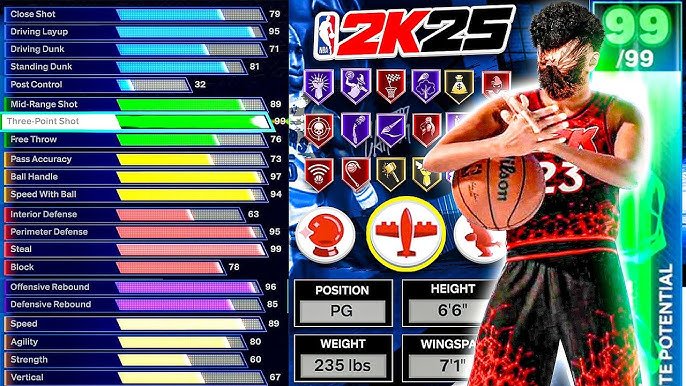
Effective NBA 2K25 player building techniques involve strategically allocating attribute points, selecting appropriate badges, and choosing the right body type to create a player that fits your desired play style.
The latest NBA 2K installment is here, and everyone is eager to make their mark on the virtual court. Getting your MyPlayer just right is crucial, because it impacts how well you can perform in various modes. Figuring out effective NBA 2K25 player building techniques can be daunting, and many people search for the best way to create their unique player.
Creating the best build requires careful planning of your player’s attributes. It’s not simply about maxing out everything. Instead, you must think of a defined play style and then boost the attributes that support it. This makes you a powerful asset on the virtual basketball court.

NBA 2K25 Player Building Techniques
Alright, future basketball legends! So you’re ready to dive deep into NBA 2K25 and create a player that’s truly your own? It’s not just about picking a position and hitting the court; it’s about crafting a virtual baller who fits your playstyle, wreaks havoc on opponents, and dominates the game. We’re going to explore all the important parts of making your dream player, making sure you know how to make the best possible build. Let’s get started!
Understanding the Basics: Archetypes and Attributes
Before we get into the nitty-gritty, it’s important to understand the building blocks. In NBA 2K25, your player starts with an archetype. Think of an archetype as a blueprint for your player. It determines your basic strengths and weaknesses, and what kinds of skills your player will be good at. For example, a “Playmaking Shot Creator” will be great at dribbling and shooting, while a “Glass Cleaning Finisher” will be a beast on the boards and close to the basket.
Along with archetypes are attributes, these are the numbers that determine how well your player performs in different areas of the game, such as:
- Shooting: How well you shoot the ball from different areas, like three-pointers and mid-range jumpers.
- Finishing: How good you are at scoring near the basket, including layups and dunks.
- Playmaking: Your ability to handle the ball, pass accurately, and create scoring opportunities.
- Defense: How well you guard opponents, steal the ball, and block shots.
- Rebounding: Your skill at grabbing the ball after a missed shot, on both offense and defense.
- Physicals: Your speed, strength, stamina, and vertical jump.
Each archetype has specific areas where its attributes are high to start, and areas where its attributes are lower to start. The goal is to build around your chosen archetype to make a player that feels right for you. It’s like having a character class in a role-playing game – each one has different strengths and weaknesses.
Choosing the Right Archetype
Picking the right archetype is a very important first step. You should consider a few things before you make a choice. Here’s a more detailed breakdown:
Playstyle Preferences
What kind of player do you want to be on the court? Do you envision yourself hitting threes from way out, driving to the hoop, setting up teammates, or stopping the other team’s best player? Your playing style should be the first thing you think about before picking an archetype. If you are a pass-first player, a playmaking-oriented archetype makes sense. If you are more of a score-first player, then a sharpshooter or slasher archetype might be a better choice.
Understanding Archetype Strengths and Weaknesses
Every archetype has its own set of strengths and weaknesses, so it’s very important that you understand them well.
For example:
- Sharpshooters are amazing at shooting but may not be as good at driving to the basket.
- Playmakers are good at passing and handling the ball but may not score easily.
- Slashers are great at scoring inside but might not be good three point shooters.
- Defensive Anchors excel on defense and grabbing rebounds, but may be limited in scoring abilities.
Make sure you know the tradeoffs you’re making before committing to an archetype. Consider how well your archetype matches your personal playstyle, while also addressing any weak spots you may have as a player.
Experimentation and Testing
Don’t be afraid to try out different archetypes. The best way to know what works for you is to spend time with each. Take the opportunity to test out archetypes that are interesting to you before you start investing in one player. It’s better to try out a few builds, and then move forward with what works for you. You can practice with different archetypes in the game’s practice mode, or start a new career and test it out in a few early matches.
Attribute Distribution and Badge Selection
Once you’ve settled on an archetype, you’ll need to distribute your attribute points wisely. You can’t be great at everything, so focus on the attributes that complement your archetype and playing style. This is where you’ll start to mold your player to really fit your game. The goal is to find the right balance for your player.
Prioritizing Key Attributes
Not all attributes are created equal. Some will be more important for your specific archetype than others.
For example:
- If you’re a sharpshooter, you’ll want to focus on attributes like three-point shooting, mid-range shooting, and ball handle.
- If you’re a slasher, your priority should be driving layup, driving dunk, and ball handle.
- For a playmaker, attributes like pass accuracy, ball handle, and speed with ball will be extremely important.
- If you want to play defense, pay attention to your perimeter defense, steal, block, and interior defense skills.
Don’t just look at the overall rating, pay attention to which attributes will be most beneficial to your role on the team. Don’t be afraid to boost important attributes first, as this will affect how your player will actually perform in games. Also consider your playing habits. For example, if you mostly play in the park, prioritize your attributes for fast action, but if you play in MyCAREER, pay attention to a well rounded player.
Balancing Attributes
While focusing on key attributes is important, don’t neglect other areas. A well-rounded player is typically better than someone who is excellent in one area but terrible in others. For example, if you’re building a sharpshooter, you can’t ignore ball-handling and speed, because without it, you will struggle getting open. Likewise, a slasher needs some midrange to be effective. Try to find a nice balance that makes your player effective in many situations.
Understanding Badges
Badges are special abilities that improve your player’s performance in certain areas. They’re like superpowers for your player. Choosing the right badges can really make a difference between a good player and an amazing one.
Here’s a look at the different badge categories:
- Finishing: These badges help you score around the basket, with things like better dunks and layups.
- Shooting: These badges make your shots more accurate and help you make more difficult shots.
- Playmaking: These badges improve your dribbling, passing, and ball-handling skills.
- Defense/Rebounding: These badges help you stop opponents, steal the ball, and grab rebounds.
Focus on the badges that fit your playing style and your archetype. For example, a sharpshooter should prioritize shooting badges like “Catch & Shoot” and “Limitless Range,” while a slasher will want “Slithery Finisher” and “Giant Slayer.” It’s important to also consider how different badges work together, to create a very effective player.
Body Settings: Height, Weight, and Wingspan
Body settings may not seem that important, but they have a huge impact on your player’s capabilities. Height, weight, and wingspan will influence things like speed, strength, and reach. Let’s see how each one will affect your gameplay.
Height
Height affects your player in multiple ways. Taller players have an advantage when grabbing rebounds and blocking shots, but they will be slower and more clumsy. Shorter players will be faster and can make quick plays, but may struggle when matched up against bigger opponents. You need to find the right balance for your position and play style.
Weight
Weight affects your player’s strength and speed. Heavier players are more difficult to push around, making them better at setting screens and grabbing rebounds. However, they will be slower. Lighter players will be quicker and more agile, but may struggle against stronger players. Again, choose what works best for your game. If you are a big player, you can add weight to defend the post and get rebounds, but if you are a guard, you will want to be quicker.
Wingspan
Wingspan is the distance between your player’s fingertips when his arms are stretched. A longer wingspan helps with rebounding, steals, and block, but it can reduce your ball handle and shooting abilities. A shorter wingspan improves handling and shooting, but it can cause you to struggle to defend. Carefully consider what you want your player to be able to do best.
Takeovers and Animations
Takeovers are special abilities that your player can use once they fill up their takeover meter during a game. Different takeovers give you short boosts to a particular attribute or skill, such as improved shooting or defense. Animations are the movements your player makes, and they really impact how the player feels and plays. You should always choose takeovers and animations that fit your playing style.
Choosing the Right Takeover
The choice of takeover should match how you play in the game. For example, if you’re a sharpshooter, a takeover that boosts your shooting stats, like “Spot Up Shooter” or “Shot Creator,” would be best. If you are an all-around player, an “All Around Playmaker” or “Slasher” takeover may be a good option. Choose a takeover that helps you maximize your player’s strengths. Takeovers can make a big difference in a game, so make sure you get it right.
Animations: The Key to Smooth Gameplay
The right animations can make your player feel more responsive and smooth. Pick animations that match your style. For example, if you like to dribble, choose animations that make it easier to do so. If you like to dunk, pick dunk animations that fit your style. Test out different animations and pick the ones that feel the best for you. The animations that you pick may not seem important, but they influence the way your player moves and feels on the court, so pay attention to this aspect.
Testing and Adjusting Your Build
Building a player in NBA 2K25 is not a “one and done” kind of situation. You’ll probably need to test your builds, and make small adjustments until you are completely satisfied. This is where the MyCAREER practice facility becomes really useful.
Utilizing the Practice Facility
The practice facility is a crucial tool for testing your player. You can try out different moves, practice your shots, and get a feel for your attributes and badges. It’s a safe place to make adjustments before going into a real game. The practice facility can help you identify strengths and weaknesses in your build, and let you make any needed adjustments before competing against other players.
Making Small Adjustments
Once you start playing games, pay attention to how your player performs. If you notice that you struggle to make shots, you can go back and improve shooting attributes and badges. If you are slow, you may need to adjust your weight and focus on getting speed-boosting attributes and badges. You can continue to make small adjustments to improve your build as you play. Don’t be afraid to go back to make small changes in attributes, badges and body settings.
Community Feedback and Resources
There are many resources available online with tips and tricks from the NBA 2K25 community. Pay attention to forums, YouTube videos, and other community resources to see how other people are building their players. You can use this to find creative new builds, or learn ways to improve your existing builds. It’s a great way to learn from others and improve your own approach.
The Final Step: Play and Have Fun
With a good strategy and these tips, you can build the best player to fit your specific playstyle. Building a player is a process of learning, experimenting, and testing. Have fun with it, and most importantly, enjoy the process!
So, there you have it. Building the best player in NBA 2K25 is a blend of strategy, understanding, and a lot of testing. Don’t be afraid to try different things and find what works best for you. Remember, the goal is to have a player that feels good for you to play with, and that you have fun controlling. It’s your player, make it your way and start dominating the court!
TOP 3 BUILDS IN NBA 2K25! Best ALL-AROUND GUARD & CENTER BUILDS! Best Build NBA 2K25!
Final Thoughts
Experiment with different attribute combinations and badges to find your optimal playstyle in NBA 2K25. Consider the importance of position and skillset when crafting your player. Different archetypes will excel in particular roles, so plan accordingly.
Properly allocate attribute points and choose the right badges. These choices drastically impact performance on the court. Understanding the significance of each rating is key to success with NBA 2K25 player building techniques.
Ultimately, consistent testing and adjustments based on your gameplay are vital to create a powerful and effective player. Player builds require careful planning and a willingness to adapt for best results.

