
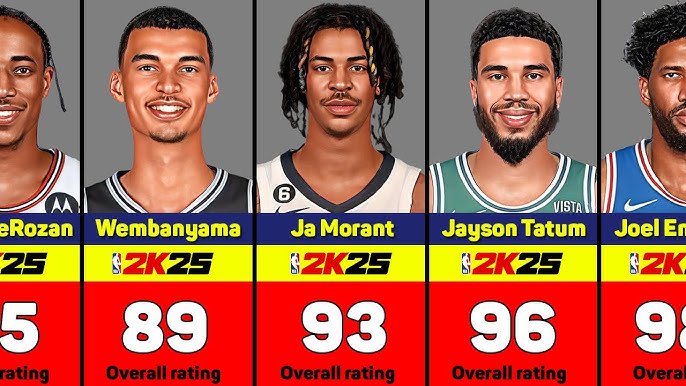
NBA 2K25 statistical comparisons reveal how player attributes stack up against each other, impacting gameplay strategies and team composition.
Figuring out which players reign supreme in NBA 2K25 is crucial for victory. Gamers constantly analyze player data. Knowing the subtle differences in stats helps you build the most competitive squad. These NBA 2K25 statistical comparisons are the key to understanding how to dominate the virtual court.
This detailed breakdown allows you to pinpoint strengths and weaknesses. This will let you make smarter decisions about your playstyle. Dive into the numbers to get a real edge!

NBA 2K25 Statistical Comparisons: Diving Deep into the Numbers
Okay, basketball fans! We’ve all been hyped about NBA 2K25, right? The shiny new graphics, the cool gameplay – it’s all amazing. But, let’s be real, a huge part of what makes these games so much fun is digging into the stats. How does your favorite player stack up against the legends? Who are the hidden gems with killer attributes? This deep dive into NBA 2K25 statistical comparisons will give you the inside scoop.
Understanding the Core Attributes
Before we get into specific player matchups, let’s break down the main attributes that 2K uses. These are the building blocks of every player’s game, and understanding them is key to figuring out who’s truly dominant.
Shooting Skills
This category includes:
- Close Shot: How good a player is at scoring right near the basket.
- Mid-Range Shot: The ability to make shots from the elbow area and baseline.
- Three-Point Shot: How accurately a player can nail those deep shots.
- Free Throw: A player’s skill at making shots from the free-throw line.
- Shot IQ: How well a player selects appropriate shots, without forcing poor attempts.
Playmaking Abilities
This category includes:
- Ball Handle: A player’s ability to dribble effectively and avoid turnovers.
- Passing Accuracy: The ability to deliver passes with precision to teammates.
- Passing Vision: How well a player sees openings and potential passing lanes.
- Speed With Ball: How fast a player can move while dribbling.
- Pass IQ: How well a player identifies the correct receiver while passing.
Athleticism and Defense
This category includes:
- Speed: A player’s quickness across the court.
- Acceleration: How fast a player can reach their top speed.
- Vertical: The ability to jump high for rebounds or dunks.
- Strength: Physical power and ability to muscle through defenders.
- Interior Defense: A player’s skill in guarding opponents near the basket.
- Perimeter Defense: A player’s effectiveness guarding players on the outside.
- Steal: A player’s success in taking the ball from opponents.
- Block: A player’s ability to prevent a shot with a block.
- Lateral Quickness: Speed while moving sideways, crucial for defending drives.
Rebounding and Physicals
This category includes:
- Offensive Rebound: A player’s ability to grab missed shots on the offensive end.
- Defensive Rebound: A player’s skill at gaining rebounds on the defensive side.
- Stamina: How much a player can play before getting tired.
- Durability: How well a player can avoid injuries.
Comparing Player Archetypes
Now that we have a grasp on the basic attributes, let’s examine how different player types stack up against each other. Each archetype has strengths and weaknesses that impact how they play in the game. Understanding these differences can help you build a well-rounded team.
Point Guards: The Floor Generals
Point guards are typically the playmakers, orchestrating the offense. In NBA 2K25, they usually excel in:
- Ball Handling
- Passing Accuracy
- Speed and Acceleration
- Perimeter Defense (especially the good ones!)
Key stats to compare for point guards include their playmaking badges, three-point rating, and speed with ball. A great point guard can create shots for themselves and their teammates. Think players like Stephen Curry or Ja Morant; their stats reflect their ability to control the game.
Shooting Guards: The Scoring Machines
Shooting guards are all about offense. Their stats often highlight:
- Three-Point Shooting
- Mid-Range Shooting
- Driving and Finishing
- Perimeter Defense
When looking at shooting guards, pay close attention to their shooting badges, their ability to create separation, and their speed. Players like Klay Thompson or Devin Booker are examples of top-tier scoring threats at this position.
Small Forwards: The Versatile Threats
Small forwards are the most versatile players, often with well-rounded stats that include:
- Scoring (all ranges)
- Rebounding
- Perimeter and Interior Defense
- Some Playmaking
Look for small forwards who have balanced stats across various categories. They can score, defend, and sometimes handle the ball effectively. Players like LeBron James or Kawhi Leonard exemplify the two-way impact of a great small forward.
Power Forwards: The Inside Muscle
Power forwards are usually about strength and hustle, excelling in:
- Rebounding (both offensive and defensive)
- Interior Scoring
- Interior Defense and Blocking
- Mid-Range Shooting
The best power forwards are physical and can dominate the paint. Look for those with high rebounding, interior defense, and strength ratings. Think of players like Anthony Davis or Zion Williamson who can make a major difference with their athleticism and strength.
Centers: The Anchors
Centers are the last line of defense and the key to rebounding. Their defining stats include:
- Rebounding
- Interior Defense and Blocking
- Post Scoring
When examining centers, focus on their rebounding, block, and interior defense ratings. Dominant centers can completely change a game with their presence in the paint. Examples include players like Joel Embiid or Nikola Jokic who are great scorers and rebounders.
Specific Player Comparisons: Legends vs. Today’s Stars
Now for the fun part! Let’s compare some specific players from different eras and see how they measure up in NBA 2K25. This helps give context to how different players, across generations, translate in a digital basketball setting.
Michael Jordan vs. LeBron James
This is a debate for the ages! In NBA 2K25, both Jordan and James are elite, but their stats reflect different styles:
Michael Jordan:
- Higher Mid-Range and Close Shooting: He’s the master of fades and dunks.
- Higher Steal and Lateral Quickness: Reflecting his defensive prowess.
- Slightly Lower Playmaking: He’s more of a scorer than a facilitator compared to James.
LeBron James:
- Higher Playmaking and Passing Accuracy: The primary ball handler, always making his team better.
- Slightly Better Strength and Rebounding: He’s a physical beast all around.
- Well-Rounded Scoring: Excellent at all three levels of scoring, making him a tough matchup.
The Takeaway: Jordan is the ultimate scoring machine and a great defender, while James is a well-rounded player who excels at both scoring and making his teammates better.
Stephen Curry vs. Damian Lillard
These two are the kings of deep threes. Let’s see how their stats compare:
Stephen Curry:
- Extremely High Three-Point Rating: Unmatched in his ability to shoot from distance.
- High Ball Handling and Speed With Ball: He’s a threat to pull up off the dribble at any time.
- Good Passing Vision: Not just a shooter, he can also facilitate.
Damian Lillard:
- Excellent Three-Point Rating: A clutch shooter, especially from deep.
- High Scoring and Shot IQ: Always dangerous in late-game situations.
- Good Ball Handling: Able to create his own shot with his dribble moves.
The Takeaway: Curry is the more consistent high-volume shooter, while Lillard is the go-to scorer when things are tight. Both have killer range and a knack for the highlight reel.
Shaquille O’Neal vs. Joel Embiid
A comparison of dominant centers from different eras:
Shaquille O’Neal:
- Extremely High Interior Scoring and Strength: Dominant in the paint.
- High Rebounding: A major presence on the boards.
- Lower Free Throw Rating: A known weakness in his game.
Joel Embiid:
- High Post Scoring: Very efficient in the low post.
- Very Good Rebounding: An amazing rebounder who creates second chances.
- Solid Mid-Range Game: Can step out and hit shots.
The Takeaway: O’Neal is the more imposing paint scorer, while Embiid has a more polished all-around offensive game with better mid range and free throw skills. Both are forces to be reckoned with in the paint.
Analyzing Badges and Their Impact
Beyond core stats, badges play a huge role in how players perform. Badges are special abilities that boost a player’s skills. They help separate good players from great players. Here are some crucial badge categories and examples:
Shooting Badges
- Green Machine: Boosts your ability to make consecutive shots.
- Limitless Range: Extends the range of your three-point shots.
- Catch & Shoot: Makes your catch-and-shoot attempts more effective.
Playmaking Badges
- Ankle Breaker: Improves your ability to create separation with dribbling moves.
- Quick First Step: Helps you accelerate quickly out of dribble moves.
- Dimer: Boosts the accuracy of your passes to open teammates.
Defensive Badges
- Intimidator: Forces opponents to miss shots when you are defending them.
- Interceptor: Increases your chance of getting steals in passing lanes.
- Rebound Chaser: Improves your ability to secure rebounds.
Finishing Badges
- Slithery Finisher: Helps you move through traffic to the rim.
- Posterizer: Increases your chance of making dunk over defenders.
- Fearless Finisher: Helps you finish better at the rim through contact.
Understanding how these badges complement a player’s stats is important. A player with a high three-point rating and “Limitless Range” is far more dangerous than a player with the rating alone.
Using Statistical Comparisons to Your Advantage
So, why should you care about all this statistical stuff? It’s simple: Understanding player attributes and badges allows you to:
- Build Better Teams: Don’t just choose the highest-rated players. Pick players that fit your playing style and your team’s needs.
- Identify Hidden Gems: Some players might not have the highest overall rating but possess very useful specific skill stats and badges that can make a big impact for your team.
- Exploit Matchups: Recognize when you have an advantage based on the stats of your players compared to your opponents, this also helps you choose the best plays to run.
- Improve Your Game: By understanding what skills are important, you can focus on using your players’ best abilities and hide their weaknesses.
For example, if you like to play fast and use a lot of three-point shots, you should pick players with high speed with ball, three-point ratings, and shooting badges, instead of just picking the highest-rated players, and vise versa for other playstyles.
Advanced Stats: Going Beyond the Basics
For the real stat nerds out there, NBA 2K25 has even more data to explore. Advanced stats like PER (Player Efficiency Rating), true shooting percentage, and win shares offer a deeper look at player impact. These stats provide a more comprehensive view of a player’s all-around performance, and how they contribute to winning games. They factor in many variables and present a more clear picture of a player’s effectiveness. By looking at these more advanced statistical categories, you can discover some surprising insights and use them to build better teams.
Ultimately, NBA 2K25 is a game that rewards deep statistical analysis. By understanding the core attributes, player archetypes, specific player comparisons, badges, and advanced stats, you can get the most out of the game and dominate the virtual court!
So, get out there, study the numbers, build your dream team, and remember to keep learning! Every player and team has unique traits; understanding and utilizing their advantages while minimizing their weaknesses is the key to becoming a true champion. Good luck!
NBA2K25 Top 10 Ratings Released 🚨👀
Final Thoughts
Ultimately, diving deep into NBA 2K25 statistical comparisons reveals crucial player strengths and weaknesses. Comparing attributes allows you to strategize effectively, whether building a franchise or dominating online.
Players should use data to refine their gameplay and make informed decisions. It provides a better understanding of how different players actually perform.
Careful analysis of NBA 2K25 statistical comparisons is a must for anyone seeking a competitive edge in the game. This knowledge translates to smarter team building and on-court execution.

