Home » Play Games » Daily Cryptogram
Tap a letter tile, then tap a key • ✔ Check is free • 💡 3 hints per puzzle
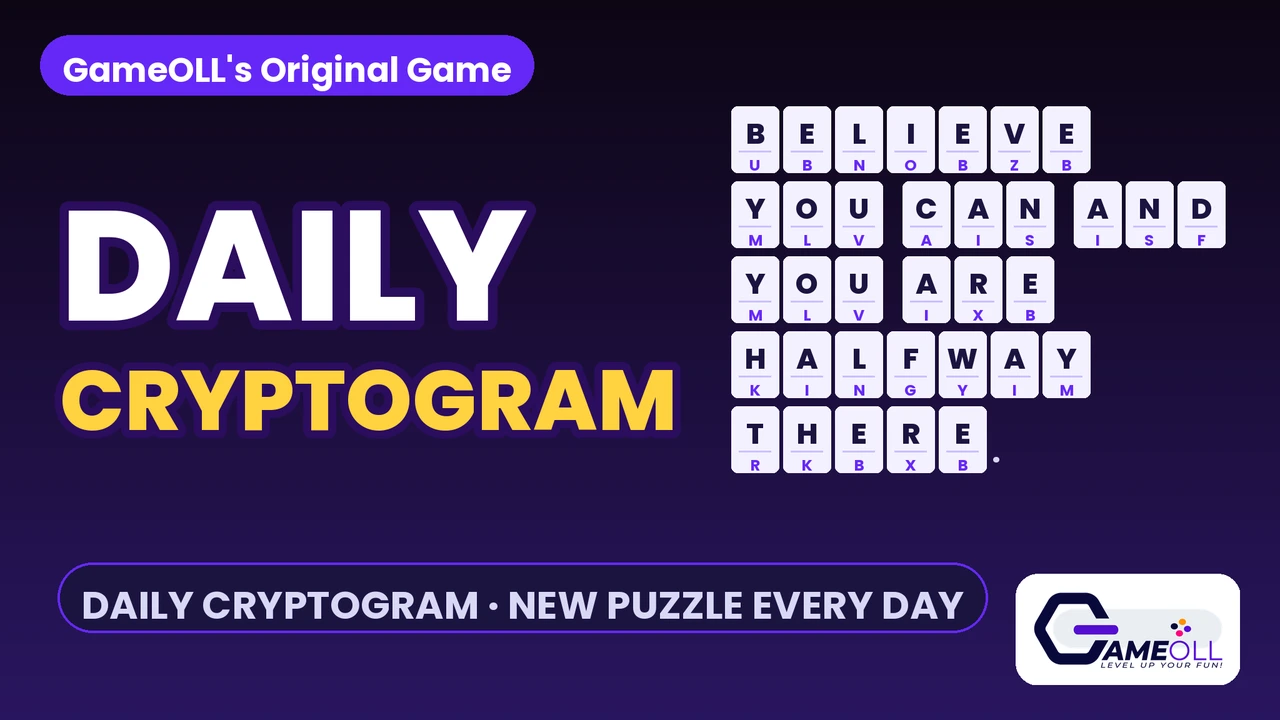
A daily cryptogram you can play right here, free. This is Daily Cryptogram, an original GameOLL word puzzle. A famous quote is locked inside a simple letter code: every letter of the quote has been swapped for a different letter, the same swap is used from the first word to the last, and no letter ever stands for itself. Your job is to crack the code. Tap a tile, guess what its letter really is, and watch the whole quote fill in as your guesses land. There is a fresh Daily Cryptogram every day, the same puzzle for every player, plus 40 set puzzles in four tiers of quote length. Every puzzle has exactly one answer, because the code is a true one-to-one swap. No download. No sign-up. It works on your phone and your PC.
Genre
Puzzle · Words
Players
1 Player
Platform
Browser · Mobile · PC
Price
Free
In this guide
- How to play Daily Cryptogram
- The letter frequency helper
- Difficulty tiers: Starter to Expert
- The Daily Cryptogram
- Stars, Check and hints
- 7 tips to crack a cryptogram faster
- Daily Cryptogram FAQ
- Final verdict
How to play Daily Cryptogram
A cryptogram is a quote written in code. The code here is the oldest one in the book: a straight letter swap. Before the puzzle reaches you, every letter of the quote is replaced by a different letter. A becomes Q, B becomes M, C becomes Z, and so on, with one swap table for the whole quote. Two promises make the puzzle fair. First, the swap is one-to-one: two different letters of the quote never share the same cipher letter, and one cipher letter never stands for two different real letters. Second, no letter ever stands for itself, so if you see a Q on the board, the real letter is never Q. Spaces, full stops, commas and apostrophes stay exactly where they were, so the shape of the quote is right in front of you.
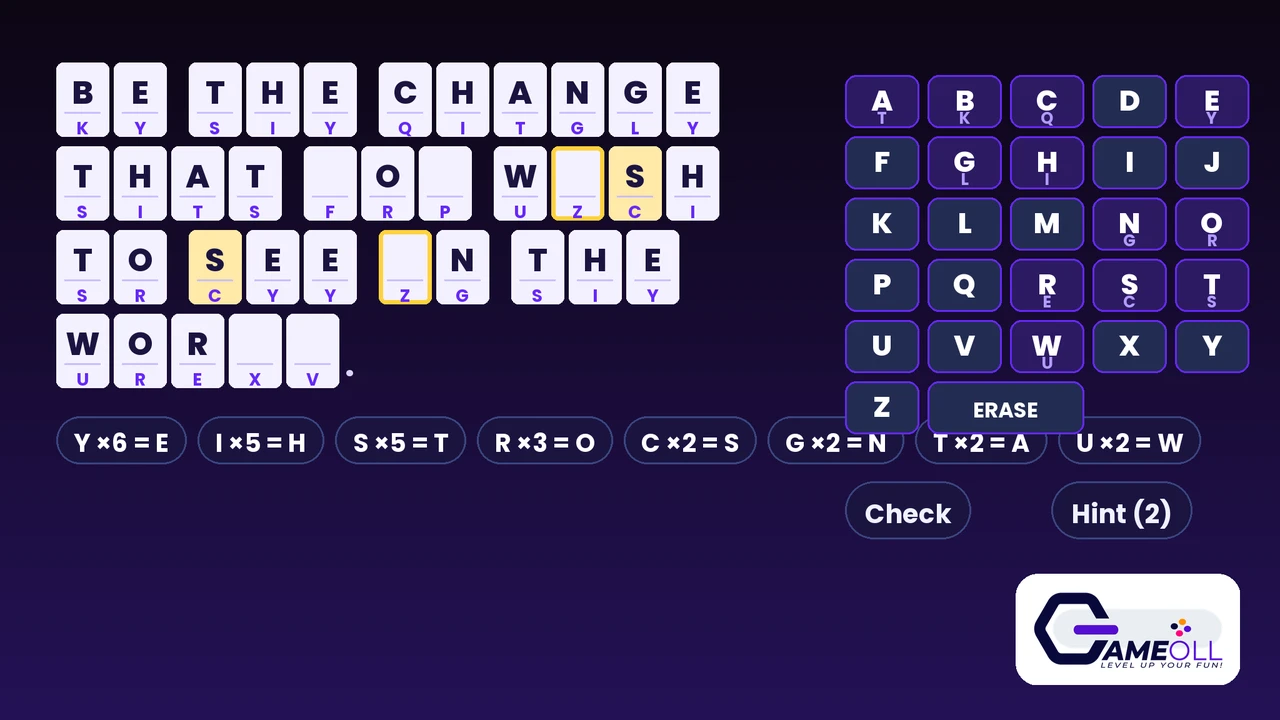
Each tile on the board shows a cipher letter at the bottom. The space above it is for your guess. Tap any tile to select its cipher letter, then tap a letter on the keyboard to decode it. Every tile with that cipher letter fills in at once, all over the quote. You can change a guess at any time: select the cipher letter again and tap a new key, or tap Erase to clear it. There is one guard rail. A plain letter can only decode one cipher letter, so if you try to spend a letter that is already used somewhere else, the game refuses and tells you which cipher letter holds it. Erase it there first, or pick another letter.
Here is how a solve usually starts. Look for a one-letter word. In English it can only be A or I, so you have a fifty-fifty that the rest of the board will quickly settle. Look for the most common cipher letter on the board, shown at the front of the frequency strip under the tiles. In a quote of any length it is very often E, the busiest letter in English. Look for a three-letter word that appears twice: it is a strong candidate for THE, the most common word in the language, and its last letter would hand you E again to cross-check. Look for double letters, because English loves a small set of them: LL, EE, SS, OO and TT lead the list. Every confirmed letter shrinks the code for all the others, and the last few letters usually fall in a rush.
Wrong guesses are allowed. The game does not punish a guess the moment you make it. Judgement comes when every cipher letter on the board holds a guess: if the decoded text matches the quote, you win; if some letters are off, the game tells you how many are wrong and lets you keep swapping. You also have a Check button that reports the same count at any moment, for free, without ever naming the wrong letters. And if a letter will not crack, a Hint fills it in correctly and locks it in gold so it cannot be changed by accident. You get 3 hints per puzzle.
| Action | Phone / tablet | PC / laptop |
|---|---|---|
| Select a cipher letter | Tap any tile with that letter, or tap its frequency chip | Click a tile, or move with the arrow keys |
| Make a guess | Tap a letter on the keyboard | Click a letter key, or type A to Z |
| Erase a guess | Tap the Erase key | Click Erase or press Backspace |
| Check your guesses | Tap the Check button | Click the Check button |
| Take a hint | Tap the Hint button | Click the Hint button |
The letter frequency helper
Frequency is the cryptogram solver’s oldest tool. English letters do not show up equally often. In ordinary writing, E appears in about one word in eight letters, while Z and Q barely appear at all. A quote is a small sample, so the match is never perfect, but in any quote longer than a sentence the busiest cipher letter is E or T far more often than chance. Our board counts for you live: the strip under the tiles lists every cipher letter in the puzzle with its count, most frequent first. The table below is the English league table the strip is quietly comparing against.
| Letter | Share of English text | Solver note |
|---|---|---|
| E | About 12.7% | The first guess to test on the busiest cipher letter |
| T | About 9.1% | Opens THE, THAT and every -TION ending |
| A | About 8.2% | One of only two one-letter words |
| O | About 7.5% | Loves TO, OF, ON and double O words like TOO |
| I | About 7.0% | The other one-letter word; starts I-words with an apostrophe |
| N | About 6.7% | Ends words constantly: AN, IN, ON, -ING with help |
| S | About 6.3% | The plural letter; check word endings |
| H | About 6.1% | Partners with T in THE, TH and WITH |
| R | About 6.0% | Common in endings like -ER and -OR |
| D | About 4.3% | The past-tense letter: -ED endings everywhere |
| L | About 4.0% | The most common double letter in English |
| U | About 2.8% | Follows Q in most words; rare as a double |
Use the two lists together. If the busiest cipher letter in your puzzle appears far more often than the second, it is E until the board proves otherwise. If two cipher letters are neck and neck at the top, they are usually E and T in some order, and a single word pattern will split them: find a three-letter word ending in one of them and test THE. Apostrophes are free gifts too. A cipher word shaped like X’Y is almost always a contraction, and a word shaped X’YZ with the first letter repeated in long words nearby is often I. The possessive ending ‘S is just as common, so a trailing apostrophe-S pattern hands you S for free. None of this is guessing in the dark. It is probability doing quiet work, and it is how these puzzles have been solved in newspapers for a century.
Difficulty tiers: Starter to Expert
The set puzzles come in four tiers of ten, and the ladder is honest: it is simply quote length. A longer quote means more cipher letters, more cross-checks and more chances for one wrong guess to hide. It also means more evidence, which is why seasoned solvers sometimes find a long quote easier to start and harder to finish. Start at the top of Starter even if you have solved cryptograms before. The short quotes teach your eyes the patterns this game rewards, and those patterns carry every tier above them.
| Tier | Quote length | What it feels like | Best for |
|---|---|---|---|
| Starter | 34 to 39 letters | One clean idea per quote; most letters crack from frequency alone | Learning the code and the frequency strip |
| Classic | 39 to 45 letters | A relaxed solve of a few minutes with a few word patterns | A calm daily-style puzzle |
| Tough | 45 to 52 letters | More letters share the load; wrong guesses hide longer | Solvers who trust patterns over hunches |
| Expert | 53 to 67 letters | Two-sentence quotes; the endgame is pure cross-checking | Patient solvers who want a real workout |
Every puzzle in every tier has exactly one answer. That is a promise built into the code itself. The swap table is a true one-to-one map: each cipher letter decodes to exactly one plain letter, so a finished board either reads as the quote or it does not. There is no second quote hiding behind the same code, and no letter ever maps to itself to muddy the water. If you are stuck, the way forward is never a coin flip. Some pattern on the board — a frequency, a word shape, an apostrophe — has not been used yet, and finding it is the game.
The Daily Cryptogram
Alongside the set puzzles there is one Daily Cryptogram. A fresh puzzle arrives every day, picked and coded from the date itself, so every player in the world gets the same quote in the same code on the same day. Solve it and your streak grows by one day. Miss a day and the streak restarts at one, so the gentle pressure is real. The Daily draws from the same 40 quotes as the set puzzles, cycling through them across the weeks, but its code is dealt fresh from the date, so even a quote you solved last month comes back wearing a new disguise.
The Daily is built on your device the moment you open it, from a seed made of the date alone. Same date, same puzzle, on every phone and every PC. A new puzzle lands at midnight your time, and yesterday’s Daily is replaced — but if you leave a puzzle half decoded, the game remembers it. Come back later the same day and your guesses, your hints and your timer are restored exactly where you left them. A Daily left unfinished overnight is swept away with the date, which keeps the streak honest: one day, one puzzle, one chance.
Stars, Check and hints
Each set puzzle pays up to 3 stars, and the rule is simple to state and hard to earn. Finish with no hints used and no wrong Checks and you earn 3 stars. Use at most one hint and at most one wrong Check and you earn 2 stars. Any other finish earns 1 star. The Daily has no stars; it pays in streak days instead, and replaying a solved Daily is practice, not a second streak day.
Check is your honest friend. Tap it at any time and it counts your guessed letters that are wrong, then reports only the count — never which letters. It is free and unlimited, but a Check that finds a wrong letter counts against your stars, so the cleanest solves are the ones where you trust your patterns and never need to ask. If every letter on the board holds a guess and some are wrong, the game tells you the count on its own, without touching your Check record. Hints are the heavier tool. A hint fills one letter correctly — the letter you have selected, if it needs one, or the first letter that does — and locks it in gold so it cannot be erased or overwritten. You get 3 hints per puzzle, and each one lowers the stars you can earn, so spend them on the letter that unlocks the most words, not the one that merely itches.
7 tips to crack a cryptogram faster
- Start with the busiest letter. Open the frequency strip, find the cipher letter with the highest count, and test it as E. In most quotes of a sentence or more, you will be right often enough that the board tells you quickly either way.
- Hunt the one-letter words. A single letter standing alone is A or I. Decide it early using its neighbours: a one-letter word before a verb-looking word is often I, and one before a noun is often A.
- Spot THE by shape, not hope. A three-letter word that repeats, especially at the start of a sentence or before other words, is THE until proven innocent. Its letters give you T, H and E in one move.
- Read the apostrophes. Contractions and possessives are free letters. A word ending in apostrophe plus one cipher letter is usually ‘S or ‘T, and a word shaped like X’YZ near the front is often I’M, I’D or I’LL territory.
- Use double letters as anchors. When two identical cipher letters sit side by side, think LL, EE, SS, OO and TT first. A double at the end of a word leans hard toward LL or SS.
- Let endings speak. English endings repeat everywhere: -ING, -ED, -ER, -LY, -TION and -S plurals. A three-letter cipher pattern at the ends of longer words is very often ING, and cracking it opens three letters at once.
- Check late, hint last. Save Check for the moment you believe the board is nearly right, because a wrong Check costs a star. Save hints for a letter that appears in many words, where one locked answer can confirm or kill several guesses at a stroke.
Daily Cryptogram FAQ
Is Daily Cryptogram free to play?
Yes. Daily Cryptogram is 100% free: the Daily and all 40 set puzzles are included. You play right on this page, with no download, no sign-up and no payment.
What is a cryptogram?
A cryptogram is a short text hidden in a letter code. Each letter of the text is swapped for a different letter, and the same swap is used all the way through. You crack it with letter frequency, word patterns and logic, one decoded letter at a time, until the hidden text reads plainly again.
Is the Daily Cryptogram the same for everyone?
Yes. The Daily is built from the date alone, so every player gets the same quote in the same code on the same day, on any device. A new Daily arrives at midnight your time, and solving it grows your daily streak.
Does every puzzle have exactly one answer?
Yes. The code is a true one-to-one swap: every cipher letter decodes to exactly one plain letter, and no letter ever stands for itself. That means a completed board either reads as the hidden quote or it does not — there is never a second quote hiding behind the same code.
Do Check and hints cost anything?
Check is free and unlimited. It tells you how many guessed letters are wrong, never which ones. A Check that finds a wrong letter counts against your stars. Hints fill and lock one correct letter, you get 3 per puzzle, and each hint used lowers the stars you can earn on that puzzle.
Does Daily Cryptogram save my progress?
Yes, in your own browser. Stars, best times, your streak and solved Dailies save automatically, and a puzzle you leave half finished is restored exactly where you left it when you come back. Nothing leaves your device and there is no account to make.
Final verdict: should you play Daily Cryptogram?
Yes — if you like puzzles that reward thinking in words. Daily Cryptogram takes the newspaper cryptogram and gives it a heartbeat: one fresh coded quote every day, the same for everyone, with a streak to protect. The set puzzles scale from a one-minute Starter to two-sentence Experts, the frequency strip teaches the real solver’s craft while you play, and the star rule honours the solves you are proudest of: no hints, no wrong checks, just frequency and word shapes read well. The quotes are short, famous and worth the decoding — Roosevelt, Twain, Wilde, Einstein and friends, hiding in plain sight behind a letter code. Two or three puzzles a day will sharpen your eye for English patterns more than a month of scrolling, and the streak will make sure you come back for them.
▶ Play Daily Cryptogram 🎮 See All Free GamesLast updated: November 7, 2026. Daily Cryptogram v1.0 — the first release of our original cryptogram game, with a Daily Cryptogram, 40 set puzzles in four tiers, a live letter-frequency strip, free Check, locking hints and star ratings. An original GameOLL browser game. Found a bug? Tell us in the comments and we will fix it in the next version.