
Home » Play Games » Heyawake
Tap to paint black · Drag to paint a stretch · Tap a black cell for a white dot · No white line crosses three rooms
Heyawake Puzzle: Play Heyawake Online Free
Heyawake is the quiet giant of the shading puzzles. The board is split into rooms, a few rooms carry numbers, and your job sounds simple: paint some cells black. Then the four rules start pulling against each other. Black cells may never touch, yet numbered rooms demand their exact count of them. White cells must all stay connected, yet a straight white line is forbidden from crossing three rooms. Every black cell you paint solves one problem and creates two questions somewhere else, and that tension is exactly why a finished Heyawake board feels so good.
The full game is on this page, free, with no download and no sign-up. There are 34 set puzzles in three tiers — Starter, Classic and Expert — and every single one was proven by an exhaustive solver to have exactly one solution before it was allowed in. A fresh Daily puzzle is generated on your device every day and proven unique the same way. Your stars, your streak and the puzzle you are halfway through are all saved automatically.
Free in your browser34 solver-proven puzzlesThree tiersDaily challengeNo download
Genre
Puzzle · Logic · Daily
Players
1 player, solo
Game length
About 3 to 12 minutes
Win by
Finding the one solution

In this guide
- How to play Heyawake
- The four rules, one by one
- A worked example: your first puzzle
- Strategy that actually works
- Controls, Check, Hint and stars
- Questions and answers
How to play Heyawake
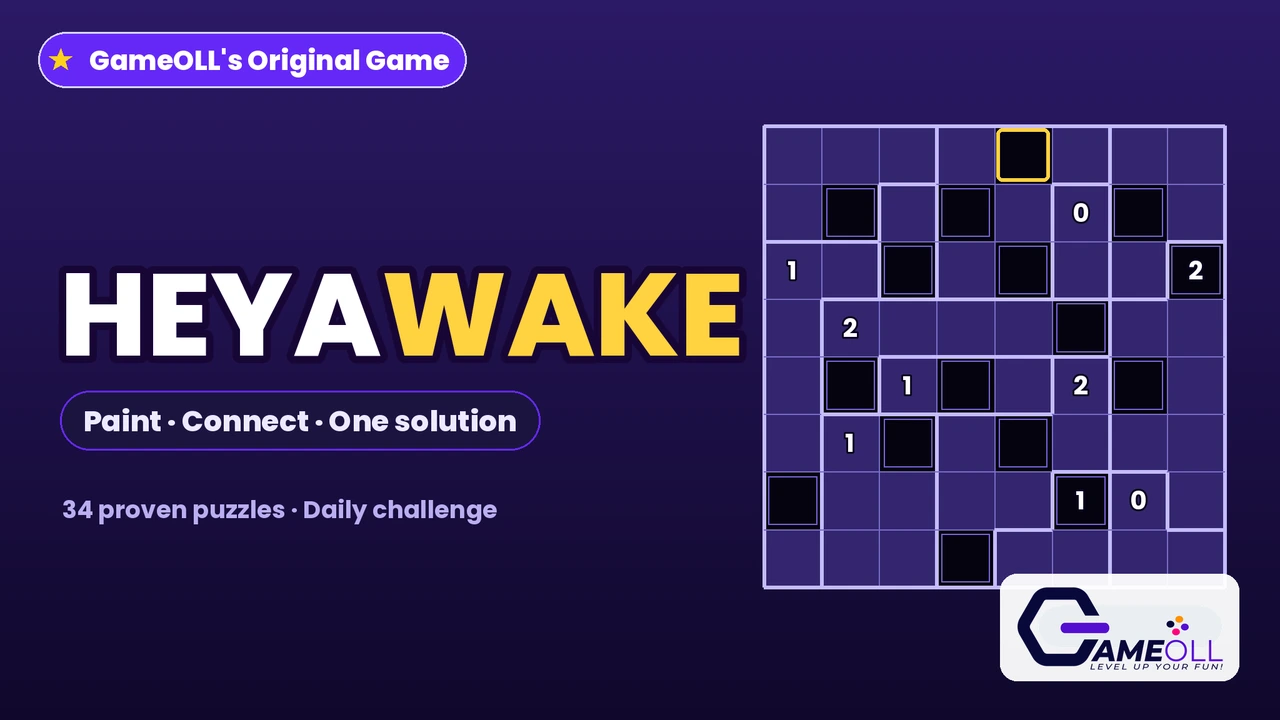
Look at the board above. The bold lines divide it into rooms of different shapes and sizes. Some rooms show a number. You decide the colour of every cell: black, or white. A puzzle is solved when every cell is decided and all four rules hold at the same time. There is exactly one colouring that works — the puzzles here are built and then proven unique by a solver, so if you are stuck, the board is never wrong. You are simply missing a deduction.
Tap a blank cell to paint it black. Tap a black cell and it becomes a gold dot, which is your mark for a cell that stays white. Tap the dot and the cell clears. You can also drag across blank cells to paint a whole stretch black in one stroke, and press on painted cells and drag to erase. Most players paint the blacks they are sure about first, then dot the cells those blacks force to be white, and let the two colours squeeze the rest of the board between them.
Work through the set puzzles in order, because each tier unlocks one puzzle at a time and the difficulty climbs gently. Starter boards are 8 by 8 and forgive a lot of exploring. Classic boards are 10 by 10, where the white-line rule starts to bite. Expert boards are 10 by 12 with smaller rooms, longer lines and far fewer numbers to lean on. The Daily is a 10 by 10 board that changes every day and pays a streak instead of stars.
The four rules, one by one
Rule 1: black cells never touch side by side
Two black cells may not share an edge. Diagonal contact is fine, and you will use it constantly. This single rule turns every black cell into a small argument: the moment you paint a cell black, all four of its edge neighbours are white, whether you marked them or not. It also means black cells form a sparse pattern — never a block, never a bar — so a room that needs several blacks must spread them out with white cells between.
Rule 2: all white cells stay connected
Every white cell must be reachable from every other white cell by walking up, down, left and right through white cells. Black cells are walls. This is the rule new players break without noticing: a few cheerful blacks in the wrong places can seal a corner cell or a small pocket away from the main white region, and the puzzle is dead even though everything looks tidy. Before you commit to a black cell, glance at the cells it walls off and ask whether each of them still has a white way out.
Rule 3: a white line may not cross three rooms
Run your eye along any row or column. A straight run of white cells may pass through at most two rooms. The moment a white run enters its third room, the board is broken. This is the rule that makes Heyawake feel different from every other shading puzzle. Long corridors are dangerous. A black cell is often forced not by its own room, but because the white line behind it has already crossed two rooms and one more white cell would cross a third. Rooms without numbers matter here just as much as numbered ones, because the line counts every room it passes through.
Rule 4: a numbered room holds exactly its number of blacks
If a room shows a 2, exactly two of its cells are black in the solution — no more, no fewer. A room showing 0 is a gift: dot every cell in it and move on. A room with no number is unconstrained by this rule and can hold any number of black cells, including none. The numbers are the engine of the puzzle. When a room reaches its number, every other cell in it is white. When the cells that could still be black shrink to exactly the number the room needs, every one of them is black.
| Rule | What it says | What it gives you |
|---|---|---|
| 1. No touching | Black cells never share an edge; diagonals are fine | Every black forces its four neighbours white |
| 2. Whites connect | All white cells form one group | Black cells may never seal off a pocket |
| 3. Two rooms per line | A white run crosses at most two rooms | Long white corridors force a black somewhere inside them |
| 4. Exact numbers | A numbered room holds exactly that many blacks | Full rooms turn white; shrinking rooms turn forced black |
A worked example: your first puzzle
Press Set Puzzles and open Starter puzzle 1. Before you paint anything, hunt for the two rooms that show 0. One sits near the top, two cells at row 2, column 6 and row 3, column 6. The other is the three-cell room in the bottom right corner. Rule 4 says those five cells are all white, so dot them straight away. Free information is rare in Heyawake — take it wherever it appears.
Now look at row 3, which your new dots have already touched. The cell at row 3, column 6 is white, and it belongs to the 0 room. Its left neighbours, row 3 columns 5 and 4, belong to a big unnumbered room, and column 3 belongs to a small two-cell room. If columns 3, 4 and 5 were all white, the white run from column 3 to column 6 would pass through three rooms — the small room, the big room and the 0 room — and rule 3 forbids exactly that. So at least one of those three cells is black. You do not know which one yet, but you have converted a rule about lines into a concrete promise about three named cells, and promises like that are how Heyawake boards fall.
The left edge teaches the opposite lesson. The tall room running down the left side shows a 1, so exactly one of its seven cells is black. Every other cell in that room is white, which means the left column is almost a solid white wall — and a wall like that is exactly what rule 2 needs and rule 3 watches. As the rest of the board develops, keep asking where that single black can sit so that it neither strands the cells above it nor lets a horizontal white line run too far. This is the rhythm of the whole game: numbers make promises, lines and walls collect on them.
Strategy that actually works
- Start with the extremes. Rooms showing 0 are fully white. Rooms whose number equals the count of cells that could still be black are fully forced. Small rooms with big numbers — a 2 in a three-cell room, say — are nearly as forced, because rule 1 limits where those blacks can sit.
- Dot what blacks give you. Every black cell hands you four white neighbours for free. Dot them immediately. Dots are information: they show the white region growing, they expose the lines rule 3 cares about, and they stop you painting a neighbour black by accident later.
- Count rooms along every long line. When a row or column runs white for a long stretch, count the rooms it has crossed. If it has crossed two and the next cell belongs to a third room, that next cell is black — or one of the earlier cells must be. This is the most common forced move in the game, and the one beginners miss longest.
- Guard the pockets. Corners and narrow necks are where rule 2 dies. A cell with only two neighbours becomes unreachable if both are black, and nearly so if one is. Whenever you paint near a corner, trace the escape route of every cell you are walling in.
- Use finished rooms as walls. When a numbered room reaches its count, dot the rest of it at once. Those new whites extend lines, squeeze neighbouring rooms and often complete the count logic of the room next door.
- When stuck, argue by contradiction. Pick an undecided cell, pretend it is black, and follow the forced whites. If a room overflows, a line crosses three rooms or a pocket seals within a few steps, the cell was white — dot it and take the information. The puzzles here are proven unique, so a contradiction is always a real deduction, never a broken board.
Controls, Check, Hint and stars
Everything is tap and drag. Tap cycles a cell from blank to black to dotted white to blank again. Dragging from a blank cell paints black along your path; dragging from a painted cell erases along it. On a phone, dragging is the fast way to lay down a run of blacks you have already reasoned out, and tapping is the careful way to place one cell at a time. The board works the same with a mouse.
The Check button is free and unlimited. It counts your rule breaks by type — touching blacks, room number errors, white runs that cross three rooms, and splits in the white group — without ever marking which cells are wrong. A clean Check is real progress: it means everything painted so far can still be part of the solution. A dirty Check costs you stars, so treat it as a tool for when you are truly stuck rather than a way to play.
Hint is stronger and limited to three per puzzle. If one of your black cells is wrong, the hint removes it. Otherwise it paints a black cell taken from the solution itself, or dots a white one when the blacks are all in place. Stars follow the house rule: three stars for a clean solve with no hints and no wrong Checks, two stars with at most one of each, and one star for finishing any other way. The Daily pays a streak instead — solve it on consecutive days to keep the flame alive.
| Tier | Board | Puzzles | Character |
|---|---|---|---|
| Starter | 8 × 8 | 12 | Bigger rooms, generous numbers, gentle lines |
| Classic | 10 × 10 | 12 | The full game: longer lines, tighter pockets |
| Expert | 10 × 12 | 10 | Smaller rooms, fewer numbers, deep deductions |
| Daily | 10 × 10 | 1 per day | Generated on your device, proven unique, pays a streak |
Questions and answers
Is Heyawake free to play on GameOLL?
Yes. Every Heyawake puzzle on this page is free, in your browser, with no download and no sign-up. The 34 set puzzles and the Daily are all included, and your stars, streak and in-progress puzzle are saved on your own device.
What are the four rules of Heyawake?
First, no two black cells may touch side by side, although diagonals are fine. Second, all white cells must stay connected in one group. Third, a straight line of white cells may not pass through three or more rooms. Fourth, a room with a number must contain exactly that many black cells.
Can black cells touch at the corners?
Yes. Only side-by-side touching is banned. Diagonal black cells are allowed, and good solutions use them often, because two diagonal blacks pinch the white cells between them without breaking the first rule.
Does every room have a number?
No. Rooms without a number can hold any number of black cells, including none at all. They still shape the puzzle, because the white-line rule counts every room a line passes through, numbered or not.
Is every puzzle here guaranteed to have one solution?
Yes. Each set puzzle was proven by an exhaustive solver to have exactly one solution before it was added, and the Daily is generated on your device by the same method: a fresh puzzle is built and proven unique before it is shown to you.
What does the gold dot mean, and do I have to use it?
The dot is your own mark for a cell you have decided stays white. A puzzle only counts as solved when every cell is decided, black or dotted, and all four rules hold, so near the end it is worth dotting the cells you know. Check and Hint never add dots for free, except when a hint marks a white cell for you.
Final verdict
Heyawake earns its place as the 150th game on GameOLL because it does more with less than almost any puzzle we publish. Four rules, one coat of virtual paint, and boards that argue back. The version here is the complete game: 34 set puzzles across three honest tiers, every one solver-proven to have exactly one solution, a Daily that is generated and proven on your own device each morning, free Check and Hint tools that respect your intelligence, and stars that reward clean logic over lucky guessing. If you like your puzzles quiet, strict and deeply fair, start with Starter puzzle 1 — the 0 rooms are waiting.
Rating: 9.5 / 10 — a proven-unique Heyawake with a real Daily, in your browser, for free.