
Home » Play Games » Kakuro
Tap a cell, then a digit • No digit repeats inside one sum • ✔ Check is free • 💡 3 hints per puzzle
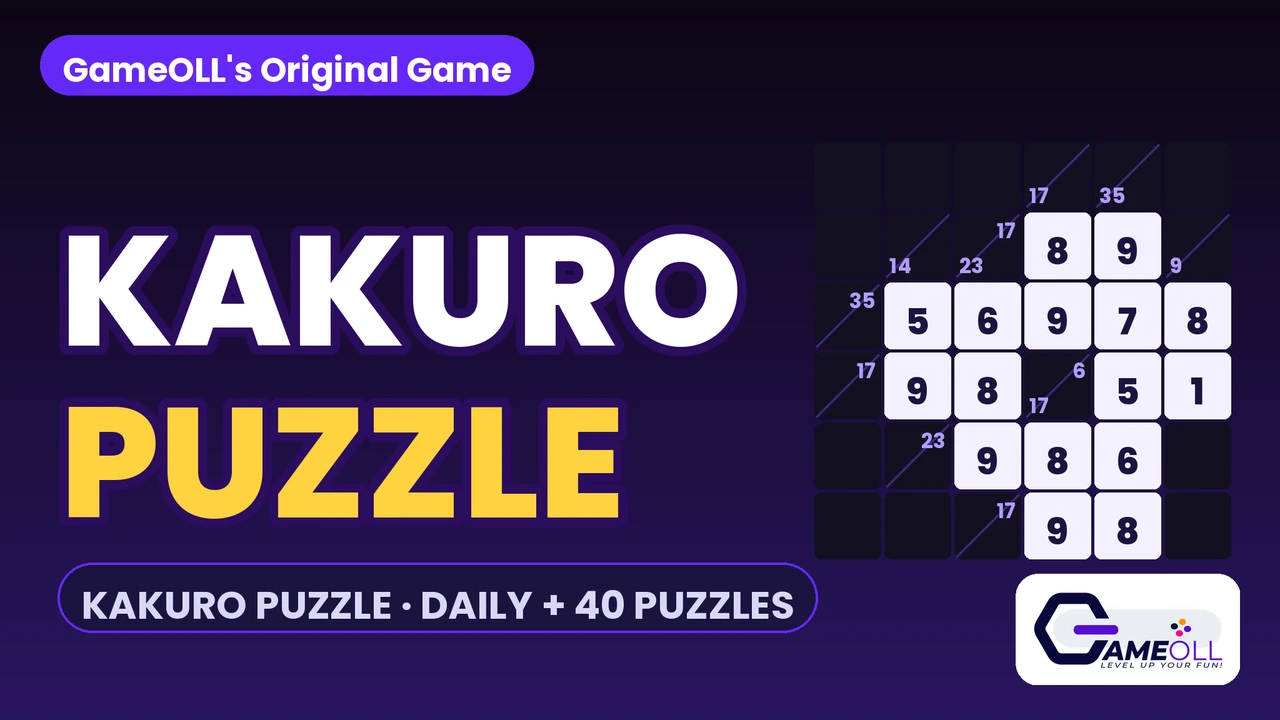
A kakuro puzzle you can play right here, free. This is Kakuro, an original GameOLL cross-sums game. The grid mixes black clue cells and white play cells. Every clue gives you a sum. Fill the white cells with digits from 1 to 9 so that each run of white cells adds up to its clue, with no digit repeated inside one run. It feels like a crossword made of numbers, crossed with the clean logic of Sudoku. There is a Daily Kakuro that is the same for every player, plus 40 set puzzles in four difficulty tiers. Every puzzle on this page has exactly one solution, proven by our own solver before it ships. No download. No sign-up. It works on your phone and your PC.
Genre
Puzzle · Numbers
Players
1 Player
Platform
Browser · Mobile · PC
Price
Free
In this guide
- How to play Kakuro
- The sum-combination helper table
- Difficulty tiers: Starter to Expert
- The Daily Kakuro
- Stars, Check and hints
- 7 tips to solve Kakuro faster
- Kakuro FAQ
- Final verdict
How to play Kakuro
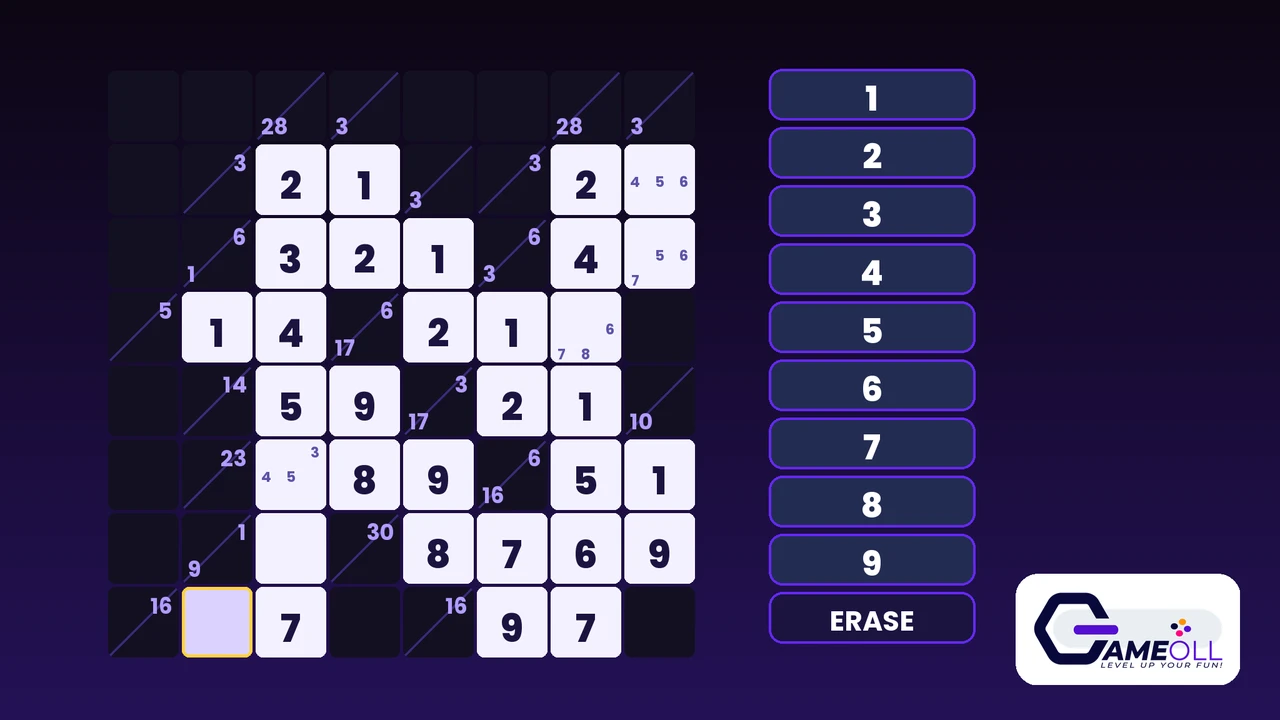
The board is a grid of black cells and white cells. The black cells are clues. The white cells are yours to fill. Each clue cell can carry up to two numbers. The number at the top right of a clue cell is the sum for the run of white cells to its right. The number at the bottom left is the sum for the run of white cells below it. A run stops when it hits a black cell or the edge of the grid.
Three rules do all the work. First, you may only use the digits 1 to 9. There is no zero in Kakuro. Second, the digits in a run must add up to exactly the clue sum. Third, no digit may repeat inside one run. The same digit can show up twice in a row or a column, as long as a black cell splits it into two different runs. That third rule is the engine of the whole game, because it turns every sum into a short list of possible digit sets.
Here is a tiny worked example. Say a clue cell shows 3 for the run to its right, and that run has two white cells. Only one pair of different digits adds to 3: 1 and 2. So those two cells hold 1 and 2 in some order. Now look at the first of those cells from above. Say the clue above it asks for 4 down a run of two cells. The pairs that add to 4 are only 1 and 3. The cell must be both in the set 1, 2 and in the set 1, 3. The only digit in both sets is 1. So the cell is 1, its partner to the right is 2, and the cell below it is 3. Three digits placed, no guessing. That crossing of two sum lists is the move you will make hundreds of times.
One special case is worth knowing. Sometimes a run has just one white cell. Then the clue simply names the digit. In our game those cells come pre-filled and locked, so you can use them as free anchors and build your logic around them.
Playing is simple. Tap a white cell to select it, then tap a digit on the pad. The game refuses a digit that already sits in the same run, so the repeat rule can never be broken by a stray tap. Tap Notes to switch the pad into pencil mode and mark small candidate digits in a cell. Tap a digit again in Notes mode to remove that note. Erase clears the selected cell. On a keyboard you can type digits 1 to 9, move with the arrow keys, erase with Backspace and toggle Notes with the N key.
| Action | Phone / tablet | PC / laptop |
|---|---|---|
| Select a cell | Tap the white cell | Click the white cell, or move with arrow keys |
| Place a digit | Tap a digit on the pad | Click a digit, or type 1 to 9 |
| Pencil notes | Tap Notes, then tap digits | Click Notes or press N, then type digits |
| Erase a cell | Tap the Erase key | Click Erase or press Backspace |
| Check your grid | Tap the Check button | Click the Check button |
| Take a hint | Tap the Hint button | Click the Hint button |
The sum-combination helper table
Every run in Kakuro is a sum plus a length. For many sums there is only one possible set of digits. Those sums are gifts: the moment you see one, you know the exact digits in the run, and only the order is left to work out. The table below lists the most useful one-way sums, plus two near-misses that have just two ways. Print it in your head a piece at a time and your solving speed will jump.
| Sum | Cells | Digits | Ways |
|---|---|---|---|
| 3 | 2 | 1+2 | Only way |
| 4 | 2 | 1+3 | Only way |
| 16 | 2 | 7+9 | Only way |
| 17 | 2 | 8+9 | Only way |
| 5 | 2 | 1+4 or 2+3 | Two ways |
| 6 | 3 | 1+2+3 | Only way |
| 7 | 3 | 1+2+4 | Only way |
| 23 | 3 | 6+8+9 | Only way |
| 24 | 3 | 7+8+9 | Only way |
| 8 | 3 | 1+2+5 or 1+3+4 | Two ways |
| 10 | 4 | 1+2+3+4 | Only way |
| 11 | 4 | 1+2+3+5 | Only way |
| 29 | 4 | 5+7+8+9 | Only way |
| 30 | 4 | 6+7+8+9 | Only way |
| 15 | 5 | 1+2+3+4+5 | Only way |
| 35 | 5 | 5+6+7+8+9 | Only way |
Notice the pattern. The one-way sums live at the edges: the smallest and the largest sums for each length. A sum of 3 in two cells is as low as two different digits can go, and 17 is as high as they can go. The sums in the middle, like 10 in two cells, have many ways and tell you much less. So scan the grid for edge sums first. They are the loose threads that unravel the whole puzzle.
Difficulty tiers: Starter to Expert
The set puzzles come in four tiers of ten. Each tier uses a bigger grid with more white cells, and the logic chains get longer as you climb. Start at the top of Starter even if you have played Kakuro before. The first tier teaches your eyes to spot one-way sums, and that skill carries the whole game.
| Tier | Grid | White cells | Best for |
|---|---|---|---|
| Starter | 6×6 | About 13 to 19 | Learning the rules and the one-way sums |
| Classic | 8×8 | About 28 to 38 | A relaxed daily-style solve of a few minutes |
| Tough | 9×9 | About 36 to 48 | Longer chains and heavier note work |
| Expert | 10×10 | About 48 to 62 | Patient solvers who want a real workout |
Every puzzle in every tier has exactly one solution. That is a promise, not a hope. We build each puzzle by first filling a grid with a digit pattern that leans on edge sums, then we run our own solver over the finished clue grid and count the solutions. If the count is not exactly one, the puzzle is rebuilt or carved into shape until it is. A puzzle ships only when the count is one. That means you never need to guess in our Kakuro. If you are stuck, the answer is never a coin flip. There is always a logical next step, and finding it is the game.
The Daily Kakuro
Alongside the set puzzles there is one Daily Kakuro. A fresh puzzle arrives every day, built from the date itself, so every player in the world gets the same grid on the same day. Solve it and your streak grows by one day. Miss a day and the streak restarts at one, so the gentle pressure is real. The Daily is a Classic-size 8×8 grid: big enough to be interesting, small enough to finish with your morning coffee.
The Daily is generated on your device the moment you open it, from a seed made of the date alone. The generator uses the same fill and solver checks as the set puzzles, and it keeps rebuilding until the solver proves the day’s grid has exactly one solution. Same date, same puzzle, on every phone and every PC. Yesterday’s Daily is gone when the new day starts, so each date is a one-time meeting. Come back tomorrow and a new grid will be waiting.
Stars, Check and hints
Each set puzzle pays up to 3 stars, and the rule is simple to state and hard to earn. Finish with no hints used and no wrong Checks and you earn 3 stars. Use at most one hint and at most one wrong Check and you earn 2 stars. Any other finish earns 1 star. The Daily has no stars; it pays in streak days instead, and a replay of a solved Daily still counts for practice, not for a second streak day.
The Check button is free and you can press it as often as you like. It tells you how many of your filled cells are wrong, but it never tells you which ones. That design is on purpose. A Check that pointed at the exact cell would do the solving for you. A count keeps the pressure honest: you know an error is in the grid, and the sums will tell you where if you read them closely. A Check that finds at least one wrong cell counts as a wrong Check for the star rule, even though pressing Check itself costs nothing.
The Hint button fills one correct digit for you, in the cell you have selected if that cell needs it, or in the first cell that is empty or wrong. You get 3 hints per puzzle. Hints are the pressure valve for the one chain you cannot crack, but each one lowers your star ceiling, so the clean solve stays the true win. Choose your moment: a hint spent late, on a nearly full grid, often unlocks three or four cells at once as the crossings fall into place.
7 tips to solve Kakuro faster
- Start with the one-way sums. Scan for sums from the helper table: 3, 4, 16 and 17 in two cells, 6, 7, 23 and 24 in three. Write their digit sets in as notes right away.
- Cross every pair of lists. A cell belongs to two runs. Intersect the two digit sets in your head. When only one digit survives the crossing, place it. This is the core move of Kakuro.
- Use the anchors. One-cell runs come pre-filled in our game. Every anchor splits its row and column into shorter runs, and shorter runs have shorter lists. Work outward from them.
- Watch the leftovers. When a run has one cell left, its digit is the clue minus the digits already placed. Finish runs to shrink the grid for everything that crosses them.
- Note small, note clean. Pencil only the digits a cell can truly be, and clean a note the moment a crossing run rules it out. Stale notes are the number one cause of wrong turns.
- Mind the middle sums. A sum like 20 in four cells looks harmless, but its sets all live high: every digit is 3 or more, and most sets hold two digits of 6 or more. Middle sums still cut the low digits out of a run.
- Check with a plan. If Check says two cells are wrong, do not tap digits at random. Re-read the runs that cross each other near your last placements. Errors travel in pairs along crossings, so the second wrong cell is usually near the first.
Kakuro FAQ
Is Kakuro free to play?
Yes. Kakuro is 100% free: the Daily and all 40 set puzzles are included. You play right on this page, with no download, no sign-up and no payment.
How is Kakuro different from Sudoku?
Sudoku fills a fixed 9×9 grid so each row, column and box holds 1 to 9 once. Kakuro uses sums instead: every run of white cells must add up to its clue, and digits may not repeat inside that run, but the same digit can appear again in a different run. Kakuro grids also come in many sizes, and the black clue cells shape each puzzle like a crossword.
Does every Kakuro puzzle here have exactly one solution?
Yes. Before a puzzle ships, our solver counts its solutions from the clue grid alone. A puzzle is used only when the count is exactly one, and the Daily is generated on your device with the same check. You never need to guess: there is always a logical path to the single solution.
What is the Daily Kakuro?
The Daily Kakuro is one fresh 8×8 puzzle per day, the same for every player, built from the date alone. Solve it to grow your daily streak. A new puzzle arrives at midnight your time, and yesterday’s puzzle is replaced.
Do Check and hints cost anything?
Check is free and unlimited. It tells you how many filled cells are wrong, never which ones. A Check that finds a wrong cell counts against your stars. Hints fill one correct digit, you get 3 per puzzle, and each hint used lowers the stars you can earn on that puzzle.
Does Kakuro save my progress?
Yes, in your own browser. Stars, best times, your streak and solved Dailies save automatically, and a puzzle you leave half finished is restored exactly where you left it when you come back. Nothing leaves your device and there is no account to make.
Final verdict: should you play Kakuro?
Yes — if you like your puzzles honest. Kakuro is the rare numbers game that never asks you to guess. Every grid on this page has one solution and a logical road to it, paved with edge sums and clean crossings. The tiers scale from a gentle 6×6 to a 10×10 workout, the Daily gives the game a heartbeat, and the star rule rewards the solves you are proudest of: no hints, no wrong checks, just reading the sums right. Two or three puzzles a day will sharpen your mental arithmetic more than a month of scrolling, and the streak will make sure you come back for them.
▶ Play Kakuro 🎮 See All Free GamesLast updated: November 7, 2026. Kakuro v1.0 — the first release of our original cross-sums game, with a Daily Kakuro, 40 set puzzles in four tiers, solver-proven single solutions, pencil notes, free Check, hints and star ratings. An original GameOLL browser game. Found a bug? Tell us in the comments and we will fix it in the next version.