
Home » Play Games » Number Match
Pairs must be equal or add to 10 • Neighbours, a clear row or column, or a row wrap • 5 adds per game
A number match game you can play right here, free. This is Number Match, an original GameOLL version of the classic digit-pair puzzle. The board is a grid of numbers, nine wide. Tap two numbers that are equal, or that add up to 10, and they clear — but only if the two can actually reach each other: side by side, down a clear row or column, or wrapped around the end of a row. Clear every number to win. When no pair can connect, the Add Numbers button deals in fresh copies of the digits still on the board — five adds per game, no more, so each one counts. Inside you get 30 solver-proven levels with star ratings and par scores, the traditional Classic opening from the old paper game, and a Daily puzzle that is the same for every player. No download. No sign-up. It works on your phone and your PC.
Genre
Puzzle · Numbers
Players
1 Player
Platform
Browser · Mobile · PC
Price
Free
In this guide
- How to play Number Match
- The four ways two numbers connect
- Add Numbers: your five lifelines
- Levels, Classic mode and the Daily
- Stars and par: how levels are scored
- 7 tips to clear boards faster
- Number Match FAQ
- Final verdict
How to play Number Match
The board is a strip of numbers laid out nine to a row. Every cell holds a digit from 1 to 9. Your job is to remove all of them, two at a time. A pair can be removed when the two digits are equal, like 7 and 7, or when they add up to 10, like 4 and 6, 3 and 7, 2 and 8, 1 and 9, or 5 and 5. That is the whole scoring rule, and there are only nine possible pair types to learn: five doubles (1-1, 2-2, 3-3, 4-4, 5-5) and four tens (1-9, 2-8, 3-7, 4-6).
The catch — the thing that turns a simple matching rule into a real puzzle — is that a pair only clears when the two numbers can connect. Numbers buried behind other numbers cannot reach each other yet. The next section lists the four connection rules exactly, but the short version is: neighbours always connect, and a clear path in a straight line or around the end of a row works too. When you tap two numbers that match but cannot connect, the game tells you the path is blocked rather than leaving you to guess, and when you tap two numbers that do not pair at all, it says so. Nothing is ever taken away by a stray tap.
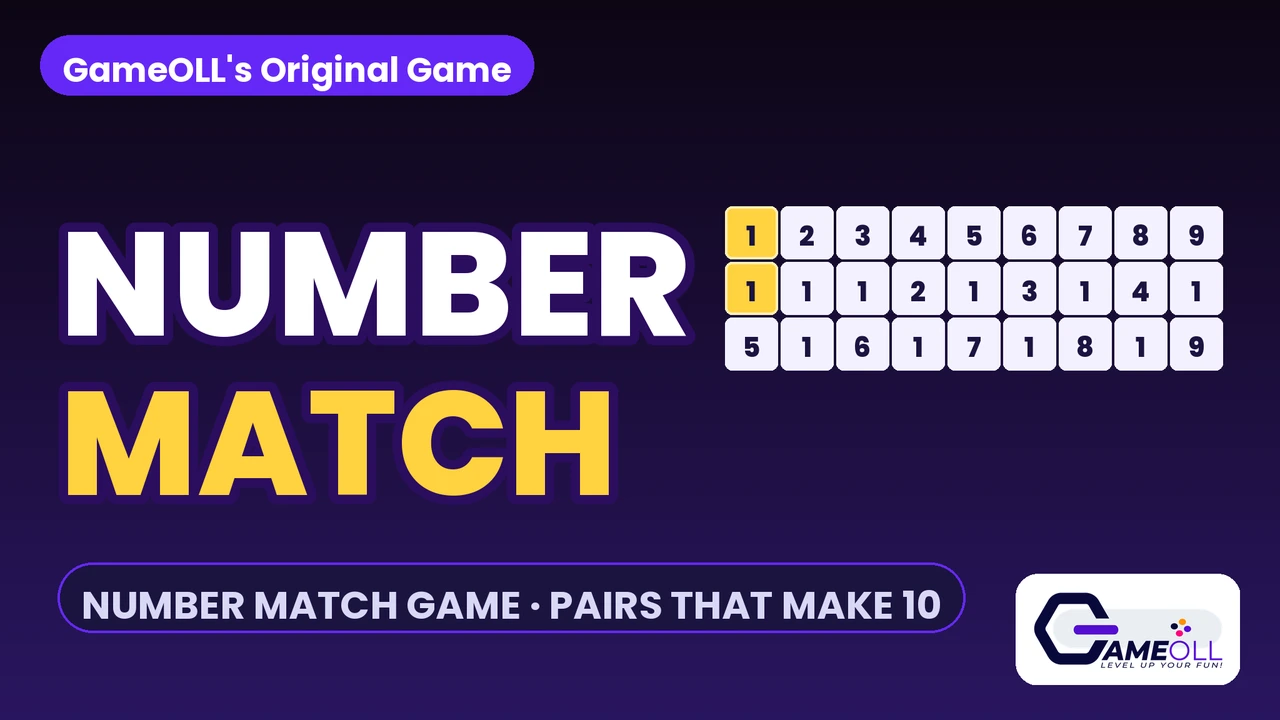
Here is the opening of Classic mode, which is also a perfect first lesson. The first two rows read 1 2 3 4 5 6 7 8 9 and 1 1 1 2 1 3 1 4 1. Look at the left edge: the 1 at the top of the first column and the 1 directly under it are neighbours, so they clear straight away. Now look at the right edge: the 9 at the end of the first row sits directly above the 1 at the end of the second row, and 9 + 1 = 10, so that pair clears too. Two pairs gone in seconds, and the board is already changing shape, because every clear opens new paths for the pairs that were blocked behind the numbers you removed.
One more shape change matters. When every number in a full row of nine has been cleared, that empty row disappears and the rows below slide up to close the gap. This is how distant numbers become neighbours, and it is why clearing a whole row is often worth more than clearing the pair by itself. Plan for the collapse, not just for the pair in front of you.
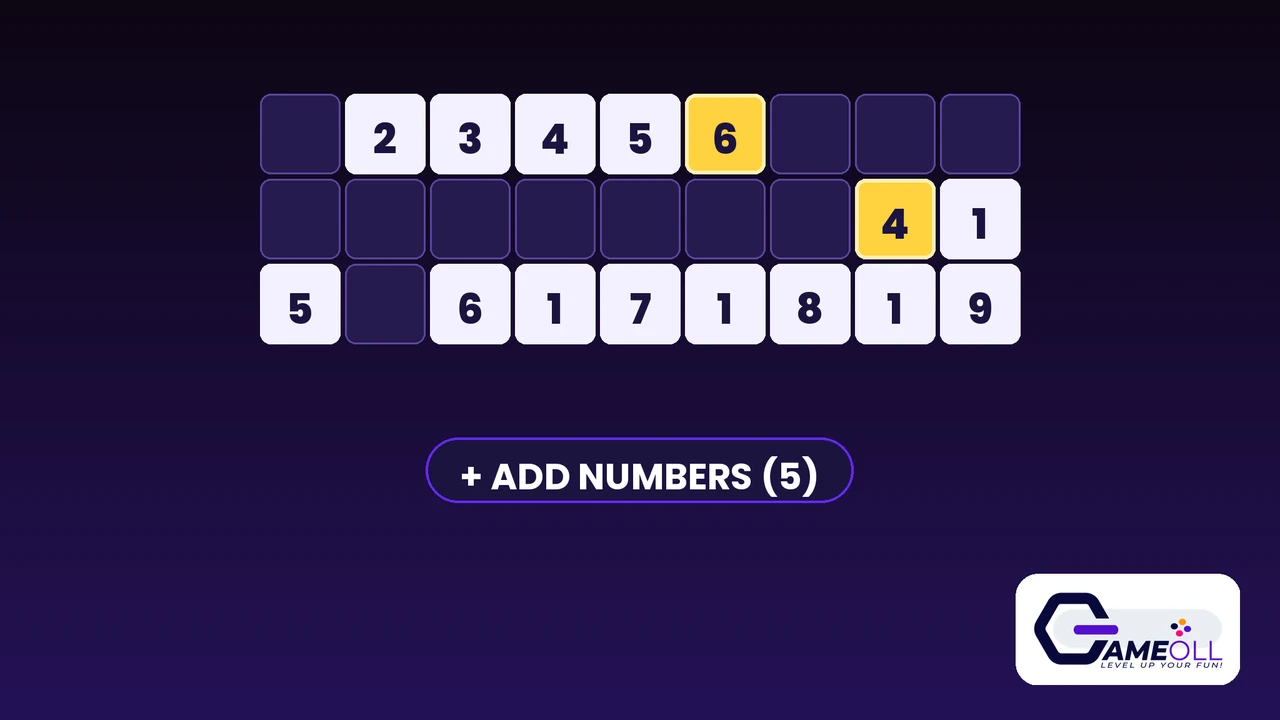
Playing takes two taps. Tap a number to select it — it lights up gold. Then tap the number you want to pair it with. If the pair works, both numbers clear and the game tells you how many numbers are left. If it does not work, the game explains why: the digits are not a pair, or the pair cannot connect yet. Tap the selected number again to put it back down. The three buttons under the board run the game: Add Numbers brings in fresh copies when you are stuck, Hint highlights a pair that can clear right now, and Restart deals the same board again from the top.
| Action | Phone / tablet | PC / laptop |
|---|---|---|
| Select a number | Tap the number | Click the number |
| Clear a pair | Tap a second number that pairs with the first | Click a second number that pairs with the first |
| Deselect | Tap the selected number again | Click the selected number again |
| Add Numbers | Tap the Add Numbers button | Click the Add Numbers button |
| Take a hint | Tap the Hint button | Click the Hint button |
| Start the board over | Tap the Restart button | Click the Restart button |
The four ways two numbers connect
Every clear in Number Match uses one of these four connections. Learn to see all four and the board stops looking like a wall of digits and starts looking like a map of open doors.
| Connection | What it means | Example |
|---|---|---|
| Neighbours | The two cells touch side to side, up and down, or diagonally. | A 4 with a 6 directly below it, or one step down and across. |
| Clear row | Same row, and every cell between the two is already empty. | A 3 and a 7 in one row with nothing but gaps between them. |
| Clear column | Same column, and every cell between the two is already empty. | A 2 at the top of a column and an 8 under a run of gaps in the same column. |
| Row wrap | The last remaining number of a row and the first remaining number of the next row, with nothing left between them in reading order. | An 8 at the end of one row and a 2 opening the next row. |
Diagonals are the connection new players miss most. A pair sitting one row apart and one column across is just as clear as a pair side by side, and diagonals often unlock a column that looked sealed. The row wrap is the second most missed. When a row is nearly empty, check its last surviving number against the first surviving number of the row below before you reach for the Add button — that wrap pair is free, and adds are not.
A pair that matches but cannot connect is not wasted information. It tells you exactly which numbers are in the way. Clearing the blockers — usually with neighbour pairs of their own — opens the path. Strong players read the board backwards from these stuck pairs: find a match that cannot connect, note what seals it in, and go clear the seal.
Add Numbers: your five lifelines
Sooner or later every board reaches a state where pairs exist but none of them can connect, or no pairs exist at all. That is what the Add Numbers button is for. Pressing it writes a fresh copy of every digit still on the board, in the same reading order, continuing from the last cell. The new digits land right after the old ones, which does two things at once: it restores matching partners for digits that were left single, and it builds brand-new neighbour pairs where the old board ends and the new copy begins.
You get exactly five adds per game, in every mode. The counter on the button always shows how many are left, and when they are gone the button says so. Adds are powerful, but they are not free of risk: copies double everything still standing, including the awkward digits, so an early lazy add can leave you with a longer board and the same problem twice. The strongest habit in Number Match is to squeeze the board first — clear every pair you can, especially pairs that collapse a row — and only then add. A board cut down to a handful of digits copies into a handful of new digits, and those fresh copies usually chain-clear in a rush.
Every level on this page carries a par: the fewest adds our solver needed to clear that board, found before the level shipped. Par is not a limit, it is a measuring stick. Finish at or under par without hints and the level pays out its full three stars. The Classic board below has a par of 1 — one well-timed add is all it takes, if you clear the right pairs first.
Levels, Classic mode and the Daily
The 30 levels are the heart of the game. They start small — short boards, gentle pars — and grow longer and stingier as you climb, ending in full six-row boards where a careless add can sink the run. Every level was generated and then proven by our solver before it shipped: each one can be cleared inside the five-add limit, and each one stores the solver’s par so your stars mean something. Clearing a level unlocks the next, and your best star rating on every level is saved, so there is always a reason to replay an old board and play it cleaner.
Classic mode is the original paper game, unchanged. Older readers may know it from notebooks: write out the digits of the numbers 1 to 19 in order, skipping the number 10 because zero is not a playable digit, and you get the famous 27-cell opening — 123456789, then 111213141, then 516171819. Players have been clearing this exact grid for decades. Our solver clears it with a single add, which makes its par 1, and your best Classic result — fewest adds, then fastest time — is saved so you can chase your own cleanest solve.
The Daily puzzle is one fresh board every day, dealt from the date itself, so every player in the world works on the same digits you do. It is a mid-size board, verified for clearability by the same solver the levels use, and finishing it grows your daily streak. A new board arrives at midnight your time. The streak is the hook players keep: one puzzle, once a day, no excuse to break the chain.
Stars and par: how levels are scored
Levels pay one to three stars, and the rule is printed here exactly as the game applies it. Three stars: clear the board using no more adds than the level’s par, and use no hints. Two stars: clear it using at most one add over par, and at most one hint. One star: any other clear — the board is beaten, and that still counts, it just was not the cleanest route. Stars are kept per level, ninety are on the table across the 30 levels, and your total rides in the game’s header so you can watch it grow.
Hints are scored because they are strong. A hint highlights a pair that can clear immediately, chosen from the pairs actually open on your board, and you get three per game. If no pair can connect, the hint tells you to add numbers instead — and that advice does not spend one of your three. Classic mode and the Daily have no stars, because they answer to older honours: your fewest-adds Classic best, and your streak.
7 tips to clear boards faster
1. Scan by digit, not by position. Do not read the board left to right like text. Pick a digit — say 4 — and find every 4 and every 6 on the board. Pairs jump out when you search for the two shapes that pair.
2. Take the free pairs first. Neighbours and wraps cost nothing and open paths. Clear them before you think, and the harder pairs often free themselves.
3. Hunt the row collapse. A row with two or three numbers left is a target. Clearing it slides everything below up a row and can create three or four new neighbour pairs at once.
4. Work the seals. When a pair matches but cannot connect, do not shrug and move on. The numbers sealing it in are your next targets — clear them and the stuck pair follows.
5. Shrink before you add. Adds copy whatever is left. Ten leftover digits become twenty cells; four leftovers become eight. The smaller the board when you press the button, the cleaner the copies play.
6. Watch the seam. After an add, the junction between the old board and the new copy is rich: the last old numbers sit right beside the first copied ones, and copies of the same digits are never far apart. Clear the seam first.
7. Save hints for the endgame. Early boards show their pairs easily. The last eight digits, when one wrong order can strand a digit, are where a hint earns its keep — and where it saves your three stars least, so spend it only when the board truly goes quiet.
Number Match FAQ
Is Number Match free to play?
Yes. Number Match is 100% free: all 30 levels, Classic mode and the Daily puzzle are included. You play right on this page, with no download, no sign-up and no payment.
What are the rules of Number Match?
Clear pairs of numbers that are equal or add up to 10. A pair only clears when the two numbers can connect: as neighbours in any direction, along a clear row, down a clear column, or wrapped from the end of one row to the start of the next. Empty rows disappear. Clear the whole board to win.
What does the Add Numbers button do?
Add Numbers writes a fresh copy of every digit still on the board, in the same order, continuing from the last cell. It restores partners for stranded digits and creates new neighbour pairs at the seam. You get 5 adds per game in every mode, so the strongest play is to shrink the board first and add late.
Is every board on this page beatable?
Yes. Every level was proven by our solver before it shipped: each one clears inside the 5-add limit, and the level’s par is the fewest adds the solver needed. The Classic board clears with 1 add. The Daily is generated on your device from the date and solver-verified the same way, with the Classic layout as a guaranteed fallback.
What is the Classic board in Number Match?
It is the traditional opening of the old paper game: the digits of the numbers 1 to 19 written in order, skipping the number 10, which makes a 27-cell grid — 123456789, 111213141, 516171819. Players have solved this exact board for decades. Here it carries a par of 1 add, and your best Classic result is saved.
Does Number Match save my progress?
Yes, in your own browser. Level stars, your Classic best, your Daily streak and sound setting save automatically, and a game you leave half finished is restored exactly where you left it when you come back. Nothing leaves your device and there is no account to make.
Final verdict: should you play Number Match?
Yes — if you like puzzles that reward patience over luck. Number Match deals you a wall of digits and one clean rule, then asks how carefully you can read. Every board here is proven beatable, every par is honest, and the five-add limit turns a relaxing matcher into a genuine resource puzzle: the players who shine are not the fastest tappers but the ones who shrink the board before they spend a lifeline. With 30 levels to star, a decades-old Classic grid to master and a Daily that keeps the streak honest, this is the rare number game that stays on your home screen. Two boards a day will do more for your number sense than a month of scrolling.
▶ Play Number Match 🎮 See All Free GamesLast updated: November 7, 2026. Number Match v1.0 — the first release of our original digit-pair game, with 30 solver-proven levels, the traditional Classic board, a Daily puzzle with streaks, hints, par scores and star ratings. An original GameOLL browser game. Found a bug? Tell us in the comments and we will fix it in the next version.