
Roblox pathfinding algorithms enable non-player characters (NPCs) to navigate complex game environments by calculating efficient routes.
Ever wondered how those NPCs in your Roblox games seem to find their way around so cleverly? It’s all thanks to clever programming! Specifically, we’re talking about the core mechanics of roblox pathfinding algorithms, the systems that allow characters to move realistically.
These algorithms compute paths avoiding obstacles, ensuring NPCs can reach their destinations within a game world. The system does this by considering things like the game’s map and all the things in it.

Roblox Pathfinding Algorithms: Guiding Your Characters Through Virtual Worlds
Let’s dive deep into the fascinating world of how characters move intelligently in Roblox games! We’re talking about pathfinding algorithms. Think of them as the brains behind the movement of non-player characters (NPCs) and even your own controlled avatar when you need it to find a clear route. They make sure characters don’t just walk into walls or get stuck in corners. Instead, they find the best paths to reach their goals. This makes your games feel more real and engaging. So, how exactly do these algorithms work? Let’s explore together!
Understanding the Basics of Pathfinding
Before we get into specific algorithms, it’s good to grasp the fundamental concepts. Imagine a maze. Pathfinding is the process of figuring out the best way to get from the entrance to the exit. In Roblox, this “maze” is the game environment with all its obstacles, such as buildings, trees, and other players. The algorithm works by analyzing the environment and deciding on a path that avoids these obstacles and takes the character to its destination effectively.
What is a Node?
In many pathfinding algorithms, the game world is broken down into smaller parts called nodes. Think of them as checkpoints. These nodes can be located at specific points or at the center of each grid cell or any other divisions of the space. The algorithm considers these nodes, not every single location in the world. This makes the calculations much faster and more manageable.
Cost Calculation
Each pathfinding algorithm also assigns costs to moving from one node to another. Costs depend on the distance, difficulty, or type of path. For example, moving through a wide-open space might have a lower cost than climbing a steep hill. The algorithm aims to minimize the total cost of reaching the goal, thus finding the most efficient route.
Popular Pathfinding Algorithms in Roblox
Now let’s take a look at some of the most common and effective pathfinding algorithms used in Roblox:
A (A-Star) Search
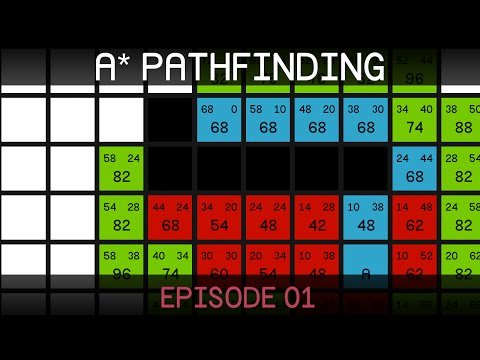
The A algorithm is a popular choice for pathfinding because it balances efficiency and accuracy very well. It is considered one of the best algorithms for finding the shortest path to a goal. It works by considering two key factors:
- g-score: The actual cost of the path traveled from the starting point to the current node. Think of this as how far you have already gone in a given path.
- h-score: The estimated cost of going from the current node to the goal. This is often called the heuristic, and it’s like making a guess about how much further you have to go.
The algorithm combines the g-score and h-score, often by adding them, to calculate an ‘f-score’ for each node. It then selects the node with the lowest f-score to explore further. This process continues until it reaches the goal. It’s like saying “I’m here, I’ve traveled this much, and I think the goal is about this far away – which route seems best overall?” The estimated part of the calculation (heuristic) makes this algorithm a lot faster.
How A Works in Simple Steps
- Start with the beginning node.
- Add the starting node to a list of nodes to check.
- Look at the nodes next to the one that was checked and calculate their f-score.
- Choose the next node with the lowest f-score and repeat until the goal is reached.
- Follow the list of checked nodes in reverse to find the complete path.
Dijkstra’s Algorithm
Dijkstra’s algorithm is another algorithm that finds the shortest path between nodes, but it does this in a slightly different way than A. Instead of using a heuristic like A, Dijkstra’s algorithm expands outwards from the starting node in all directions. It keeps track of the shortest distance to each node it finds until the final goal node is found. It’s a bit like exploring a new area by slowly growing a circle of exploration around where you start. It works well for finding the shortest path when there is not an estimate on how far the goal is, but since it expands in every direction, it can be slower than A in scenarios where the end is pretty direct.
How Dijkstra’s Works in Simple Steps
- Assign a starting node with a distance of 0, and the remaining with a value of infinity.
- Check all the nodes adjacent to the starting node, and update their distances by adding the current distance from the starting node.
- Mark the start node as done.
- Keep going by choosing the node with the minimum distance and check its adjacent nodes.
- Repeat this process until the goal is found.
Breadth-First Search (BFS)
Breadth-First Search (BFS) is a simple and straightforward algorithm that explores the game world level by level. Imagine a wave expanding outwards. It starts at the starting point and then checks all the neighboring nodes, then their neighbors and so on. BFS guarantees to find the shortest path if every move has the same cost, however, it can be inefficient if you have a very large map or a map where the target is very far away. Since it searches in all directions, it may need to search a much larger part of the map compared to A in many scenarios.
How BFS Works in Simple Steps
- Start by checking the starting node.
- Add all adjacent nodes to a queue.
- Take a node from the beginning of the queue, and check all of its neighbors.
- Add the unchecked neighbors to the queue.
- Keep repeating this until the goal is found.
Implementing Pathfinding in Roblox
Roblox makes it relatively simple to use pathfinding in your games. You can accomplish this using two primary methods:
Roblox’s Built-in PathfindingService
Roblox provides a special service called PathfindingService. This service offers an easy way to generate paths for your characters. Here’s how you generally use it:
-
Create a Path: First, you create a path using the
PathfindingService:CreatePath()method. You can provide a character that the path should avoid. -
Compute the Path: Next, use the
path:ComputeAsync(startPosition, endPosition)to calculate the route. This method does the heavy lifting for you by calculating all the nodes. -
Get Waypoints: After calculating the path, you retrieve a list of points, called waypoints, using
path:GetWaypoints(). These waypoints are the key steps your character needs to follow to reach its goal. - Move the Character: Finally, you use the waypoints to direct the character’s movement. A commonly used method involves iterating through each waypoint and moving the character to the next until the target is reached.
Here’s some example Lua code to show how to use the Pathfinding Service:
local PathfindingService = game:GetService("PathfindingService")

local startPos = Vector3.new(0, 2, 0) -- example starting position
local endPos = Vector3.new(10, 2, 10) -- example target position
local hum = --the humanoid to move

local path = PathfindingService:CreatePath({
	AgentRadius = 2,
	AgentHeight = 5,
	AgentCanClimb = true,
	AgentCanJump = true,
})

path:ComputeAsync(startPos, endPos)

if path.Status == Enum.PathStatus.Success then
	local waypoints = path:GetWaypoints()
	for i, waypoint in ipairs(waypoints) do

        hum.MoveToFinished:Wait()

		if waypoint.Action == Enum.PathWaypointAction.Jump then
			hum.Jump = true
		end
	hum:MoveTo(waypoint.Position)

	end
	hum.MoveToFinished:Wait()
end
Implementing Custom Pathfinding Algorithms
Sometimes, you might want to create your own pathfinding algorithm or tailor an existing one to suit your specific needs. This approach allows for more control, but also involves more work. In this case, you need to write the algorithm yourself in Lua. The core idea is always the same, you need to first find which points to connect together and then search through them, however, you can customize the algorithm and how it functions to better suit your needs. For example, you might want to use different criteria for calculating the cost or use different heuristics.
Considerations When Implementing Custom Algorithms:
- Performance: Writing your own pathfinding algorithm can provide some flexibility, but you have to ensure that it performs well because the performance may not be as optimized as the one provided by Roblox.
- Complexity: Creating efficient and working pathfinding algorithms is complex, and it is better to use the standard Roblox functionality unless you have very specific needs.
- Debugging: Debugging pathfinding algorithms can be tricky. Thorough testing will help make sure there are no unintended consequences.
Pathfinding Considerations and Optimizations
Regardless of the algorithm used, there are some factors that need to be considered to make sure that your pathfinding works efficiently and effectively.
Navmesh Generation
A navmesh, or navigation mesh, is like a simplified map used for pathfinding. Instead of dealing with each and every object, the pathfinding algorithm only uses the navmesh. The navmesh describes walkable surfaces within your game world. Using a pre-generated navmesh allows the pathfinding algorithm to find paths a lot quicker and more efficiently. It also ensures that the characters don’t try to walk through walls or other non-walkable surfaces.
When using Roblox’s PathfindingService, the service automatically handles the Navmesh creation. For custom solutions, you will need to implement the creation yourself which can be complex. The navmesh needs to be updated whenever the environment changes, or new obstacles are added.
Dynamic Obstacles
In your game world, obstacles are not always stationary. Things move around. For instance, players moving, doors opening and closing, or the game environment itself might change dynamically. Your pathfinding solution needs to handle this.
- Recomputing Paths: If a character is moving and a new obstacle appears, you have to recompute the path to avoid getting stuck.
- Partial Updates: To avoid recalculating paths from scratch, you can make a system for checking only specific areas for updates so you don’t need to do a complete re-calculation each time.
Performance and Optimization
Pathfinding can be computationally expensive. When many characters are doing pathfinding at the same time it can lead to lag. Here are some common optimization strategies:
- Node Culling: Don’t add waypoints that are redundant. If two waypoints are in a straight line, removing the middle one will still work while saving time.
- Reduced Node Density: Don’t add nodes for every location in the game world. The number of nodes has a big impact on performance. Using less nodes is better for performance but if there are too few nodes, pathfinding may fail.
- Rate Limiting: Don’t calculate paths too often. If the goal isn’t moving, you can calculate a path once and use the same path until something changes, unless you think you might want to recompute it to account for small movement.
- Multithreading: For complex algorithms, doing computations in parallel (on separate threads) can greatly increase the performance of your game.
Real-World Applications in Roblox Games
Pathfinding algorithms are the workhorses behind many types of interactive games. Here are a few examples:
- NPC Movement: You’ll find pathfinding algorithms everywhere for NPCs. They allow NPCs to follow players, patrol areas, or seek out other targets.
- Enemy AI: Enemies will use pathfinding to move in an intelligent manner toward their targets. The more complex the pathfinding, the smarter the enemy appears.
- User Controlled Characters: For certain games that require pathfinding to be utilized in user-controlled characters, the user can select their desired point, and the pathfinding algorithm will allow the character to reach their goal.
In summary, Roblox pathfinding algorithms are powerful tools that can dramatically improve the quality and sophistication of your games. Understanding these algorithms and implementing them effectively will lead to much better game experiences.
Advanced Roblox Scripting Tutorial #21 – Pathfinding (Beginner to Pro 2019)
Final Thoughts
In summary, understanding how Roblox pathfinding algorithms operate is crucial for creating engaging and dynamic games. We discussed several techniques developers use for efficient NPC movement. The choice of algorithm depends on your game’s specific needs.
Implementing these pathfinding strategies will significantly improve player experiences. Careful consideration of performance is key to avoid lag in your Roblox creations. Specifically, a good grasp of roblox pathfinding algorithms helps you develop sophisticated game mechanics.

