
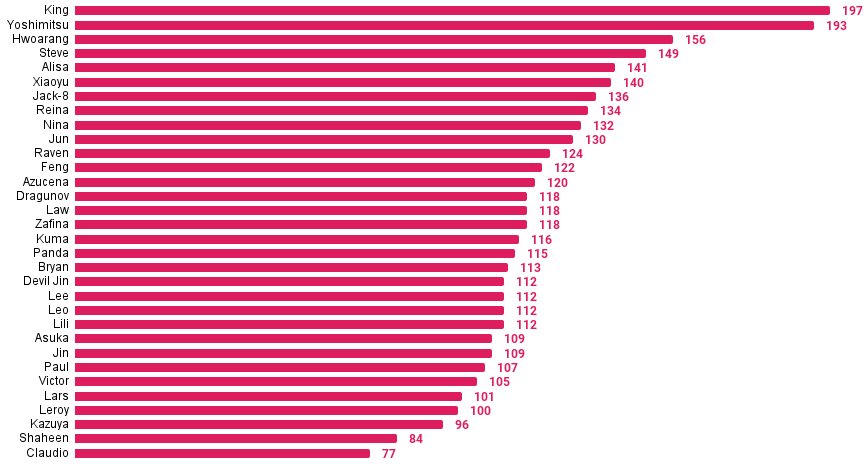
Understanding Tekken 8 character move properties requires analyzing frame data, damage values, and attack ranges, allowing players to execute effective strategies.
Tekken 8’s combat system is deep and complex, requiring players to learn nuances of each character. This includes understanding Tekken 8 character move properties. It’s not just about button mashing; knowing which moves are safe, which launch, and their impact is key to victory.
Each fighter has a unique set of techniques, each with its own characteristics. Players must study these properties and utilize them to their advantage. Effective players learn how to use frame data and range to predict opponent’s actions.

Tekken 8 Character Move Properties: A Deep Dive
Okay, so you’re diving into the world of Tekken 8, and things are getting intense! You see flashy moves, characters flying across the screen, and probably wonder, “What’s going on under the hood?” Well, a huge part of what makes Tekken battles so strategic and exciting are character move properties. These are like the secret sauce that determines how each attack works. Let’s explore these properties and see how they impact your gameplay.
Understanding the Basics: Move Categories
First, it’s important to know that not all moves are created equal. Tekken 8 divides moves into categories, each with its own rules and purpose. Think of it like different types of toys: each one has its special way of working.
High, Mid, and Low Attacks
These are the most fundamental move categories. They define where an attack hits:
- High Attacks: These moves target the upper body and head. You can often avoid these by ducking or crouching. They’re usually fast but can be predictable if you overuse them.
- Mid Attacks: These target the mid-section of the body. They’re difficult to avoid by ducking, so you’ll have to block them standing. Many of the most important attacks in Tekken are mids.
- Low Attacks: These attacks hit your opponent’s lower body. You need to block low to defend against these, and they often leave you at a disadvantage if blocked.
Think of it like a three-lane highway: high attacks go high, mids go in the middle, and lows go low. You need to watch your opponent carefully and react accordingly.
Special Move Types
Beyond the standard high, mid, and low, you have other move categories:
- Throws: These are special moves that can bypass blocking, dealing damage. They are usually performed by pressing the throw button or specific directional inputs. You can break throws if you know the correct way to do so.
- Unblockable Attacks: These, as the name suggests, can’t be blocked normally. You’ll have to dodge, sidestep, or interrupt them. They are often slow but pack a punch.
- Power Crushes/Armor Moves: These moves absorb a single hit and continue their attack animation. They are great for powering through your opponent’s offense. However, they are still vulnerable to low attacks.
Frames: The Speed of Moves
In Tekken, everything runs on frames – think of them as tiny snapshots in time. When we talk about move properties, frame data is crucial. It tells you exactly how fast a move is and how long it takes to recover from it.
Startup Frames
This is how long it takes for an attack to actually hit after you press the buttons. The lower the startup frame number, the faster the move is. A move with 10 startup frames is faster than one with 20. Fast startup means it’s harder for your opponent to react.
Active Frames
This is the window during which the move can actually hit an opponent. It might be only 1 frame or multiple frames. The more active frames a move has, the more forgiving it is if you aren’t perfectly precise with your timing.
Recovery Frames
This is how long it takes for your character to return to a neutral state after performing an attack. The lower the recovery frames, the safer the move is. If a move has high recovery frames, you could be open for a punish attack.
Frame data is shown as simple numbers, like 10i (meaning 10 frames startup). You will get a sense of frame data as you gain experience, but learning some of the important moves of your character is a great way to begin understanding the core of frame data. Many players refer to websites and resources that track frame data of characters in the game.
Hit Properties: What Happens When a Move Connects?
So, your move hits—now what? The “hit properties” determine what effect that attack has on your opponent.
Hit Advantage and Disadvantage
When you land a move, you might have “advantage” or “disadvantage” on hit. If a move has advantage on hit, you are able to act before your opponent. This means you can attack or do other things while your opponent is still recovering. On the other hand, if a move has disadvantage, the opponent can act before you, so you must be careful and aware. Frame advantage and disadvantage are usually referred to as “+” or “-” followed by the number of frames, like “+3” or “-2”.
On Block
Much like when a move hits, a move also has block advantage or disadvantage. Knowing the frame advantage or disadvantage on block is crucial, because sometimes, blocking is the best choice for your defense. Block advantage and disadvantage are also usually referred to as “+” or “-” followed by the number of frames, like “+3” or “-2”.
Hit Stun
When you hit an opponent, they go into a “hit stun” animation. How long the hit stun lasts depends on the move. A powerful move that knocks an opponent on the ground will create more hit stun than a light jab, for example.
Knockdown
Certain moves will knock an opponent down, making them vulnerable for additional follow-up attacks. Knockdown can be a very useful property of attacks, because it gives you a big advantage in the match.
Launch
Some moves will “launch” your opponent into the air. This opens up combos, letting you do big damage. Understanding which of your moves launch the opponent is extremely important.
Stagger
Stagger moves force the opponent to recover while standing. It is a different animation than being hit while blocking, and certain moves gain additional advantage if the opponent is staggered. Stagger is a very powerful property of an attack.
Tracking Properties: How Moves Move Through Space
Moves aren’t just about speed and hit effects; they also have unique ways of moving across the screen.
Linear vs. Homing Moves
- Linear Moves: These go straight ahead, without any tracking. If your opponent sidesteps, they can avoid it easily.
- Homing Moves: These moves have some level of tracking, meaning that they will slightly adjust their trajectory to follow a sidestepping opponent. These moves are very useful.
Range
Some moves have short range, while others can reach across the whole screen. Understanding the effective range of your character’s moves is very important for understanding how to space yourself against opponents.
Verticality
Some attacks can hit opponents who are airborne, and some attacks can hit opponents who are ducking. These are important properties to keep in mind when attacking opponents in Tekken.
Special Properties: Character Specific Goodies
Each character in Tekken has a unique set of moves and special properties. Some characters have stances, some can absorb attacks, and others can quickly transition between moves. Understanding your character is vital. Here are a few things to consider:
Stances
Some characters enter into stances which change their available moves. Stances can drastically alter a character’s strategy. For example, some stances can create unique evasion properties and allow the character to quickly move into and out of it. Understanding each stance a character has, and the moves available in it, is very important.
Power Moves
Some characters have specific moves that break through armor moves. These special properties are usually not written anywhere in the move list, and come with experience and research. You will have to do research and play games to find out unique aspects of characters.
Unique Movement
Some characters have dashes, teleports, jumps, or other movement options, that give them unique advantages over other characters. Mastering these movement options is very important to mastering your character.
Applying Move Properties in Your Gameplay
All this information might feel like a lot, but it gets easier over time. Here are some tips for putting this into practice:
- Experiment: Don’t just stick to one or two moves. Try out different moves in training mode to see how they work. Pay attention to their speed, range, and hit properties.
- Frame Data Training: Frame data is very important, so you should research and find out some of the fastest and safest moves your characters have. You don’t have to memorize everything, but it will greatly improve your understanding.
- Watch Replays: Watching your own replays can help you find weaknesses in your strategy and learn how to better approach situations.
- Practice: Tekken is a game that rewards dedicated practice. Put time into learning your moves and understanding how each move works in different situations.
- Learn by Watching: Watch skilled players to see how they use character move properties. Pay attention to how they apply pressure and how they punish mistakes.
Understanding these move properties will greatly improve your Tekken gameplay. It takes time and practice, but you will be well on your way to becoming a great Tekken player.
And so, we’ve looked at how moves work in Tekken 8. It might feel like a lot to take in at first, but the more you play, experiment, and learn, the more these properties will make sense. Keep playing, keep practicing, and have fun exploring all the intricate details that Tekken 8 has to offer. Remember, every move has a purpose, and understanding those purposes will make you a better player.
Tekken 8 Complete Beginner Guide
Final Thoughts
Analyzing Tekken 8 character move properties is crucial for competitive play. Understanding frame data, range, and damage output helps players form effective strategies. Each character possesses unique moves, demanding individual study.
Effective use of move properties leads to better mix-ups and punishes. Players should therefore spend time in practice mode. Optimizing gameplay revolves around utilizing each character’s specific strengths.
Tekken 8 character move properties dictate the flow of battle. Successful players learn and adapt to these properties.

