
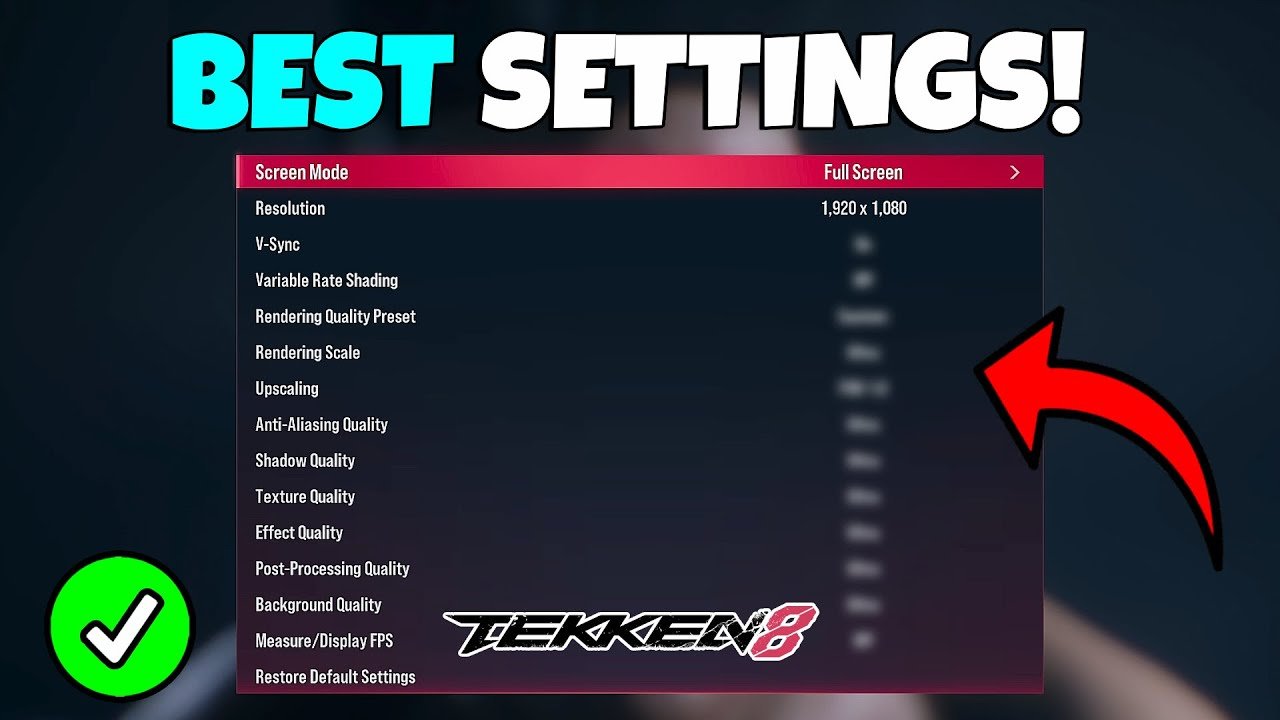
To optimize settings in Tekken 8, prioritize lowering graphics options like shadows, anti-aliasing, and textures for better performance, while ensuring your resolution matches your monitor for clarity.
Struggling with Tekken 8’s performance? Many players are searching for ways to improve their game’s responsiveness and visual fidelity. The good news is that you can fine-tune the game to get the best possible experience on your PC or console. Knowing exactly Tekken 8 how to optimize settings is key to achieving smooth gameplay.
Tweaking the in-game graphics settings can make a significant impact, allowing you to enjoy the intense fighting action without frustrating frame drops. By carefully adjusting these parameters, players can achieve a balance between visual quality and smooth, responsive play.

Tekken 8 How to Optimize Settings
Getting the best performance in Tekken 8 is super important, whether you’re playing online or offline. Nobody wants to deal with lag or choppy graphics when they’re trying to pull off a perfect combo! This article will walk you through all the settings you can tweak to make Tekken 8 run smoothly and look great on your PC or console.
Understanding the Basics: What Affects Performance?
Before we jump into specific settings, it’s good to know what makes Tekken 8 run well (or not so well!). Think of it like building with LEGOs. Some LEGOs (like your graphics card) are bigger and more powerful than others. Here are some main factors:
- Graphics Card (GPU): This is the main engine for visuals. A stronger GPU lets you use higher graphics settings without slowdown. It’s like having a big, fast race car.
- Processor (CPU): The CPU handles all the thinking. It’s important for processing game logic, AI, and physics. A better CPU means less chance of lag or stuttering. Imagine it as the brain that controls all the actions.
- RAM (Memory): RAM is where the game stores the information it’s currently using. More RAM means the game can access the information quickly, which results in smoother gameplay. Picture RAM like a big desk where your work can be kept easily accessible.
- Storage (SSD vs HDD): Where you store the game matters, too. SSDs (Solid State Drives) are much faster than HDDs (Hard Disk Drives), so if you have an SSD, use that for your game. It will make loading times much faster. It’s like having a super-fast elevator instead of stairs.
- Monitor Refresh Rate: This tells you how many times per second your monitor updates the image. A higher refresh rate (like 144Hz or 240Hz) can make the game look smoother if your computer can keep up. Think of it like flipping pages in a flipbook really fast.
Optimizing Graphics Settings on PC
Okay, let’s dive into the nitty-gritty of graphics settings on PC. Tekken 8 has lots of options you can change to find the perfect balance of visuals and performance. Here’s a breakdown:
Resolution
Resolution is how many pixels make up the image on your screen. Higher resolution means sharper images, but it also uses more processing power. If your game is running slowly, consider lowering the resolution. Here’s what to know:
- Native Resolution: This is the resolution that matches your monitor. It’s usually the sharpest.
- Lower Resolutions: If you are struggling with performance, using resolutions like 1280×720 or 1920×1080 can significantly boost frame rate.
How to change resolution:
- Go to the game’s options menu.
- Find the “Graphics” or “Display” settings.
- Look for the “Resolution” option and choose your desired setting.
Texture Quality
Texture Quality controls how detailed the surfaces of objects look. Higher quality textures can make things look more realistic, but they use more of your GPU’s memory. Here’s a simple guide:
- High Textures: These look the best, but they’ll eat up memory. Use this setting if you have a good graphics card.
- Medium Textures: A good middle ground. They look decent while being kinder on your GPU.
- Low Textures: Use this option if your computer is struggling. The visuals might not look as impressive but the performance will improve.
Steps to change texture quality:
- Go to the Graphics settings.
- Locate “Texture Quality” or a similarly named option.
- Use the dropdown to choose your setting preference.
Shadow Quality
Shadows add depth to the game, but they also can be very demanding. Lowering the quality of shadows can result in a big jump in performance, especially on lower-end hardware. Key aspects include:
- High Shadow Quality: Detailed, sharp shadows that look very realistic.
- Medium Shadow Quality: A balance between detail and performance.
- Low Shadow Quality: Simple shadows, less detailed, and give you more performance.
- Shadows Off: No shadows. This can greatly increase performance but will make the game look much flatter.
Steps to change shadow quality:
- Open the game settings menu.
- Find and open the graphic settings.
- Change the setting using the “Shadow Quality” option.
Anti-Aliasing
Anti-Aliasing smooths out the jagged edges of objects and lines, making them appear less pixelated. There are several types of Anti-Aliasing, each with different performance costs and results. Here are the common types you might see:
- FXAA (Fast Approximate Anti-Aliasing): Very light on performance, but can make the image look a bit blurry.
- TAA (Temporal Anti-Aliasing): Good balance of smoothness and clarity, but can cause ghosting in some cases.
- MSAA (Multi-Sampling Anti-Aliasing): More demanding, but can provide a clearer, sharper image.
- Off: Turns anti-aliasing off completely, which can give the largest boost in performance.
Steps to change the anti-aliasing setting:
- Go to the graphic settings.
- Find the “Anti-Aliasing” setting.
- Choose your preferred anti-aliasing option.
Effects Quality
This controls how detailed special effects such as explosions, fire, and other visual elements are displayed. Adjusting this can significantly impact performance. Here’s a simple overview:
- High Effects Quality: Maximum detail for the effects.
- Medium Effects Quality: A middle ground, providing decent visuals without a heavy performance impact.
- Low Effects Quality: Minimal detail for special effects.
How to change the Effects Quality:
- Navigate to the graphics settings
- Find the option for “Effects Quality” or a similar setting
- Make your desired changes in the setting.
Motion Blur
Motion Blur creates a blurring effect when things move quickly, mimicking the way our eyes see movement. Some people like it because it adds to the cinematic look. Others find it distracting and prefer a sharper image. Here’s what you should know:
- On: Motion blur is enabled, which can reduce the visibility of small details.
- Off: Motion blur is turned off, giving a sharper image with fast-moving objects.
How to turn Motion Blur on or off:
- Open the game options menu.
- Look for “Motion Blur” in the graphics settings.
- Turn the setting on or off to your preference.
Ambient Occlusion
Ambient Occlusion (AO) adds realistic shadows to the corners and crevices of objects, making them look more grounded. While it can add depth, it can also be very demanding on your GPU. If you have performance issues, try turning this down. Some options are:
- High AO: Adds realistic shadows.
- Low AO: Reduces the quality of these shadows.
- Off: Turns ambient occlusion off.
How to control the Ambient Occlusion setting:
- Open the graphics settings menu.
- Find the “Ambient Occlusion” setting.
- Choose your desired setting.
Screen Space Reflections
Screen Space Reflections (SSR) create reflections on surfaces like puddles or shiny floors. SSR can add a lot to the visual fidelity, but it can be demanding. Here’s what to consider:
- On: Reflections are visible and look great.
- Off: Reflections are turned off which greatly improves performance.
How to toggle Screen Space Reflections:
- Go to the graphics settings menu.
- Look for the “Screen Space Reflections” or “SSR” option.
- Turn the setting on or off as needed.
V-Sync
V-Sync syncs your game’s frame rate with your monitor’s refresh rate. This prevents screen tearing, which happens when the monitor displays parts of two different frames at the same time. If your monitor’s refresh rate is 60Hz, then V-Sync will limit the maximum frame rate of your game to 60 frames per second (FPS). Here’s what to consider:
- On: Prevents screen tearing, but it can sometimes cause input lag and lower frame rates if your GPU struggles.
- Off: No limit to how many frames are rendered, but you might see screen tearing.
How to use V-Sync:
- Go into your game’s graphic settings menu.
- Look for a setting called “V-Sync” or “Vertical Sync”.
- Turn the setting on or off as per your needs.
Note: If you have a monitor with adaptive sync (like G-Sync or FreeSync), you might not need to enable V-Sync and can enable that in the graphics control panel itself.
Frame Rate Limit
Tekken 8 allows you to set a limit on your frame rate, which can prevent your computer from working harder than it needs to. This is especially useful if you get fluctuating frame rates that go too high or low.
- No Limit: Renders as many frames as possible.
- 30/60/120/Max: Limits the frame rate to your selected FPS.
How to use frame rate limit:
- Open your Tekken 8 settings.
- Go to your graphics settings.
- Find the “Frame Rate Limit” and set to your preferred setting.
Console Settings: PS5 and Xbox Series X/S
Consoles have fewer graphics options than PCs, but there are still things you can do to get the best performance. Tekken 8 is optimized for consoles, so it should generally run well by default. However, here are a few things to consider:
Performance vs. Resolution Mode
Some games, including Tekken 8, let you choose between a “Performance Mode” and “Resolution Mode”. Here is what to expect:
- Performance Mode: This setting prioritizes higher frame rates, often with a lower resolution. It results in a smoother game.
- Resolution Mode: This setting prioritizes higher resolution and sharper images at the cost of frame rate. The game will look crisper, but may not feel as smooth.
How to set this in Tekken 8:
You will likely find the graphics or visual mode option in the game’s display settings. Choose the mode that best matches your needs.
HDR
HDR (High Dynamic Range) can make colors look more vibrant and realistic, but this can only be used if your TV or monitor supports it. If it’s enabled by default, you can try turning it off to see if it improves performance.
How to use HDR:
You can find the HDR settings in your console’s settings or in the game’s display settings, if available. Toggle the setting as needed.
System Updates
Keep your console’s system software up to date. Console manufacturers often release updates that improve game performance and stability.
Game Updates
Also, make sure your games are always updated. Game developers often release patches that fix bugs and improve performance.
Advanced Tweaks (PC)
If you want to go even further, here are some extra tweaks you can try, particularly on PC.
NVIDIA Control Panel and AMD Radeon Software
Both NVIDIA and AMD offer control panels where you can tweak graphics settings for individual games. Here are a few settings you might want to try:
- Image Sharpening: A good setting to increase image quality without significant performance loss.
- Low Latency Mode: Try this to reduce input lag.
- Texture Filtering Quality: Adjust this to find a good balance between performance and image quality.
- Anisotropic Filtering: This makes textures look sharper at angles. Try setting this to 16x.
Background Applications
Close any unnecessary applications running in the background. This frees up resources for Tekken 8. Software like web browsers, music players, or other game launchers can use resources that should be dedicated to the game.
Drivers
Make sure you’re using the newest graphics drivers. Often, driver updates include performance improvements and bug fixes. You can download these from the NVIDIA and AMD websites.
Overclocking
Overclocking can help squeeze extra performance out of your GPU or CPU. Be cautious when doing this, and make sure you know what you are doing. Overclocking can cause instability or damage to your hardware if not done correctly.
Finding Your Sweet Spot
Optimizing settings is all about finding the right balance for your computer or console. Don’t be afraid to try different settings and see what works best for you. You may need to change settings one by one and keep testing to find the best performance.
Here’s a general plan to follow:
- Start with recommended settings.
- Lower resolution and texture quality if performance is not great.
- Experiment with shadow, anti-aliasing, and effects quality.
- Toggle V-Sync and motion blur as needed.
- Use third-party utilities for fine-tuning if needed.
Ultimately, the best settings are the ones that let you enjoy Tekken 8 without annoying lag or stuttering. Don’t be afraid to experiment and have fun!
TEKKEN 8 BEST GRAPHICS SETTINGS + FAST RESPONSE TIME
Final Thoughts
Optimizing your graphics settings significantly improves Tekken 8’s performance. Adjust resolution, anti-aliasing, and shadows for smoother gameplay. Experiment with lower settings to achieve a stable frame rate, essential for competitive play. This guide helps you understand ‘Tekken 8 how to optimize settings’.
Fine-tuning texture quality and effects impacts visual clarity and speed. Disable motion blur and depth of field to reduce input lag. These tweaks provide a more responsive and fluid experience. Adjusting those options will give you better perfomance.

