
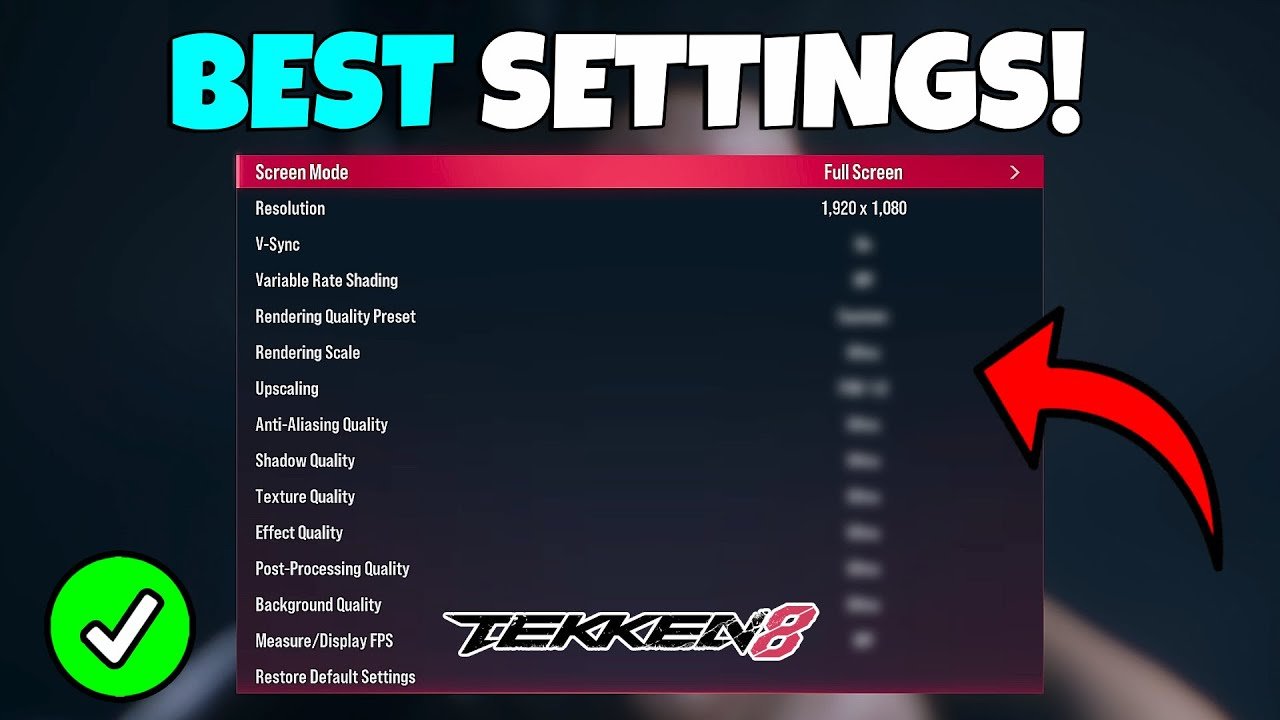
Tekken 8 graphic settings allow players to adjust resolution, texture quality, shadow detail, and various effects to optimize performance or visual fidelity.
Dive into the world of Tekken 8! Many players are keen to get the best visual experience and smooth gameplay. Understanding Tekken 8 what are graphic settings is key to achieving this balance.
You can modify multiple options to fine-tune the game to your PC. These settings influence frame rates and the overall appearance of the game.
Adjusting these properly will certainly make your matches more enjoyable. Experimentation is often the best way to find what works for you.

Tekken 8: Diving Deep into Graphic Settings
Alright, fighters! Let’s talk about making Tekken 8 look its absolute best. You’ve got the skills to win, but having the right graphic settings can really make those electrifying battles pop. This isn’t just about making the game look pretty; it’s about finding that sweet spot between amazing visuals and smooth gameplay. We’re going to explore all the graphic options Tekken 8 throws at you and how to tweak them to get the best experience on your PC or console. It can be a bit overwhelming at first, but don’t worry, we’ll break it all down nice and easy.
Understanding the Basics
Before we jump into specific settings, let’s get a handle on some key terms. Think of these as the building blocks for how Tekken 8 looks.
Resolution
Imagine your game screen like a big grid. The resolution is how many tiny squares, called pixels, make up that grid. Higher resolution means more pixels, which translates to a sharper, more detailed picture. Common resolutions include 1920×1080 (also known as 1080p or Full HD), 2560×1440 (1440p or Quad HD), and 3840×2160 (4K or Ultra HD). A higher resolution usually looks better, but it also needs more power from your computer or console.
Frame Rate (FPS)
FPS stands for frames per second. It’s how many images your screen shows every second. Think of it like a flipbook; the more pages you flip per second, the smoother the animation looks. A higher FPS makes the game feel more responsive and fluid. 60 FPS is often the goal for smooth gameplay, though higher refresh rates (like 120Hz or 144Hz) and higher FPS can make it feel even better.
Graphics Quality Presets
Tekken 8, like many games, offers preset graphic quality levels – usually Low, Medium, High, and sometimes Ultra. These presets automatically adjust several settings at once. Low focuses on performance, sacrificing visual quality. High or Ultra aims for the best visuals, but they require a more powerful system. It is a good place to start when figuring out what works best for you. Try these presets to get a feel for how much your computer can handle. If one preset is too much for your setup, then try going a step lower to see if it runs better.
Essential Graphic Settings Explained
Okay, now let’s get into the nitty-gritty. These are the settings you’ll be tweaking to find the right balance of looks and performance.
Texture Quality
Textures are like the wallpaper on the objects, character models, and backgrounds. High texture quality means sharper details, making everything look crisp and clear. If your system struggles, lowering texture quality can improve performance, but at the expense of visual fidelity.
Here’s a simple breakdown:
- High: Best details, uses more VRAM.
- Medium: A good balance.
- Low: Least detail, helps performance.
Shadow Quality
Shadows add depth and realism to the game, but they can be resource intensive. Higher shadow quality means softer, more accurate shadows, while lower quality can result in jagged or less realistic shadows. If you are on a lower powered setup, then turning down shadow quality is a good way to boost performance.
Here’s a simple breakdown:
- High: Soft, detailed shadows.
- Medium: Good balance of quality and performance.
- Low: Basic, sharper shadows, better performance.
Effects Quality
This setting controls how good things like explosions, fire, and other visual effects appear. Lowering this can improve performance but means some of those flashy moments may lose some of their impact. In a game like Tekken, where you are looking at the fighting most of the time, this setting is not as important as some of the others.
Here’s a simple breakdown:
- High: More complex and detailed effects.
- Medium: Good for overall effect quality.
- Low: Simpler effects, better performance.
Anti-Aliasing
Imagine edges on diagonal lines look jagged or pixelated. Anti-aliasing smooths these edges, making them look cleaner. There are different types of anti-aliasing, and some are more demanding than others. Common options are TAA (Temporal Anti-Aliasing), MSAA (Multi-Sample Anti-Aliasing), and FXAA (Fast Approximate Anti-Aliasing).
Here’s a simple breakdown:
- TAA: Good for overall smoothness, can sometimes cause slight blurring.
- MSAA: Provides sharp results, but more demanding.
- FXAA: Less demanding, but may not smooth edges as effectively as the others.
- Off: Can improve performance but will produce jaggy looking lines
Motion Blur
Motion blur simulates the effect of fast-moving objects by blurring them. It can add a sense of speed, but some players dislike it because it can make the image look a little blurry, especially during intense action. Some people really like the effect, while others find it distracting. It’s all down to personal preference.
Here’s a simple breakdown:
- On: Adds motion blur effects.
- Off: No motion blur.
Ambient Occlusion
Ambient occlusion creates realistic shadows where objects touch each other or in small corners. It adds depth and makes the scene look more natural. Higher quality ambient occlusion can be pretty demanding on resources. If you are looking to improve performance, then try lowering this setting, or switching it off completely.
Here’s a simple breakdown:
- High: More detailed shadows.
- Medium: A balance between quality and performance.
- Low: Basic ambient shadows.
- Off: No ambient occlusion.
Dynamic Resolution
This is a setting that tries to keep the frame rate consistent by changing the game’s resolution in real-time. If your computer or console starts to struggle, dynamic resolution lowers the resolution slightly to keep the game running smoothly. The trade off is that the resolution fluctuates, so it might not look consistent all of the time.
Here’s a simple breakdown:
- On: Resolution can go down to keep the frame rate high.
- Off: Resolution is constant even if the performance isn’t good.
V-Sync
V-Sync (Vertical Synchronization) syncs the game’s frame rate with your monitor’s refresh rate. This can prevent screen tearing (where parts of the image are misaligned) but can sometimes cause input lag (delayed responses). If your computer is struggling to keep up with the monitor’s refresh rate, then v-sync can reduce the performance of the game. If you do not notice any screen tearing, then turning V-sync off can boost performance slightly.
Here’s a simple breakdown:
- On: Prevents screen tearing.
- Off: Can improve performance if tearing isn’t a big issue.
Finding the Right Balance
Alright, so how do you find the perfect settings? It’s all about trial and error. Start with the graphics preset that is closest to your desired performance and image quality. If you have a high powered system then start with the Ultra preset. If you have a mid range system, then the High preset should be a good place to start. If you have an older PC or you are on a laptop, then start with the medium or low preset.
From there, start tweaking individual settings. If the game is running sluggishly then lower each one at a time, checking to see how much each setting impacts performance. Then work on the image quality. You will want to keep an eye on your frame rate (FPS). Aim for a consistent 60 FPS or higher for smooth gameplay. Many games display an FPS counter so you can see how the game is running. If your frames are too low, try turning the most demanding settings down. Things like shadow quality, ambient occlusion and anti-aliasing are good settings to lower first as they often have a big impact on performance.
Use the game’s benchmark mode if available. Tekken 8 may not have this, but if it does it will help to test out your settings and give you an idea of how the game will perform during a regular match.
Specific Recommendations
While everyone’s setup is different, here are some general guidelines:
For High-End PCs
If you have a powerful gaming PC with a recent graphics card (like an RTX 30 series or higher), you can usually max out most settings at 1080p, 1440p or even 4k. Start with the “Ultra” or “Highest” preset and then experiment with turning some of the settings up further, or adding higher levels of anti-aliasing to make the game look even better. Make sure you are still hitting that target FPS though.
For Mid-Range PCs
With a mid-range PC, starting with the “High” or “Medium” preset is a good bet. Try not to lower the texture quality too much because that is something you will notice right away in terms of the look of the game. If you need more FPS, try lowering the shadow and effects quality and make sure you test the game both with V-Sync on and off to see what works best.
For Lower-End PCs or Laptops
For less powerful systems, focus on performance first. Start with the “Low” preset and see if it is hitting the target of 60 FPS. Then experiment with changing the settings up a little bit at a time. If you can turn textures up without losing FPS, then try that first. The shadows and effects qualities can probably be kept on low. Make sure to test if V-sync improves or hurts the performance on your system. Using dynamic resolution is also recommended, as this will ensure the game is playable by reducing the resolution in times of stress, which will hopefully be unnoticeable during the match. You can also try lowering the games resolution if the settings still cause the game to have low FPS.
Console Players
On consoles, the options are more limited, and are usually automatic to suit your console model. But, you can usually choose between performance mode or graphic mode. Performance mode, focuses on keeping the frame rate high. Graphic modes prioritize the look of the game, and will often lower the frame rate to achieve a higher resolution or graphical effects. Consoles are generally very good at optimizing games so it shouldn’t require much work to get it running well, no matter which console model you are using.
A Quick Reference Table
Here’s a table to summarize some of the key settings:
| Setting | High | Medium | Low | Effect on Performance |
|---|---|---|---|---|
| Texture Quality | Best details | Balanced | Least details | High |
| Shadow Quality | Soft, detailed | Good balance | Basic shadows | Medium to High |
| Effects Quality | Detailed effects | Good details | Simpler effects | Medium |
| Anti-Aliasing | Smoothed Edges | Balanced | Basic smoothing | Medium to High |
| Ambient Occlusion | Complex shadows | Good shadows | Basic shadows | Medium to High |
Experimentation is key, as every system is unique! Don’t be afraid to dive into the options menu and see what works best for you.
Adjusting the graphic settings in Tekken 8 is all about finding that sweet spot. This is that perfect balance of visual quality and smooth, responsive gameplay. It may take a little time, but with some tweaking, you’ll be able to make Tekken 8 look and play its absolute best on your setup. Good luck in the arena!
TEKKEN 8 BEST GRAPHICS SETTINGS + FAST RESPONSE TIME
Final Thoughts
Adjusting Tekken 8 graphic settings is key for optimal performance. Players can tweak options to balance visuals and frame rates. Experimentation with different settings will benefit every gameplay experience.
Finding the best configuration for your system is vital. This can ensure smooth battles. Understanding ‘Tekken 8 what are graphic settings’ will help you customize the game to your preference.

