
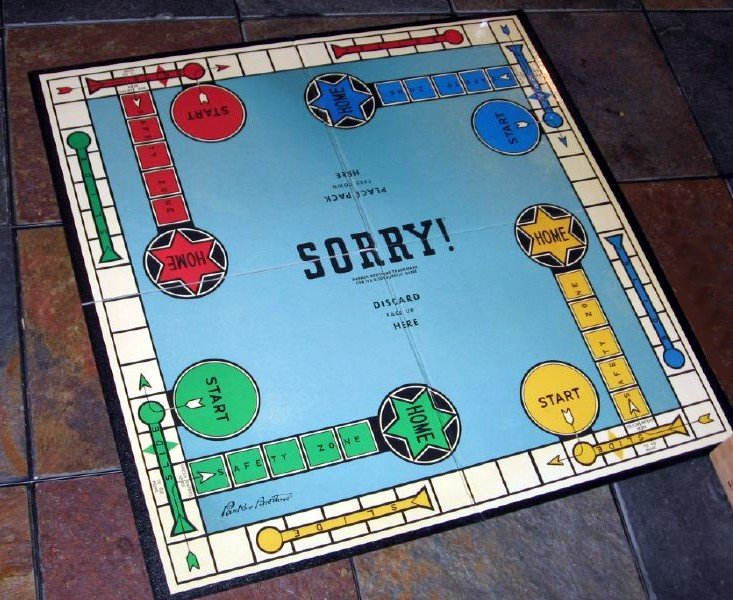
The rules for the board game Sorry! involve moving pawns around the board, drawing cards to determine movement, and trying to get all your pawns “home” while bumping opponents back to start.
Have you ever wondered exactly how to play that classic game gathering dust on your shelf? It can sometimes feel like you need a referee just to figure out the gameplay. Let’s dive into the essentials, answering the question, what are the rules for the board game sorry?
The game revolves around getting your four pawns from your start space to your home space. You achieve this by drawing cards, which dictate how many spaces you move or whether you can swap positions with opponents. Landing on an opponent’s pawn sends it back to their start.

What Are the Rules for the Board Game Sorry?
Let’s dive into the exciting world of Sorry!, a classic board game that has entertained families for generations. If you’ve ever wondered how to play or need a refresher on the rules, you’ve come to the right place. This guide will explain everything you need to know to get started and enjoy a fun-filled game.
Setting Up the Game
Before you can start sending your pawns around the board, you need to get everything ready. Here’s how to set up a game of Sorry!:
- The Board: Place the game board in the center of the playing area, making sure everyone can easily reach it.
- The Pawns: Each player chooses a color and takes all four pawns of that color. Place these pawns on their corresponding “Start” area.
- The Deck of Cards: Shuffle the deck of cards well and place them face down within reach of all players. This will be the draw pile.
The Goal of the Game
The main goal in Sorry! is to be the first player to get all four of your pawns safely from your “Start” area, around the board, and into your “Home” area. Sounds simple, right? But watch out for those sneaky “Sorry!” cards and other players trying to bump you back to “Start”! It’s a race to the finish where being a bit strategic can get you ahead.
Understanding the Game Board
The Sorry! game board has a very specific design that players need to understand to move their pawns correctly. It includes several important areas that each has specific roles. Let’s get familiar with them:
- Start Areas: Each player has their own color-coded start area. This is where your pawns begin the game. They must remain there until you draw the right card.
- The Track: This is the path that your pawns travel around the board. Pawns move in a clockwise direction around the board.
- Slide Spaces: These are spaces with colored arrows on them. If your pawn lands at the start of a slide, it must slide forward to the end of the slide, potentially bumping other pawns out of the way.
- Safety Zones: These are colored pathways leading directly to each player’s “Home” space. Only pawns of the correct color can enter these zones.
- Home Areas: Each player’s “Home” area is at the end of their safety zone. This is where you need to get all your pawns.
The Sorry! Cards and What They Mean
The cards in Sorry! are your key to moving pawns. Each card has a different number and effect. Here’s a breakdown:
Number Cards (1-4)
- Card 1: Move one pawn one space forward, or take a pawn from “Start” and move it one space forward. You can always choose to start a pawn if you have one at “Start.”
- Card 2: Move one pawn two spaces forward. You can also choose to move one pawn from “Start,” moving that pawn two spaces forward on the main track.
- Card 3: Move one pawn three spaces forward.
- Card 4: Move one pawn four spaces forward.
The Special Cards (5-12 & Sorry!)
- Card 5: Move one pawn five spaces forward.
- Card 7: You can move one pawn seven spaces forward, or you can move one pawn backward seven spaces. You must do one or the other.
- Card 8: Move one pawn eight spaces forward.
- Card 10: Move one pawn 10 spaces forward, or move one pawn one space back. You must do one or the other.
- Card 11: Move one pawn 11 spaces forward. You can also swap any one of your pawns with an opponent’s pawn on the main track.
- Card 12: Move one pawn 12 spaces forward.
- The “Sorry!” Card: Take any one of your pawns from “Start” and move it directly to any space occupied by an opponent’s pawn. The opponent’s pawn you bumped goes back to their “Start”. You can’t use this card on pawns in the “Safety Zone”. This is a key way to move your pieces and send others back to the beginning.
Starting a Pawn
You need a 1 or 2 card to get a pawn from the “Start” area and onto the main track. Remember, you can always use a 1 or 2 to move a pawn onto the main track if you have one available at “Start”. This strategic approach can help you get all your pawns into play quickly.
Moving Your Pawns
When moving, pawns always move in a clockwise direction around the board. Follow these guidelines:
- Count out the number of spaces on the card carefully. Be sure to double check the path you are moving to avoid any mistakes in counting.
- If you land on a space occupied by another player’s pawn, move your pawn to that space, and send the opponent’s pawn back to their “Start”. This is a central game mechanic that creates competition between players.
- When you reach your home safety zone, only your own colored pawns can enter.
Using Slides
Landing at the beginning of a slide, indicated by a colored arrow, requires that you immediately slide forward to the last space on the slide. This means you automatically jump forward, and send any pawns along that slide back to the their “Start.” For example, if you land at the start of a red slide, your pawn will be immediately moved to the end of the slide, which can provide you an advantage. You must slide even if it doesn’t benefit your game, or hurts your game play.
Entering the Safety Zone
Pawns can only enter their own colored safety zone. You cannot enter another player’s safety zone. Once in the safety zone, pawns are immune from being bumped back to “Start” by an opponent. However, you cannot move the pawn backwards out of the safety zone.
Getting Home
To get your pawns into the “Home” area, you must move them exactly into the space. If you don’t have the exact number of spaces, you will have to wait for the right card on future turns. Getting all four pawns into “Home” is the goal of the game, and it requires patience and sometimes a little luck!
Bumping Opponents
The act of bumping an opponent’s pawn back to their “Start” is a core part of Sorry!. If your pawn lands on an occupied space, the opponent’s pawn immediately goes back to their “Start,” and they need to draw a one or two card to get that pawn back into play again. This bumping action keeps the gameplay dynamic and exciting!
Strategic Play Tips
While luck plays a role in the cards you draw, here are a few strategies to keep in mind:
- Focus on getting all your pawns into play: Don’t leave all four pawns in the “Start” area for too long. Get them moving around the board to get more chances to move toward home.
- Use the “Sorry!” cards wisely: When you draw a “Sorry!” card, plan the best pawn to use to bump the opponent you need to bump to gain an advantage.
- Plan your moves: Try to anticipate moves to avoid getting bumped back to “Start” as much as possible.
- Use slide strategically: Use slides to jump ahead and knock opponent’s pawns out of your way when you have the chance.
- Protect pawns in the safety zones: Once your pawns are in your safety zone, they are protected from bumping, and the last stage to get home.
Common Misconceptions About the Rules
Let’s clear up some common misunderstandings about the Sorry! rules:
- You can only enter the safety zone with a precise move: Yes, you cannot overshoot the “Home” area, and need the exact amount of spaces.
- You can’t bump yourself back home: Yes, you cannot move another one of your own pawns back to the start.
Winning the Game
The first player to successfully get all four of their colored pawns into their “Home” area is the winner of the game. Congratulations, if this is you!
Variations of Sorry!
There are some minor variations of the game that may be played between groups of people, especially in families that play the game often. Here are some to look for:
- “Sorry” With a Partner: If playing with 4 players, you can team up as partners for a 2 v 2 game.
- The Mercy Rule: Sometimes a house rule will be put into effect where a player can put their pawn back in the start area if they are about to win and be bumped by a “Sorry” Card.
These variations can offer different levels of challenge and fun, depending on how your group plays the game.
Understanding these rules and strategies makes playing Sorry! even more enjoyable and competitive. So grab your game, gather your friends and family, and get ready for a fun-filled experience!
How to Play Sorry!
Final Thoughts
In summary, a player must move their pawns around the board, following the spaces. They draw cards indicating how many spaces to move or if special actions are possible. A ‘Sorry!’ card sends another player’s pawn back to start.
The rules also state that you must slide down any slides on the board if you land on their beginning. The primary goal remains to be the first player to move all four of their pawns “home.” So, now you have a better grasp of what are the rules for the board game sorry.

