
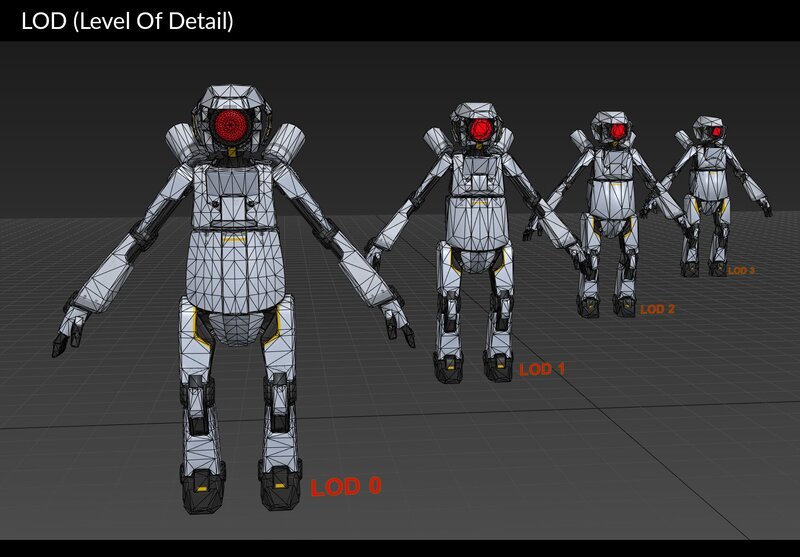
‘LOD in games stands for Level of Detail, which refers to the complexity of a 3D model based on its distance from the player.’
Ever wondered how games manage to render vast landscapes without causing your computer to explode? What does LOD mean in games, and why is it so crucial? This term appears frequently in discussions about game optimization and performance.
Level of Detail, as it’s known, helps games become smoother by simplifying objects that are far away. Instead of showing every intricate detail on distant mountains, the game shows a less complex version. This saves resources and boosts frame rates.

What Does LOD Mean in Games?
Have you ever played a video game and wondered how it looks so good, especially when there’s so much happening on the screen? Well, a big part of that magic is something called LOD, which stands for Level of Detail. It’s a clever trick that game developers use to make games run smoothly and look amazing at the same time. Let’s dive deeper into what LOD is all about.
Understanding Level of Detail
Imagine you’re looking at a car from really far away. You wouldn’t see all the tiny details, like the lines on the tires or the reflection in the paint. You’d mostly see a basic shape. Now, imagine you walk right up to the car. Suddenly, you see every little detail! That’s kind of how LOD works in games.
In video games, everything you see – from trees and buildings to characters and cars – is made of shapes called polygons. These polygons create all the details we see. The more polygons an object has, the more detailed it looks. But here’s the thing: rendering (or drawing) a ton of super-detailed objects all the time would be incredibly hard for your computer or console. It would make the game slow down and might even cause it to crash. That’s where LOD comes to the rescue.
How LOD Works Its Magic
LOD involves creating different versions of the same object, each with a different level of detail, or polygon count. Game developers create multiple models. Each model has different amounts of detail. The game only shows the model with lots of detail when it’s close to the player. As an object moves farther away, the game switches to models with fewer polygons. It does this because your eyes can’t see tiny details from far away anyway. So there’s no need to draw those details. This helps the game keep a steady speed. It makes sure the game runs without lagging or slowing down.
Think of it like this:
- High Detail Model: Used when objects are very close to the player. It has many polygons, showing all the tiny details.
- Medium Detail Model: Used when objects are a bit farther away. It has fewer polygons, removing some of the smaller details.
- Low Detail Model: Used when objects are far away. It has very few polygons, showing just a basic shape.
The game automatically changes between these models, often so quickly you won’t even notice it’s happening! It’s like a magic trick that makes your game perform better.
Why is LOD Important?
LOD is really important for a few reasons. Firstly, it helps games run smoothly, keeping the frame rate high. The frame rate is how many pictures per second your screen displays. A high frame rate makes the game look fluid and responsive. Without LOD, games would be very slow and choppy. This is because computers would struggle to render a lot of detailed objects all at once.
Secondly, LOD helps games look better. Because when something is close to you, it looks super detailed. But as objects move farther away, the details decrease. This makes the game world feel more realistic. It makes it seem like the way things look in real life. It’s much better than always having the same level of detail for everything.
Different Types of LOD
There are different ways game developers use LOD. While the basic principle remains the same, they might adjust how they apply LOD for various situations. Here are a few examples:
Discrete LOD
This is the simplest form of LOD. Discrete LOD uses separate models for each distance level. Think of it as distinct steps. The game suddenly switches from one model to another as the object moves farther away. This method is straightforward to implement. But sometimes, you can notice the sudden switch. This is called ‘popping’ and it can be distracting if not handled carefully.
Continuous LOD
This is a more advanced method. It smoothly changes the detail of an object. Instead of distinct steps, the detail level changes gradually as the object moves farther away. This makes the change less noticeable. It usually looks more visually pleasing than discrete LOD. However, this method is more complex to implement.
Billboard LOD
This kind of LOD is often used for things like trees or bushes that are very far away. Instead of using a 3D model, the game will switch to a flat 2D image that rotates to always face the player. This 2D image is called a billboard. Billboard LOD uses very few resources. It’s perfect for faraway objects. It helps the game run even faster. It is a very effective LOD technique.
Imposter LOD
Imposters are like super charged billboards. Instead of just flat images, they can store more data, including depth. This helps to create a better sense of perspective and volume. They give an illusion of more detail when viewed from specific angles. Imposter LODs are a powerful way to reduce the amount of work the computer has to do while retaining more visual fidelity than typical billboards. The game uses this technique for very far away objects. The result is a good balance of good looks and performance.
Factors Affecting LOD Implementation
The specific way LOD is implemented in a game depends on several factors:
- The game’s genre: A fast-paced action game might need more aggressive LOD to maintain a high frame rate. A slower, more detailed strategy game might prioritize visual quality over speed.
- The platform: Games for powerful PCs can use more detailed models and more complex LOD techniques. Games for less powerful devices will need simpler models and more aggressive LOD.
- Art style: Highly stylized games may use fewer polygons and simpler LOD transitions. Games that aim for photorealism will likely utilize more complex techniques.
- The game engine: Different game engines have different features. These will affect how developers can implement LOD. Some engines have built-in tools for managing LOD. Others may require developers to create their own solutions.
Examples of LOD in Action
Let’s look at how LOD might be used in some common game scenarios:
Open World Games
In open world games, you often see lots of trees, buildings, and characters at once. LOD is critical here. When you’re close to a city, the buildings have lots of tiny details. As you move farther away, the building details become less intricate. The trees in the distance become simple shapes. This is all thanks to LOD.
Racing Games
In a racing game, the player is constantly moving very fast. LOD changes become crucial for maintaining a smooth experience. The car you’re driving might have a very detailed model when you’re looking at it up close. But when you are racing with 20 other cars, only the car that is very close to you has the most detailed model. The cars that are in the far, look slightly less detailed. This helps the game run with stable speed and prevents lags.
First Person Shooters
In first-person shooters, it’s important to be able to see enemies clearly. The player may also have to react very quickly. LOD is used to ensure the objects close to the player, such as weapons, are very detailed and sharp. Enemies nearby will also have a higher level of detail. But the characters that are far away will be displayed in a simpler model. This helps the game run faster and make sure the player sees what’s important.
Challenges with LOD
While LOD is a very useful trick, there are also some challenges associated with it:
- Popping: This is when you can notice the switch from one level of detail to another. If not handled smoothly, it can be very distracting. Game developers need to carefully fine-tune the transitions. This way they can reduce popping and make the LOD changes more seamless.
- Model Creation: Creating multiple models for each object can be a lot of work. It is time-consuming and can increase development costs.
- Memory Management: Games need to be able to manage all the different models in a way that doesn’t use too much memory. Efficient memory management is crucial for making sure that the game does not lag.
The Future of LOD
As gaming technology gets better and better, LOD will continue to be an important part of game development. New techniques may emerge. They will help LOD systems become even more efficient and improve visual quality. We can expect to see more and more advanced LOD techniques in upcoming games. This will make the games look very realistic.
LOD has become an essential part of game development. It balances visual quality and performance. It helps your computer or console manage the game efficiently. It is an invisible but powerful technique. This helps to make the games we play look amazing. Also, this technique will help games perform much more smoothly. Next time you play a video game, think about all the hard work going on behind the scenes thanks to Level of Detail. It truly is a game-changing technology!
UE4 LOD Generation (Quick Tip)
Final Thoughts
Level of detail (LOD) in games refers to how complex a 3D model appears based on its distance from the player. This technique optimizes game performance, rendering less detailed versions of objects far away. Using LOD ensures smoother gameplay and prevents resource strain.
Therefore, what does lod mean in games? It primarily means managing object detail based on viewing distance for better game optimization. This greatly impacts how your favorite games run without lag.

