
The rules of the game of chess symbolize a structured conflict where strategic thinking and tactical maneuvering dictate victory through the capture of the opponent’s king.
Ever pondered what does the chess symbolize in rules of the game? It is more than just moving pieces on a board. The chess game’s rules provide the very framework for a battle of wits.
Each piece’s unique movement and capabilities create a complex system. This system requires calculated risk and forward planning, turning it into a game of strategy. The ultimate aim, of course, is to checkmate the opposing king.

What Does Chess Symbolize in the Rules of the Game?
Chess, more than just a game of black and white squares, is a rich tapestry of strategy, tactics, and symbolism woven into its very rules. Each piece, with its unique movement and purpose, contributes to a larger narrative. Understanding what chess symbolizes within its rules is not just about learning how to play, but about appreciating the deeper lessons it offers. Let’s take a journey into this fascinating world of pawns, knights, bishops, rooks, queens, and kings.
The Pawn: Symbol of Potential and Sacrifice
The pawn, the smallest and seemingly weakest piece on the chessboard, is actually a powerful symbol of potential and sacrifice. Let’s think about it:
Humble Beginnings: Pawns start in the second row, the most vulnerable area on the board. They take little steps forward, one square at a time, except for their first move where they can move one or two squares. This symbolizes how we all start somewhere, often with limited abilities.
The Power of Progress: Though their movement is restricted, pawns have the ability to promote to a much stronger piece when they reach the opposite side of the board. This “promotion” is a powerful illustration of growth, that with perseverance and steady progress, even the smallest amongst us can achieve great heights. They could become a queen, a rook, a bishop or even a knight.
Sacrifice for the Greater Good: Pawns are often sacrificed to gain positional advantage or to launch a bigger attack. This emphasizes the importance of making small sacrifices for a larger goal or in favor of a bigger victory.
En Passant Rule: This special move, where a pawn can capture another pawn that has moved two squares from its starting position, emphasizes the fact that things can change quickly in chess and sometimes you have to adapt to unexpected situations. It’s a reminder that life isn’t always a straight line, and sometimes we need to adjust our plans.
In essence, the pawn teaches us that even the most unassuming among us holds a tremendous potential for growth and influence. It showcases that small and consistent steps, combined with the willingness to sacrifice, can lead to significant accomplishments.
The Knight: The Symbol of Unconventionality and Dexterity
The knight, with its unique “L-shaped” movement, is a symbol of unconventionality and dexterity in the game. Here’s why:
The Only Jumper: Unlike other pieces, the knight can jump over other pieces, making it incredibly difficult to predict. This makes it a symbol of thinking outside the box, showing you that not all progress needs to be in a direct line.
- It emphasizes that sometimes the most unexpected strategies are the most effective.
Tactical Flexibility: The knight’s ability to move in all directions with an ‘L’ shape provides a unique tactical advantage. It’s great for controlling central squares, creating forks (attacking two pieces simultaneously), and getting into unexpected positions.
- This flexibility can teach the importance of being adaptable in life and not relying always on the same strategies.
Symbolism of Agility: A knight requires practice to move and it teaches us the importance of skill and quick thinking.
The knight embodies the idea that success often comes from thinking differently and being adaptable, and showing us the worth of learning different skills, and that it is important to have agility of mind and body.
The Bishop: Symbol of Strategy and Long-Term Planning
The bishop, moving diagonally across the board, represents strategy, long-term planning, and perspective. Let’s break down its symbolic meaning:
Diagonal Movement: Bishops are restricted to moving only on one color of the squares (either light or dark) and they move diagonally, they cannot jump over other pieces. They are restricted to one color and yet they control all the squares of that color throughout the board. This symbolizes the fact that you can find strength and influence within your limitations and you can cover a large area with a single skill.
Long-Range View: The bishop’s ability to move long distances diagonally symbolizes long-term thinking, and the planning of moves several steps ahead.
- A bishop can often control a significant portion of the board from a single square, teaching us the importance of careful planning.
Strategic Positioning: Placement of the bishop is essential. A good bishop is one that has free movement, it has no obstacles in its path. This teaches us that being in a strategic position is often more important than just being strong.
- Bishops are also useful in pairing with other bishops as two bishops control all the squares in the board. This teaches the importance of team work and working in pairs.
The bishop shows the importance of not only focusing on the immediate situation, but also the long-term repercussions of each move, and to find your skill and place in the world and then become as proficient as possible in it.
The Rook: Symbol of Power, Stability and Straightforwardness
The rook, moving in straight lines, represents power, stability, and directness. Let’s examine its symbolism:
Straight Movement: Rooks move horizontally or vertically and can move many squares along the straight lines. This is different from other pieces that move diagonally or in L shape. This illustrates a straightforward and direct approach to problem-solving. Rooks are a symbol of simplicity and clarity in approach.
Unstoppable Force: When a rook enters the open files of the board, they become an unstoppable force. This teaches us that focus and persistence can have great impact.
Castle: The rook plays an important role in castling with the king and this move shows the importance of security and teamwork for safety, by bringing your king into a safer corner of the board, it shows the need of security for success.
Endgame Power: Rooks become extremely potent in the endgame, highlighting the importance of patience and long-term planning.
- In the endgame, rooks often become the most powerful piece, they are very important in delivering a checkmate to the opposite king, teaching us that patience pays off.
The rook is a symbol of directness and stability, it shows us that clarity and focus are powerful tools. It also emphasizes the need for stability and the long-term power that comes from focused approach.
The Queen: Symbol of Versatility and Unrestricted Power
The queen, with its unrestricted movement, is the most powerful piece on the board. She represents versatility, adaptability, and the potential for both immense power and immense vulnerability. Let’s examine her symbolical presence in chess rules:
The Most Versatile: The queen can move any number of squares horizontally, vertically, or diagonally. She combines the powers of the rook and the bishop, which gives her unmatched versatility. She embodies the power of being good at many things.
- The queen’s movement highlights how being adaptable and versatile can provide a significant advantage in every situation.
A Double-Edged Sword: The Queen is so powerful that she becomes the target for other pieces, highlighting the fact that big power also means big vulnerability.
Decision Making: Because the queen is so powerful, every move you make with her is critical, because she is the center point of most attacks. She symbolizes the need for careful consideration and strategic thinking, because your decisions have a big impact on the direction of the game.
Commanding Presence: The queen’s presence on the board always exerts a strong influence, it has the potential to change any position. She symbolizes leadership and strategic vision.
- She teaches that sometimes you need to be assertive to achieve your goals.
The queen’s versatility highlights the importance of being versatile and adaptable. She emphasizes the need for strategic thinking, careful decision-making, and understanding that power comes with responsibility. She serves as a reminder that the most impactful individuals are those who can adapt to their environment and utilize their strengths to the fullest.
The King: Symbol of Vulnerability and Strategic Importance
The king, though seemingly weak, is the most important piece on the board. He symbolizes vulnerability, responsibility, and the core strategic importance of protection and safety. Let’s explore his symbolism:
Limited Movement: The king can only move one square at a time in any direction. He is the weakest in terms of his movement. He shows that no matter how powerful we are, there are also areas in which we are vulnerable.
- This vulnerability is not a weakness but a recognition of our own limitations, urging us to seek protection and strategic planning.
The Most Important Piece: The king’s capture results in checkmate, leading to the end of the game. This emphasizes that your core objectives must be protected at all costs, even if that means sacrificing other things.
Strategic Importance of Protection: The entire game of chess is focused on protecting the king from threats and attacks. It symbolizes that security is essential for success and is even more important than strength.
- Castling is a good example of this where the king is made secure, and protected behind the pawns.
Responsibility of Leadership: The king’s moves are closely monitored because his safety is the core purpose of the game. He symbolizes the heavy responsibilities of leadership where every decision can have far reaching consequences.
The king’s symbolism shows the fact that strength is not just about power but also about recognizing our own vulnerabilities. The king highlights the importance of protecting our core goals, seeking security, and taking responsibility for our decisions. He teaches us that true success comes from being both strategic and responsible in every move that we make.
The Board: Symbol of the World and its Rules
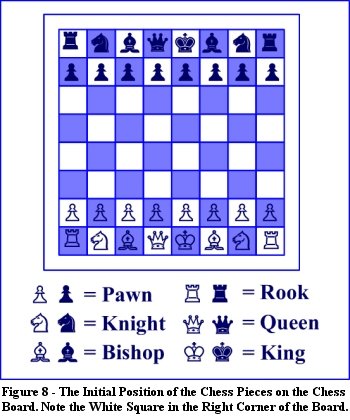
The chess board itself, with its 64 squares alternating between light and dark, is a symbol of the world and its rules. It’s a microcosm that demonstrates the need for structure and strategic navigation within the confines of certain laws.
64 Squares: The division of the board into 64 squares symbolizes the structure of the world.
Light and Dark: The alternating colors on the board emphasize the dualities that exist in life.
Fixed Rules: Chess has fixed rules, symbolizing that rules are essential for having a good and well-functioning society. The rules make the game fair and provide a well-defined structure.
Strategy: The board acts as a playing field where the players have to make strategies to reach their goals. The board provides a level playing ground where both players start with equal opportunities.
The chess board, with its structured layout and rules, is a powerful reminder that navigating life requires strategic thinking and the ability to work within the confines of existing rules.
The Interactions of Pieces: Symbol of Teamwork and Cooperation
The way the chess pieces interact with each other – the combination of different strengths and weaknesses, the way the pieces defend each other, and the way in which they work together to achieve checkmate – symbolizes the importance of cooperation, teamwork, and the power of collective action.
Pawns as a shield: Pawns can protect more powerful pieces, while at the same time more powerful pieces can protect weaker pieces.
Coordinated Attacks: Successful chess attacks often involve the combined movement of several pieces, highlighting the power of teamwork.
Defense: Players need to defend their own pieces, showing the value of mutual support in times of adversity.
The interactions of the pieces highlight the fact that every individual has a unique role to play in a larger objective and that success is often achieved by working together and supporting each other, and acknowledging the interconnectedness of our actions.
By examining the chess pieces and their unique movements and roles we start to realize that chess is much more than a simple game of strategy. It’s a world filled with symbolism, a microcosm of life’s many challenges and opportunities. It provides very important lessons on planning, adaptability, and responsibility, and encourages us to think strategically, to value teamwork, and to always strive for our goals. Understanding the symbolism of chess within its rules can provide a deeper appreciation of the game itself and provide valuable insights for life beyond the chessboard.
Chess is not only a game; it is a world where each piece tells a story. From the unassuming pawn to the powerful queen, every piece contributes to a grand narrative of life’s possibilities, challenges, and triumphs. Understanding what chess symbolizes within the rules of the game provides an appreciation for its underlying structure and how it can enhance the process of learning.
The Symbolism of Chess
Final Thoughts
Chess pieces represent a structured hierarchy and distinct roles within a strategic conflict. Each piece moves according to specific rules, reflecting their symbolic power and limitations. The king embodies leadership, while pawns portray commoners.
The Queen’s versatile movement signifies her powerful influence, whereas the knight’s unique pattern illustrates unconventional tactics. what does the chess symbolize in rules of the game? It symbolizes a microcosm of power dynamics, strategic planning, and the interplay of different forces within a defined context, a truly powerful representation.

