
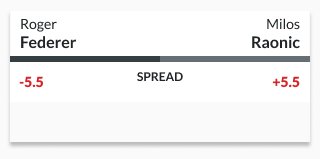
In tennis, game spread refers to the difference in the number of games won by each player within a set.
Have you ever watched a tennis match and wondered why the commentators keep mentioning a “game spread”? It’s a key factor in understanding the dynamics of a match. Specifically, what is game spread in tennis? It’s a simple but informative statistic that offers a quick snapshot of how a set is progressing.
A large game spread, say 6-1, means one player dominated that set. While a smaller spread, such as 6-4, indicates a much tighter contest. The concept of the game spread can help you grasp the patterns and momentum changes within the game.

What is Game Spread in Tennis?
Let’s dive into the exciting world of tennis and explore a concept that’s key to understanding how matches unfold: game spread. In simple terms, game spread in tennis is the difference between the number of games won by one player and the number of games won by their opponent. It’s a way to measure how dominant a player was in a match, or conversely, how much they struggled. It’s not just about who won; it’s about by how much they won. Understanding game spread can give you more insight into the match’s dynamics than just looking at the final score. Instead of just seeing a final score of 6-4, 6-3, knowing the game spread helps you see that one player won 12 games and their opponent won 7, giving a game spread of +5 games for the winner. This game spread can tell the tale of a match, showing a player’s dominance or a hard-fought battle.
Understanding the Basics of Game Scoring
Before we fully grasp game spread, let’s quickly recap how scoring works in tennis. This foundation is vital because games are the building blocks of sets, and the number of games won determines the game spread. A tennis match is made up of sets, and each set is made up of games. To win a game, a player needs to score four points, with at least a two-point lead over their opponent. The points are called 15, 30, 40, and game. If the score reaches 40-40 (known as deuce), a player has to win two points in a row to win the game. In short, the goal of tennis game scoring is to win the game first, and in order to win the game one has to keep the track of points, with winning point in the game by at least two point gap.
How Games Lead to Sets
Once you understand the scoring of points and games, next comes sets. Sets are a group of games that eventually lead to victory. A player wins a set by winning six games, but must also win by at least a margin of two games. So if the score in a set reaches 6-5, for example, the set is not won yet. The set would continue until someone wins 7-5, or if the score is 6-6 then the set would usually move to a tie-break where the set is won by the player that win seven points with a gap of two points. Different competitions use different set formats. Some use best-of-three sets, whereas some others use best-of-five sets. In best of three sets, the first player that wins two sets, wins the match. In best of five sets, the first player to win three sets, wins the match.
Calculating Game Spread: A Practical Approach
Calculating game spread is pretty straightforward. All you have to do is subtract the total number of games won by the losing player from the total number of games won by the winning player. The resulting number will be your game spread. For example, if player A wins a match 6-3, 6-4, and their opponent player B loses with the given score, then player A wins 6 + 6 = 12 games and player B wins 3 + 4 = 7 games. Then we subtract the games, so the game spread is 12 – 7 = 5. So, player A has a game spread of +5, indicating a comfortable victory and player B has a game spread of -5.
Positive vs. Negative Game Spread
A positive game spread means a player won more games than their opponent, and a larger positive game spread signals a more dominant victory. A negative game spread means a player lost more games than their opponent, and a larger negative game spread signals a more crushing defeat. For example, if player X has a game spread of +7 and player Y has a game spread of -7 it means player X won 7 more games than player Y.
Why Game Spread Matters: Beyond Just Winning
Game spread provides a much more detailed picture of a match than simply looking at who won. It can show you the dominance or closeness of a match and also offer valuable information for tennis analysis and predictions. Let’s explore how understanding game spread enhances your comprehension of tennis matches.
Assessing Player Performance
Game spread allows you to accurately assess how well a player has performed in a match. For example, a player might win a match 2-1 in sets. However, if you look into the game spread, you might find the player won in straight sets 6-4, 6-4 and 6-4 and so the total game spread for player A is +6, while in another scenario, a player might have won 6-4, 2-6 and 7-6. Even though in both scenarios, the player won the match, but the game spread will be different in each match. In first scenario, player A won 18 games and the player B won 12 games, giving a game spread of +6. In the second scenario, let’s say that in a tie break set player A won 7 points and player B won 4 points, which gives a game score of 7-6 for the player A. Then in the second scenario, the player A has won 6 + 7 = 13 games, and the player B has won 4 + 6 = 10 games. So, the game spread for player A is +3. So, even though player A wins in both scenarios, but the game spread can show you the margin of the win and closeness of match. So, in this scenario, the game spread for player A is lower in the second scenario, showing that even though the player won the match, but they had to work much harder to win the match. Thus, analyzing the game spread helps in gaining a much better and detailed analysis of the match, rather than just looking at who won. Game spread can often show you that the losing player actually performed much better, even if they didn’t win the match. This is one reason why the game spread is important to tennis analysis.
Predicting Future Match Outcomes
Game spread data, when collected over a period of time, can be very useful in predicting the outcomes of future matches. Analysts and fans regularly use game spreads to predict future matches. If a player has a consistently large positive game spread, they are more likely to win future matches against opponents with smaller game spreads. Analyzing the game spread of players over many matches can tell you much more than just the final winning scores, and these game spread statistics can be used to predict future matches. So, the game spread statistics can be very useful for predicting the future outcome of matches, and is one reason why tennis commentators often talk about the game spread.
Game Spread and Betting
Game spread is used by many people in tennis betting. It’s more common to bet on the game spread instead of just betting on who will win. Many betting services offer game spread betting, and knowing how the game spread works can help people bet better. So, it’s often seen that people bet on the game spread in tennis, because it gives you the full perspective of match, rather than just betting on who will win. This also can be useful when there are two close contenders, and you’re unable to guess who is going to win, but you still want to bet.
Factors Influencing Game Spread
Several factors influence the game spread in a tennis match. Understanding these factors can help you better understand the match, and also help you gain a better insight into tennis strategy. Let’s explore some key factors:
- Player Skill and Form: This is the biggest factor. If one player is much more skilled or in better form than the other, they will win more games, creating a bigger game spread. The skills and the current form of the players plays the biggest role. If the player has better skills and is in better form then the player can easily create a bigger game spread.
- Serving Performance: A strong serving game is a huge advantage in tennis. Players with powerful and accurate serves often win more games, contributing to a positive game spread, which is why serving performance is very crucial. If the serving game is strong then they can score easy points, which can help them in getting a big game spread.
- Return Game: The ability to break an opponent’s serve is also very crucial. A player with a great return game can win more games, leading to a higher game spread, and that’s why people often say return is as important as a serving game. A player who can win more games returning, will ultimately win more matches and thus create a positive game spread.
- Mental Toughness: Tennis is as much of a mental game as it is a physical one. Players who can stay focused and composed often win crucial games, and thus create a positive game spread, and that’s why the mental toughness is crucial in a tennis match. A player who is mentally tough can always come back to win the game, no matter the situation, and so this is a very big factor that often decides the game spread of the match.
- Tactical Adjustments: A player’s ability to adapt their strategy during a match can impact the game spread. A player who has good tactical knowledge will often know when to switch up their game, which can contribute towards a positive game spread. For example, a player who is returning poorly can try to come towards the net, and that might give the player much-needed points.
- Fatigue: This is a very important factor. Tennis players might play multiple matches over a period of time, which often leads to fatigue. And fatigue impacts their performance. A tired player may struggle to keep up with a fresher opponent, resulting in a lower game spread.
Game Spread in Different Match Formats
Game spread can also look different depending on the format of a tennis match. For example, it can be different in a match with best of three set format, versus best of five sets. Let’s explore some popular formats and look how game spread can differ.
Best-of-Three Sets Matches
In a best-of-three sets match, the game spread might not be as high as in a five-set match. For example, a dominating win in a best of three sets would see a maximum spread of around +12 or +13. This would happen if the player A wins the match in straight set, 6-0, 6-0. So, the game spread will be +12. Another example of a good win in best of three sets would be 6-3, 6-4 where player A wins 12 games and player B wins 7 games, so the game spread is +5. Since the match is shorter, the game spread is likely to be more moderate. However, a close match with tight sets can result in a very small or even zero game spread. So, in shorter formats, such as best of three sets, the game spread can be much lower.
Best-of-Five Sets Matches
In best-of-five sets matches, the game spread can often be more significant. A player can accumulate a large positive game spread by winning sets convincingly. For example, a player winning 6-2, 6-2, 6-1 will have a very high game spread. Since there are more sets, the game spread can be significantly more in this format. On the other hand, a tight five-set match can still result in a very small game spread even when one player is dominant. Because five set match can have more games, therefore the game spread is usually higher.
Impact of Tie-Breaks on Game Spread
Tie-breaks also have some impact on game spread, particularly when matches go to 7-6 or 6-7 scorelines. Even though the player wins one extra game, it’s still a single game to be added on to the game spread. This is important to keep in mind while analyzing a match using game spread. Since the tie-break only counts as one game, its impact on the overall game spread can be subtle. A match with several tie-breaks might have a much tighter game spread compared to a match with many straight-set wins. So it is always important to consider the tiebreaks when analyzing game spread.
Real-World Examples of Game Spread
Now let’s look at some real-world examples and look how game spread can change in different situations. These examples will give you an even better understanding of game spread.
Example 1: Dominant Victory
In a match where a top player is facing a lower-ranked opponent, the game spread can be very high. For instance, if the score is 6-2, 6-1, the winning player won 12 games and the losing player won 3 games. Therefore, the game spread will be +9, which can be considered a very dominating victory. This indicates a clear performance difference and the dominance of the player winning. These type of high game spread often happens when there is a clear gap in the skill level between two players.
Example 2: Close Match
On the other hand, a match between two evenly matched players might have a very low game spread. For example, a match that goes to 7-6, 6-7 and 7-5 might end up with a game spread of just +2. For example, player A won 7 + 6 + 7 = 20 games and player B won 6+7+5 = 18 games. Thus, the game spread is +2. This indicates that while one player has won, the game was very close and could have gone either way. So, close games often end up with low game spread.
Example 3: Upset Result
Sometimes, a lower-ranked player may create a positive game spread against a higher-ranked opponent. This can happen if the player is in their peak performance. For example, a lower ranked player wins a match 6-4, 6-7 and 6-3. Here the lower-ranked player has won 6 + 6= 18 games, and the higher ranked player has won 4 + 7 = 11 games. Therefore, the total game spread will be +7. This shows how an upset can happen, where the lower-ranked player won a match with a clear margin.
Game Spread in the Bigger Picture
Game spread is more than just a number in tennis. It’s a tool that helps coaches, players, and fans better understand the dynamics of a tennis match. Here’s how it fits into the bigger picture:
Coaching Tool
Coaches often use game spread data to analyze a player’s performance and identify areas for improvement. If a player has many negative game spreads, a coach might work on areas such as improving the serve game. Coaches keep track of the game spread to identify if there is any issue in player’s game. In general, coaches keep a track of both positive and negative game spreads to come up with player improvement plans.
Player Development
Players can also keep an eye on their game spreads over time. A player might have a higher game spread against lower-ranked player, and if a player is not seeing an improvement in the game spread then it might be an area they need to focus on. Players often use game spread to focus on their weaknesses and strengths. They use this data to understand what they need to work on to get better at their game. The game spread provides valuable insight for the players to improve their game.
Fan Engagement
For fans, understanding game spread makes the viewing experience much more interesting. It adds another layer of depth to watching a match. It gives them a much more deeper understanding of the match, and also provides them better insight on the players and the game.
In short, game spread is an extremely important concept in tennis. It provides much more insight into the match, and tells a much more in-depth story of the match than just looking at the final score. The game spread is an important tool for tennis players, coaches, and fans to improve their game, make future prediction, and understand more about tennis dynamics. By knowing the concept of game spread and its impact on tennis match, you’ll become a much more informed tennis watcher.
Best Tennis Sports Betting Strategy 🎾 | Courtsiding Explained
Final Thoughts
Game spread in tennis represents the difference in the number of games won between two players. It’s a key indicator of dominance within a match. A large game spread suggests one player significantly outperformed the other.
Calculating game spread is simple: you subtract the loser’s total games from the winner’s. This number gives a clear picture of the match’s competitiveness. Therefore understanding what is game spread in tennis is crucial.

