
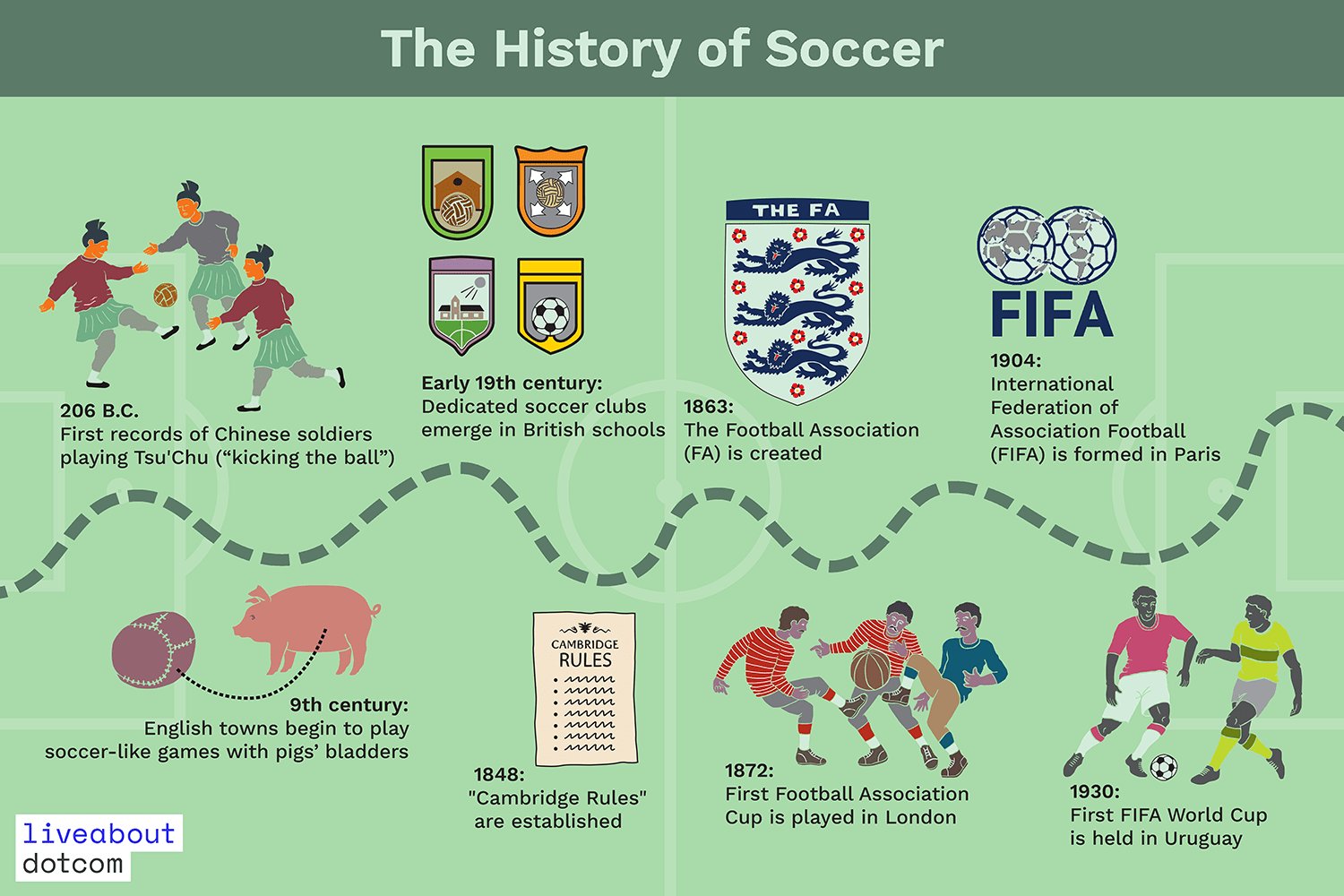
The modern version of the game soccer does not have a single creator; rather, it evolved from various football games in England throughout the 19th century, with the Football Association playing a key role in standardizing the rules.
The beautiful game, soccer, a global phenomenon enjoyed by billions, has a history as intriguing as its matches. Many people often ask the simple yet complex question: who created the game soccer? It’s a query that takes us on a journey through time, examining how a collection of different football games came together to make the sport we know today. The answer is more complicated than a single inventor, rather it is an evolution.
So, we delve into this history, and explore how the game we call soccer came into being. This will reveal the various influences that shaped it. And that story goes back much further than you might think.

Who Created the Game Soccer? Unpacking the History of Football
The question “who invented soccer?” is actually a bit trickier than it sounds! Unlike some games with a clear inventor, soccer’s story is a long and winding one. It didn’t just pop up one day; it evolved over time with many different people and places playing a part. We can’t point to one single person and say, “That’s the inventor of soccer!” Instead, we have to look at the different stages of the game’s development, from ancient times to the modern sport we all know and love today. Let’s dig in and explore this fascinating journey!
Ancient Roots: Early Ball Games
Long, long ago, people in different parts of the world played games that involved kicking a ball. These games weren’t exactly like soccer, but they were important steps in how soccer came to be. Think of them as the grandpas and grandmas of the modern game. Let’s take a peek at some of these early ball games:
Ancient China: Cuju
In China, a game called Cuju dates all the way back to the 2nd and 3rd centuries BC! It was a military training exercise involving kicking a leather ball through a small opening. Imagine that – practicing your aim by kicking a ball. Sounds familiar, right? Cuju means “kick the ball with the foot.” It involved two teams, with the aim being to kick the ball into a net. While not exactly soccer, it shows that kicking a ball was a popular activity centuries ago.
Ancient Greece and Rome: Episkyros and Harpastum
The ancient Greeks had a game called Episkyros, and the Romans had one called Harpastum. These games also involved teams, a ball, and a lot of running and tackling. Harpastum, especially, was known to be quite rough! These games show us that the idea of a team sport involving kicking and running around with a ball was not new, even before a long time. These activities contributed to the global development of ball games and have a history much before the modern soccer.
Indigenous Games: Around the World
Many indigenous cultures around the world also had their own ball games that involved kicking, carrying, and throwing a ball. These games, often part of rituals or festivals, show us that the desire to play with a ball is something that humans have always felt. These diverse cultural ball games further cemented the foundations for games involving a ball that are played today.
The Emergence of Football in Britain
Now, let’s fast forward to Britain. This is where things start to get a bit more like the soccer we know today. Before the 1800s, there were many different kinds of “folk football” games in different parts of Britain. These games often involved entire villages and were very chaotic, with almost no rules. Think of a giant free-for-all with a ball!
Chaotic Folk Football
These early games of folk football were far from the structured sport we see today. They were characterized by:
- Large numbers of players: Often entire villages participated.
- Few rules: There were local customs, but not really a set of rules.
- Violence and Injuries: These games were often very rough, with tackling and sometimes even injuries.
- Varying Ball Sizes and Types: The type and size of the ball used varied.
- Long-Distance Goals: The objective was often to get the ball to a predetermined location, sometimes quite far away.
These forms of football were very localized, which meant that there were many variations of the game. Different areas would have different approaches, which meant a standardized game was needed.
The Need for Standardization: The Birth of Rules
As more people began playing these folk football games, it became clear that a more organized and agreed-upon set of rules was needed. This was particularly true with the growth of football in British schools. Students from different schools would often play each other, and the different sets of rules used in different schools made matches confusing, so that created a need for standard rule book.
The Cambridge Rules: An Early Step
In 1848, a group of students at Cambridge University came together to try and create a unified set of rules. These rules became known as the “Cambridge Rules.” These rules are very important because they formed the first proper attempt to create a common code for football, which could be used across different clubs and schools. While they were not universally adopted immediately, these Cambridge Rules were a crucial step towards a more organized game.
The Formation of the Football Association (FA)
The next important step came in 1863 when representatives from different football clubs met in London. They formed an organization called the Football Association (FA). This was a huge moment in soccer history. The FA’s main goal was to create and agree on a set of rules that everyone could play by. They wanted to end the confusion that existed between different football games.
The Great Divide: Rugby vs. Association Football
During the early meetings of the Football Association, a major disagreement occurred. It was a difference of opinion in the matter of handling the ball with the hands. Some clubs wanted to allow carrying the ball with the hands, like in what we know today as rugby. Other clubs were firmly against handling the ball. This disagreement resulted in a split of codes. The clubs that favored handling the ball went on to form the Rugby Football Union. Those who disagreed with handling the ball continued working on the rules for what eventually became association football or what we now call soccer.
This was a defining point in history. The decision made on that day ultimately created two distinct sports: rugby and soccer. This split shows us that even within the same sport, there are many possibilities in the rules, leading to very different outcomes. The term “soccer” actually comes from the word “association” and “er”, which was the slang at the time, which is how it got the name “soccer”.
The 1863 FA Rules: A Foundation for Modern Soccer
The set of rules created by the FA in 1863 was a major milestone. These rules laid the foundation for the modern game of soccer we know today. Some of the key aspects of these rules included:
- No handling of the ball: Except for the goalkeeper. This was a key difference from rugby.
- Kicking the ball: Emphasis was on kicking and controlling the ball with the feet.
- Specific field dimensions: They established basic sizes of the field.
- Goals: They defined a goal and the method of scoring a goal.
- Throw-ins: When the ball went out of bounds, it was to be brought back in by throw-in.
These rules provided clarity and structure, making it possible for different teams to play each other fairly. They enabled the game to grow in popularity and spread all around the world.
The Spread of Soccer Globally
Once the rules of soccer were standardized, the game started to travel across the world. British soldiers, sailors, and traders, and engineers took the game with them to different countries, which further contributed in the spread of the game of soccer. Soon, people from various countries began to adopt the sport.
Early International Competitions
The first international soccer match took place in 1872 between England and Scotland. This game demonstrated how the standardized rules allowed different teams from different countries to compete. As the game grew in popularity, different countries also started creating their own national football associations. This led to the establishment of major international competitions like the FIFA World Cup.
The Role of FIFA
In 1904, FIFA, or the Federation Internationale de Football Association, was formed. FIFA’s role was to create a single governing body for soccer around the globe. They are responsible for organizing international competitions, including the FIFA World Cup, and ensuring that the rules of soccer are followed consistently all over the world.
Key Individuals in the Development of Soccer
While we can’t point to one specific person as the “inventor” of soccer, we can point to key individuals who were influential in the game’s development and made significant contributions. Here are some of the key players in the evolution of soccer:
Ebenezer Cobb Morley
Often called the “Father of the Football Association,” Ebenezer Cobb Morley was an English sportsman and lawyer who was instrumental in the formation of the FA. He drafted the first set of laws for association football, which became the basis for the modern game. His contribution played a significant part in standardizing the game.
Charles Alcock
Charles Alcock was an English sportsman and administrator who was a vital figure in the development of soccer in England and is often called the “Father of Modern Sport.” He was heavily involved with the FA, and he also made significant contributions to the standardization and popularization of the game. Alcock also conceived of the FA Cup. He helped structure the FA and the game.
Early Football Clubs
Early football clubs also played a role in developing soccer’s standard rules and regulations. Clubs like Sheffield FC and Notts County made huge contributions to shaping how soccer is played and perceived today. They acted as test beds for different ideas and playing styles. They were also at the forefront of adopting these rule sets in early days.
The Evolution Continues
Even though soccer has a long history, it continues to change and adapt. New techniques are developed, tactics change, and even the rules are modified from time to time. The use of technology like VAR (video assistant referee) has also added a new layer to the game. Soccer is constantly moving forward.
So, instead of thinking about a single creator of soccer, it’s more accurate to think of a long story with different people and places playing their part. From ancient ball games to the standardization in 1863 and beyond, soccer is a game built upon the efforts of many people over time. It’s a game that belongs to everyone now, enjoyed and loved across the world. The story of soccer is an ongoing journey, it’s a story that is still being written as players, coaches, and fans all over the world continue to enjoy this game. The story of the beautiful game is still very much alive!
So, who created soccer? The answer isn’t a simple one. It’s a tapestry woven from threads of ancient ball games, the chaotic fun of folk football, the need for standardization, and the efforts of many dedicated people and organizations. Ultimately, it is a game that is still being shaped every day by those who play it, watch it, and love it.
Football: when and who invented football?
Final Thoughts
Determining who created the game soccer is complex. The sport evolved from various ancient ball games played globally. No single person invented soccer, but rather it is a culmination of historical development.
Different countries contributed to the rules and form we know today. England played a crucial role in standardizing the rules with the formation of the Football Association. This standardization led to the game’s widespread popularity.

