
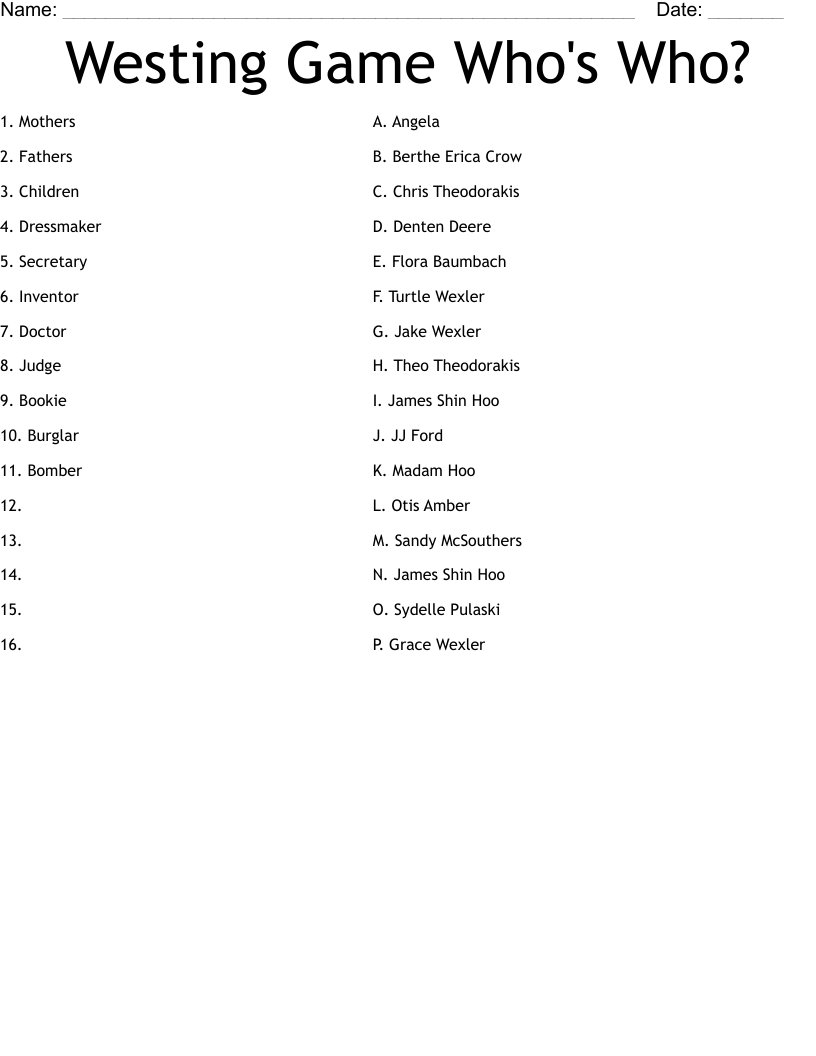
The burglar in The Westing Game is actually Turtle Wexler, who was trying to win the game by strategically stealing items.
Mysteries swirl within the walls of the Westing mansion, and one question persistently echoes: who is the burglar in The Westing Game? It’s a question that keeps readers turning pages, trying to piece together the clues.
The seemingly simple act of theft becomes a significant part of the puzzle. The characters suspect each other, their motives and actions under scrutiny.
The search for the guilty party adds another layer of complexity to the already intricate game.

Who is the Burglar in The Westing Game?
The mystery of the burglar in The Westing Game is one of the most captivating puzzles within this beloved book. It’s not just about a simple break-in; it’s about deception, misdirection, and the complex personalities of the characters. Instead of a single, obvious culprit, the story cleverly weaves a web of suspects, making us question everyone’s motives. Let’s dig deep into this intriguing aspect of the Westing Game.
The Initial Burglaries and Red Herrings
At the start, we know that several odd things happen at Sunset Towers. Someone is entering apartments and stealing seemingly random items. The first hint that something is amiss occurs when a series of unusual thefts begin. These aren’t your typical burglaries; the items taken don’t seem to follow a pattern or hold significant monetary value. They aren’t things like jewelry or money, which a typical thief would go for. This is crucial because it suggests that the thief isn’t interested in profit.
The Stolen Items
Let’s look closely at what’s missing. The things taken include:
- Shin Hoo’s new rubber boots
- Turtle Wexler’s clock radio
- Flora Baumbach’s antique clock
- Sydelle Pulaski’s notebook
- Angela Wexler’s engagement ring
The variety of items confuses the residents, as does the fact that they are all relatively insignificant. For example, why would anyone want an old radio? This lack of logic throws everyone off and leads to much speculation. This mystery becomes another element of Sam Westing’s complex game.
Why “Red Herrings”?
These thefts are what we call “red herrings”—clues that are meant to mislead us from the truth. They cause confusion and distract attention from the real reason why everyone is in Sunset Towers. The story uses these burglaries to fuel the mystery and to get the characters (and the readers) looking in the wrong places.
The Suspects and Their Motives
With the burglaries occurring, the spotlight turns to the residents of Sunset Towers. The book introduces many potential suspects, and each one comes with their own possible reasons for these strange crimes. Here are a few key characters who the author makes us suspect, and why:
The Wexler Family: A Hotbed of Suspicion
The Wexler family, with their complex dynamics, becomes a focal point for suspicion. They have various reasons to be considered suspicious. Let’s see why:
- Grace Wexler: With her desire for social status and her tendency towards manipulation, it’s easy to wonder if she might be involved to somehow get an edge in the game. Maybe she’s looking for something that will give her a clue about Westing’s will.
- Jake Wexler: A podiatrist, he might be looking for something to improve his practice or something that would somehow benefit him in the game. His calm demeanor also makes him a possible suspect, because he is hard to read.
- Turtle Wexler: Smart and often underestimated, Turtle seems to be involved in almost every aspect of the game, it’s easy to see how she might have had access to the other apartments. It’s also plausible to consider that these thefts are some way for her to try to solve the mystery and win the inheritance, or perhaps a way to test other people and analyze their behaviours.
- Angela Wexler: As the supposedly “perfect” daughter, she seems too good to be true, and it can make one wonder if she is masking something. She also has a secret engagement, and may have some secret agendas.
Other Possible Suspects
Beyond the Wexlers, many other characters seem to have secrets or suspicious behavior:
- James Shin Hoo: Always struggling with his restaurant, he has a motive for wanting money and might be looking to steal something valuable to solve his financial woes. He has past grievances against Westing, making him a potential suspect.
- Madame Hoo: Her inability to communicate makes her a mysterious figure. The story makes us wonder if she might be secretly involved in the thefts or be hiding something. Her isolation and quiet nature make it easy to see her as a potential burglar.
- Berthe Erica Crow: As the former wife of Sam Westing, she had a very tumultuous relationship with him, and she has an obvious motive to seek some type of revenge. She is also seen as an outcast by many residents of Sunset Towers.
- Otis Amber: With his odd delivery boy job and constant presence around Sunset Towers, he’s always within the group of potential suspects. He also seems to be everywhere and knows the ins and outs of the Towers.
- Sandy McSouthers: A doorman who was recently fired, he is there from time to time, which can give suspicion towards him. He’s also friendly with the characters and well-liked, which could be an attempt to avoid suspicion.
The Truth Revealed: It’s Not Who You Think
As the mystery unfolds, we discover that the burglar isn’t a single person with greedy motives. Instead, the “burglaries” are part of a complex scheme designed by Sam Westing as part of his final game. Sam Westing’s plans are always more complicated than they seem at first glance.
The Real Mastermind: Sam Westing’s Plan
The “burglaries” were never about stealing; they were about a different goal. Sam Westing, even in death, is orchestrating the events in Sunset Towers. He isn’t just testing the residents through the will, but also through the events in the building.
- Testing Observation: The “burglaries” were partly designed to see who was paying attention to the events happening around them. The “clues” were all in plain sight. The point was to observe and solve puzzles.
- Shifting Focus: By making it seem like there was a thief, the residents spent time trying to solve the wrong puzzle. This distracted them from figuring out the true purpose of the will and their roles within it.
- Manipulating Relationships: The false burglaries created suspicion among the characters. This forced them to interact with one another, which ultimately helped them to learn more about each other. It also was a way to test how they would interact under pressure.
The Role of Sydelle Pulaski
Although the burglar wasn’t one person, the one character who may be seen as the closest one to being a burglar is Sydelle Pulaski. Sydelle was not actually a thief, but she is involved. She faked her injury and used a crutch to move around without being noticed, and she also kept a detailed notebook of everyone’s activities. She wanted to get attention, as she felt invisible. She also wanted to figure out what was really going on, and hoped that by doing so she would be part of the game. Her notebook, although taken, is part of the clues.
- The Notebook: Sydelle’s notebook, taken by the “burglar,” turns out to be important, as it holds clues that she writes in code. The fact that this book is stolen makes other players think they should be looking for it, which gives an advantage to Sydelle who knows what is inside the book.
- Using Crutch: The use of crutch is part of her plan, as she uses it to be not noticed while she collects information. It adds another layer to her character, and contributes to the mystery of what her goal is.
The Impact of the “Burglaries” on the Characters
The “burglaries” are more than just a plot point. They significantly change how the characters interact with each other and their perspectives of the game. They lead to some growth and revelations among them.
- Increased Suspicion: The thefts immediately create tension, distrust, and suspicion. People become isolated and unsure of whom they can trust. The community is shaken, and everyone is on edge.
- Character Development: Under the pressure of the burglaries, the residents show their true colors. Some people become more resourceful, while others become more suspicious and closed off. The way they respond to the thefts gives insight into their personalities and their own goals.
- Teamwork and Cooperation: Eventually, after the false accusations and suspicion, the characters learn to work together. They start to realize that the “burglaries” are part of a bigger game, and they must look at the problem with a collaborative point of view to win. This is an important turning point of the book.
The Theme of Deception
The mystery of the burglaries shows one of the main themes of The Westing Game: deception. The whole game is built around lies and misdirection, and the “burglaries” are a perfect example of it. What appears to be a problem turns out to be a complicated puzzle.
Deception as a Strategy
Westing was a master of disguise, and his final plan is no different. By using the idea of a burglar, he deceives the residents, and distracts them with a false mystery. The story is a way for him to continue playing his complex games from beyond the grave.
The Power of Perspective
The residents, along with the readers, have been looking at the situation with limited information. They believe there is a burglar, simply because things are missing. This shows how important perspective is when we try to solve any puzzle. The “burglaries” highlight how easy it is to jump to conclusions and how we can be easily manipulated by what we think are facts.
In summary, the burglar in The Westing Game is more than just a simple mystery. It’s a part of Sam Westing’s complex plan to test the residents and to push them to become better, both as individuals and as a community. The strange events weren’t about random theft but about manipulation, misdirection, and, most importantly, understanding that things aren’t always as they seem. The story teaches us about looking deeper, questioning assumptions, and embracing the unexpected.
The Westing Game in 60 Seconds
Final Thoughts
The true burglar in the Westing game was Madame Hoo. She stole to repay her husband’s debts and to fund her return to China. The text reveals her actions gradually, not immediately.
The will’s puzzles eventually pointed towards her motive and guilt. Unraveling the clues provides the answer to ‘who is the burglar in the westing game’. The game focused on the must to discover the truth.

