
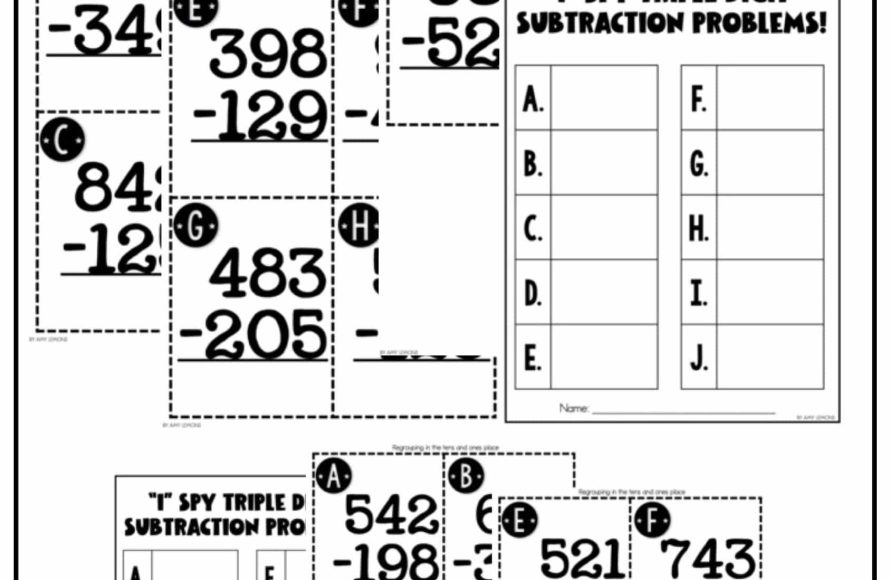
3 digit subtraction with regrouping games offer fun, interactive ways for students to practice complex borrowing and subtraction skills, making learning engaging and effective.
Learning three-digit subtraction can be a bit tricky, especially when regrouping is involved. Many students struggle with the concept of borrowing across multiple places. Luckily, a fantastic way exists to make this challenging topic exciting and understandable for them.
Enter the world of 3 digit subtraction with regrouping games! These interactive activities turn a daunting math concept into an enjoyable challenge. They provide hands-on practice, helping children grasp the process step-by-step and build confidence.

3 Digit Subtraction with Regrouping Games
Learning 3 digit subtraction with regrouping can feel challenging for many young students. This specific mathematical concept requires a strong understanding of place value and the ability to borrow across different places. Engaging games transform this complex skill into an enjoyable and accessible learning experience for children.
Games provide a dynamic environment where students can practice repeatedly without feeling the pressure of traditional drills. They offer immediate feedback, allowing children to correct mistakes and reinforce correct procedures in a fun way. Integrating these games into math lessons can significantly boost a child’s confidence and mathematical fluency.
Why Games Make a Difference in Learning Subtraction
Traditional teaching methods often involve rote memorization and repetitive worksheets, which can sometimes lead to disengagement. Games introduce an element of play, making the learning process exciting and motivating for students. This playful approach helps solidify complex mathematical concepts.
They create a low-stakes environment where mistakes are viewed as learning opportunities rather than failures. Children are more likely to experiment with strategies and truly grasp the underlying principles of regrouping. This active engagement fosters a deeper understanding of mathematical operations.
Boosting Engagement and Motivation
Children are naturally drawn to activities that are interactive and fun. Educational games tap into this innate curiosity, transforming routine math practice into an adventure. The element of competition or challenge within a game often inspires students to try harder and persist.
This increased motivation directly translates into more focused practice time. Students willingly spend more time on tasks when they are enjoying the process. High engagement is crucial for mastering difficult concepts like 3-digit regrouping.
Strengthening Place Value Understanding
Regrouping, or “borrowing,” relies heavily on a solid understanding of place value: ones, tens, and hundreds. Games often incorporate visual representations or manipulatives that explicitly demonstrate the exchange of values between places. This visual aid makes the abstract concept of regrouping tangible.
For instance, a game might show 1 ten being exchanged for 10 ones, or 1 hundred being exchanged for 10 tens. Such explicit demonstrations reinforce the foundational knowledge required for accurate subtraction. Children can see how a digit in one column ‘borrows’ value from the column to its left.
Developing Mental Math Skills
While many games involve physical or digital tools, the repeated practice they offer gradually builds mental math capabilities. Students begin to internalize the steps of regrouping and perform calculations more quickly in their minds. This mental agility is a valuable skill extending beyond just subtraction.
Consistent exposure to subtraction problems within a game context helps children develop number sense and estimation skills. They start to anticipate outcomes and check their work more efficiently. These cognitive developments are essential for overall mathematical proficiency.
Providing Immediate Feedback
One of the most powerful features of well-designed educational games is instant feedback. If a student makes an error, the game can immediately highlight it and often provide a hint or explanation. This real-time correction prevents the reinforcement of incorrect procedures.
Immediate feedback allows students to learn from their mistakes on the spot. They don’t have to wait for a teacher to grade a worksheet, which can delay understanding and correction. This quick turnaround loop accelerates the learning process significantly.
Types of 3-Digit Subtraction with Regrouping Games
A wide variety of games can help students practice 3-digit subtraction with regrouping. These can range from digital applications to hands-on activities using everyday materials. Choosing the right type of game often depends on the student’s learning style and available resources.
Diversifying the types of games used can keep learning fresh and engaging. It also caters to different preferences, ensuring all students find an enjoyable way to practice. Exploring various formats helps reinforce the concept from multiple angles.
Online Interactive Games
Online platforms offer a plethora of interactive games specifically designed for math practice. These games often feature engaging graphics, sound effects, and gamified elements like points, levels, or character customization. Many are accessible on computers, tablets, and even smartphones.
Popular educational websites and apps provide a structured progression of difficulties, starting with simpler problems and gradually introducing more complex scenarios. Some even offer adaptive learning, adjusting the challenge based on the student’s performance. They provide a convenient and appealing way to practice.
Adventure Quests: Students solve subtraction problems to advance through a storyline, defeat a monster, or find a treasure. These games often embed math problems directly into a narrative.
Timed Challenges: Players solve as many subtraction problems as possible within a given time limit, encouraging speed and accuracy. Leaderboards can add a competitive element.
Drag-and-Drop Activities: Users physically “regroup” digits or blocks by dragging them to different place value columns. This visual manipulation helps reinforce the concept of borrowing.
Puzzle Solvers: Subtraction problems are presented as pieces of a larger puzzle, where solving each problem reveals part of an image or unlocks a new level. This provides a clear goal for students.
Printable Board Games and Worksheets
Printable resources offer a tangible, screen-free option for practicing subtraction. These can include board games, mazes, color-by-number activities, or cut-and-paste exercises. They are easily reproducible and can be used in classrooms or at home with minimal preparation.
Many printable games encourage interaction between players, fostering communication and collaborative learning. They provide a hands-on approach that can be very beneficial for kinesthetic learners. These resources are often customizable to suit specific learning needs.
Subtraction Race Tracks: Players roll a die and move along a track, landing on spaces with subtraction problems. The first player to reach the end wins.
Regrouping Bingo: Call out subtraction problems, and students mark the correct answer on their bingo cards. The first to get a “Bingo” wins.
Place Value Cut-and-Paste: Students cut out numbers representing hundreds, tens, and ones, then physically move them around to perform subtraction with regrouping. This helps visualize the borrowing process.
Subtraction Mazes: Students solve problems to navigate a maze, connecting correct answers to find the path from start to finish. This adds a problem-solving element to practice.
Hands-On Manipulative Games
Using physical manipulatives helps bridge the gap between abstract mathematical concepts and concrete understanding. Materials like base ten blocks, popsicle sticks, or even everyday objects can represent numbers and facilitate the regrouping process. These games are especially effective for visual and kinesthetic learners.
Manipulatives allow students to literally “see” and “feel” the numbers changing as they regroup. This hands-on experience provides a strong foundation before moving to more abstract symbolic representations. It reduces the intimidation factor associated with multi-digit subtraction.
Base Ten Block Subtraction: Students use physical base ten blocks to represent numbers and perform subtraction. They physically exchange a hundred-block for ten ten-blocks, or a ten-block for ten one-blocks, to model regrouping.
Popsicle Stick Bundles: Use bundles of ten popsicle sticks to represent tens, and single sticks for ones. Students can unbundle a ten-bundle to get ten singles for regrouping.
Money Exchange Game: Use play money (pennies, dimes, dollars) to model subtraction with regrouping. Exchanging a dollar for ten dimes, or a dime for ten pennies, directly illustrates the concept of borrowing across place values.
DIY Regrouping Cards: Create large number cards for hundreds, tens, and ones. Students physically move and ‘borrow’ from larger value cards to smaller ones by replacing them with equivalent smaller denominations.
Key Features of Effective 3-Digit Subtraction Games
Not all games are equally effective in teaching complex math concepts. Identifying key features of well-designed educational games ensures that the learning outcome is maximized. A good game balances fun with pedagogical soundness.
These features contribute to a game’s ability to genuinely help students grasp the intricacies of regrouping. They ensure that the playful aspect serves a clear educational purpose. Selecting games with these characteristics will lead to better learning outcomes.
Clear Visual Representation of Regrouping
The process of regrouping can be abstract for young learners. Effective games provide clear visual aids that demonstrate how a larger place value unit is “broken down” into smaller units for subtraction. This might involve animated exchanges or physical block manipulations.
Seeing a hundred block transform into ten ten-blocks, or a ten-block into ten one-blocks, makes the concept concrete. These visuals help students internalize the equivalence of different place values. Clarity in visual representation is paramount for understanding.
Emphasis on Place Value Understanding
Successful 3-digit subtraction hinges on a firm grasp of place value. The best games explicitly highlight the hundreds, tens, and ones columns and how operations are performed within each. They often color-code or label the columns to guide the student.
Some games might even require students to identify the place value of specific digits before performing the subtraction. This consistent emphasis ensures that students don’t just memorize steps but understand the logic behind them. A strong place value foundation prevents common regrouping errors.
Adaptive Difficulty Levels
An ideal game adjusts its challenge based on the student’s performance. If a student is struggling, the game might offer simpler problems or additional hints. Conversely, if a student is excelling, the game progresses to more complex problems, perhaps involving multiple regrouping steps.
Adaptive difficulty keeps students in their “zone of proximal development,” where the challenge is just right to promote learning without causing frustration. This personalized approach ensures continuous progress and prevents boredom or overwhelm. It caters to individual learning paces.
Interactive and Engaging Mechanics
The core of any game is its ability to engage the player. For educational games, this means using mechanics that are not only fun but also reinforce the learning objective. This could involve puzzles, quests, timers, or creative scenarios. The interactivity encourages active participation.
Interactive elements might include drag-and-drop features, clickable answers, or opportunities to customize game elements. High engagement ensures that students remain focused and motivated throughout their practice session. Fun mechanics are the hook that keeps students learning.
Constructive and Immediate Feedback
As mentioned earlier, immediate feedback is critical. Beyond just telling a student if an answer is right or wrong, effective games provide constructive feedback. This might involve showing the correct steps, explaining the error, or offering a helpful hint.
The feedback should be non-judgmental and encouraging, focusing on guiding the student toward understanding. This type of feedback loop accelerates learning by allowing students to self-correct and deepen their comprehension without delay. It turns mistakes into valuable lessons.
Strategies for Incorporating Subtraction Games Effectively
Simply providing games is often not enough; how they are incorporated into the learning routine matters significantly. Thoughtful implementation can maximize the educational impact of these playful tools. A strategic approach ensures consistent progress and engagement.
Parents and educators can create a supportive and encouraging environment that promotes both learning and enjoyment. Integrating games seamlessly into a broader math curriculum provides a holistic approach to skill development. Planning is key to successful implementation.
Introduce Concepts Before Playing
While games are excellent for practice and reinforcement, they are most effective when students have a foundational understanding of the concept. Briefly review the steps of 3-digit subtraction with regrouping before introducing a new game. This ensures students aren’t completely lost.
A quick review can include demonstrating with base ten blocks or walking through a few example problems together. This initial guidance provides context and helps students connect the game mechanics to the mathematical principles. Games then serve as powerful practice tools.
Encourage Discussion and Explanation
After playing a game, ask students to explain their strategies or how they solved certain problems. This encourages metacognition – thinking about one’s own thinking process. Articulating their methods helps solidify their understanding and identify any lingering misconceptions.
Asking questions like “How did you know to regroup here?” or “What happened to the hundreds digit after you borrowed?” prompts deeper reflection. Discussion can also help identify patterns in errors. This verbalization component is vital for long-term retention.
Balance Game Play with Other Practice
While games are valuable, they should be part of a balanced learning approach. Supplement game play with traditional worksheets, problem-solving tasks, and real-world application examples. This diverse approach caters to different learning styles and reinforces skills in varied contexts.
Over-reliance on any single method can limit a child’s understanding. A mix of game-based learning, direct instruction, and independent practice provides a comprehensive learning experience. Variety keeps learning fresh and prevents monotony.
Celebrate Progress, Not Just Perfection
Acknowledge and praise effort and improvement, not just correct answers. Learning complex concepts like regrouping takes time and persistence. Celebrating small victories, such as understanding a specific step or making fewer errors, builds confidence and motivation.
Positive reinforcement encourages students to keep practicing even when they face challenges. Focus on the learning journey rather than just the destination. This approach fosters a growth mindset, essential for mastering difficult academic skills.
Make It a Regular Activity
Consistency is key to mastering any skill. Incorporate 3-digit subtraction games into the daily or weekly routine. Short, frequent practice sessions are often more effective than long, infrequent ones. Regular exposure helps concepts stick.
Whether it’s 15-20 minutes a few times a week or a dedicated game day, consistent practice reinforces learning. This regularity ensures that the mathematical concepts remain fresh in students’ minds. It builds fluency over time.
Connect to Real-World Scenarios
Help students see the relevance of 3-digit subtraction by linking it to real-life situations. For example, calculating change when buying multiple items, determining differences in populations, or comparing distances. This practical application makes the skill meaningful.
When students understand why they are learning something, they become more invested in the process. Real-world connections transform abstract math problems into relatable challenges. This context can significantly boost a child’s interest and engagement with the topic.
Common Challenges and How Games Can Help
Students often face specific hurdles when learning 3-digit subtraction with regrouping. Understanding these common difficulties allows educators and parents to select or design games that directly address these pain points. Games can offer targeted support.
By anticipating these challenges, one can proactively choose games that provide specific scaffolding or repeated practice in problematic areas. This targeted approach makes learning more efficient and less frustrating for the student. Games can be incredibly versatile tools.
Confusion with Borrowing/Regrouping
The most prevalent challenge is understanding the borrowing process itself. Students often struggle to grasp that 1 ten becomes 10 ones, or 1 hundred becomes 10 tens. They may forget to reduce the digit from which they borrowed, leading to incorrect answers.
Games with strong visual representations, like base ten block simulators or drag-and-drop regrouping animations, directly address this. They show the actual exchange, making the abstract concept concrete and repeatable. Visual cues are critical here.
Place Value Errors
Sometimes, students understand regrouping but make errors by misaligning digits or forgetting the value of each column. They might incorrectly subtract tens from hundreds or ones from tens. This often stems from a weak foundation in place value.
Games that use color-coding for place values, clearly labeled columns, or activities requiring explicit identification of hundreds, tens, and ones can mitigate this. These visual cues reinforce the importance of column alignment. Consistent visual aids help prevent these common mistakes.
Multi-Step Regrouping
Problems requiring regrouping across multiple places, such as 300 – 123 (requiring borrowing from the hundreds and then from the tens), can be particularly challenging. Students might correctly perform the first regrouping but then forget the second or third step.
Games that gradually introduce multi-step regrouping, perhaps with highlighted steps or interactive hints, can provide the necessary scaffolding. Timed challenges can also help students practice sequencing the steps more quickly and accurately. Repeated practice with increasing complexity is key.
Zeroes in the Minuend
Subtracting from numbers with zeroes (e.g., 500 – 123 or 405 – 127) presents a unique challenge, as students must borrow across a zero. This often requires borrowing from a digit multiple places away, which can be confusing. It tests a deeper understanding of regrouping.
Games that specifically focus on “borrowing across zero” scenarios can provide targeted practice. These might highlight the process of borrowing from the next non-zero digit and then “unbundling” tens or hundreds as needed. Visual demonstrations of these complex exchanges are very beneficial.
Lack of Fluency and Speed
Even after understanding the concept, some students lack the automaticity to perform subtraction quickly. This can hinder their progress in more complex mathematical operations. Speed and accuracy come with consistent, focused practice.
Timed games, flashcard-style online drills, or competitive race games can significantly improve fluency. These activities encourage quick recall of facts and efficient execution of the regrouping process. Regular, short bursts of practice are highly effective for building speed.
Integrating Technology for Enhanced Learning
Technology offers powerful tools for creating immersive and adaptive learning experiences in 3-digit subtraction. Digital games provide unique advantages that traditional methods sometimes lack, making them an excellent complement to hands-on activities. Leveraging these tools can significantly boost learning outcomes.
Tablets, computers, and interactive whiteboards can host a wide array of engaging educational software. These platforms often incorporate sophisticated algorithms that personalize the learning path for each student. This technological integration enhances engagement and provides rich data for educators.
Interactive Whiteboard Activities
Interactive whiteboards can transform a classroom into a dynamic learning space. Teachers can project and manipulate digital base ten blocks, guide students through regrouping steps, or play interactive 3-digit subtraction games as a class. This collaborative environment fosters shared learning.
Students can come up to the board to demonstrate their problem-solving, making the learning process interactive and visible to everyone. This direct interaction helps solidify understanding and encourages peer learning. The large visual display is beneficial for all learners.
Educational Apps and Websites
Numerous educational apps and websites specialize in math practice, including 3-digit subtraction with regrouping. Many are designed by educators and incorporate sound pedagogical principles. They often track student progress, providing valuable insights for teachers and parents.
Subscription-based platforms might offer comprehensive curricula, while free resources provide focused practice. Exploring different options can help find the best fit for individual student needs and preferences. These digital tools offer convenience and variety.
Personalized Learning Paths
Many advanced educational platforms use algorithms to create personalized learning paths for students. They identify areas where a student struggles and then provide targeted practice problems or additional instructional content. This adaptive approach ensures efficient learning.
If a student masters 3-digit subtraction quickly, the system might introduce more complex problems or move on to related topics. Conversely, if a student struggles, the platform provides more scaffolded practice. This personalized approach optimizes learning for every student.
3-Digit Subtraction with Regrouping – 3rd Grade
Final Thoughts
Understanding 3 digit subtraction with regrouping comes easily with interactive methods. 3 digit subtraction with regrouping games provide a fun, practical approach for students. These activities truly help children build strong math skills.
These games allow students to practice borrowing and subtracting larger numbers effectively. You create an enjoyable and rewarding learning experience. Parents and educators find these tools valuable for math instruction.

