
A Sector Darkly is a 2D real-time space exploration sandbox RPG, and it launches on Wednesday, November 25, 2026, on PC through Steam. You command one ship and one crew, far from home, in a sector going dark one system at a time. Steam lists no price yet, and this guide covers only what the developer has confirmed before launch.
This is a beginner guide, not a walkthrough. The game is not out yet, so this page prints only facts from the Steam page and the developer’s own blog posts.
Release Date
Wednesday, November 25, 2026
Price
Not listed on Steam yet
Developer
A Paradise Lost Studios
Genre
Space exploration sandbox RPG

What A Sector Darkly is, in one minute
A Sector Darkly is a 2D real-time space exploration sandbox RPG. You explore, trade, scavenge, research, and craft to survive in a sector falling into chaos. The game calls itself 4x-LITE: you command one ship and one crew, not a whole faction, while you learn why sectors are going dark and get your crew home.
| Fact | What we know |
|---|---|
| Release date | Wednesday, November 25, 2026 |
| Platform | PC on Steam (Windows) |
| Developer | A Paradise Lost Studios |
| Genre | 2D real-time space exploration sandbox RPG |
| Players | Single-player |
| Price | Not listed on Steam yet |
You will meet more than 10 alien races, and you can talk to them, trade with them, or fight them. Some will help you if you stay on good terms. Others will hunt you, and the U’Guul are the ones to watch the most.
Before you launch: date, price, and your PC
A Sector Darkly launches on Wednesday, November 25, 2026, on PC through Steam. The Steam page says the game is not yet available, and it lists no price, so check the Steam store page on launch day before you buy, and do not trust any price from another site until Steam lists one.
| Requirement | Minimum | Recommended |
|---|---|---|
| Operating system | Windows 10 or 11, 64 bit | Not listed separately |
| Processor | Ryzen 3 3300X | AMD 5600x |
| Memory | 16 GB RAM | Not listed separately |
| Graphics | GTX 1060 | GTX 1660 |
| DirectX | Version 11 | Not listed separately |
| Storage | 1 GB, SSD recommended | 2 GB |
One honest note before you buy. The developer says generative AI was used for icons, textures, and sprites in surface environments, curated by the artist. No AI runs while you play.
Your first hours: the opening route
Your first hours should be slow, close to home, and safe. Stay near known stations while you learn the controls and sensors, and mine and salvage whatever you can reach.

- Stay near a Large Space Port or a station until you know the area.
- Mine a belt and salvage nearby wrecks for iron, copper, and parts.
- Learn to read your sensors before you chase any signal.
- Stock food, water, fuel, spare parts, and ammunition before any long trip.
- Never chain unstable wormholes without a plan for the way back.
That order matters. Food and water keep your crew alive, fuel keeps you moving, and spare parts keep your ship whole.
How the living sector works
The sector does not wait for you. Miners pull ore to refineries, traders move goods to star ports and industrial stations, and haulers and freighters move goods sector-wide. Military patrols watch the trade lanes and fight hostile forces like the invading U’Guul.

That living economy is your early income. You can mine, scavenge, salvage, and pillage, and you can protect trade lanes for the stations that use them.
Stations also offer missions, and finishing them earns you favor and research assistance. You can follow local laws, or you can take what you want by force.
Your ship: side-grades, energy, shields and armor
There is no best ship in A Sector Darkly. Every ship class is a side-grade, with role bonuses and one unique special device or weapon, and dozens of components combine into hundreds of builds. The named examples are a hull-repair device, the entropy beam, and the Assault Frigate’s Mac-Cannon, a coil-gun.
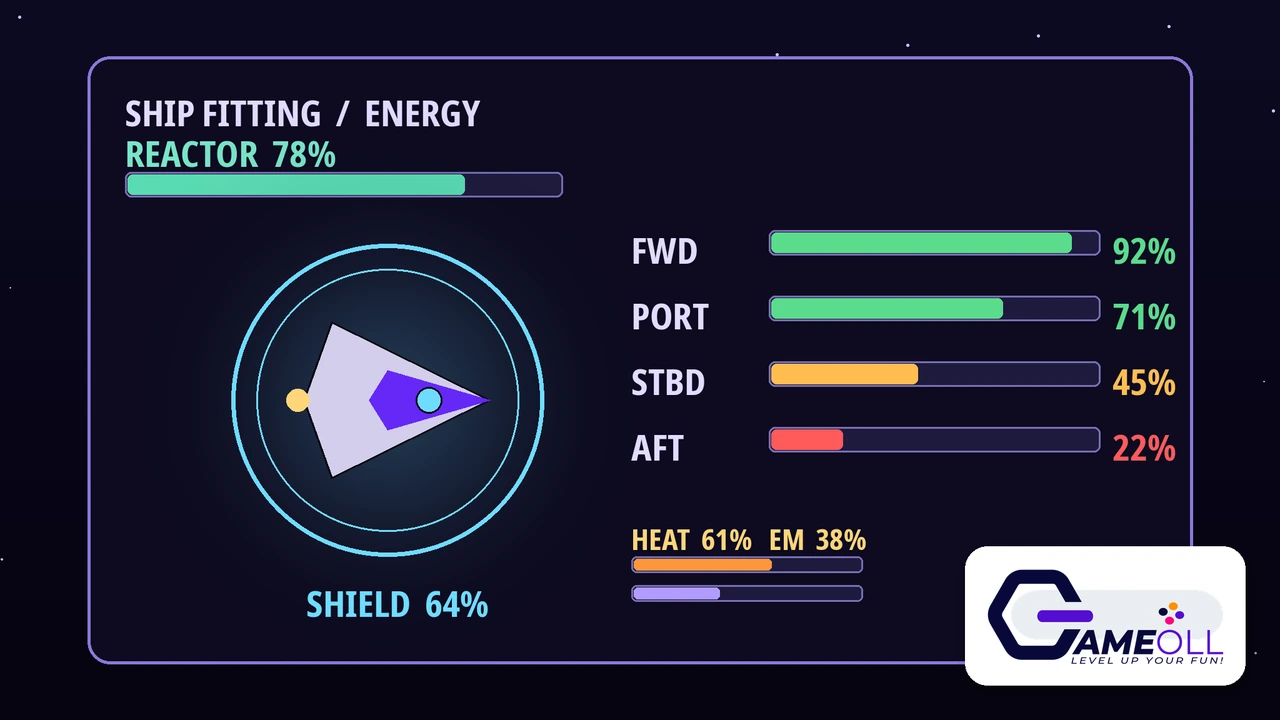
Energy is the budget that runs everything. Your reactor has a charge rate and a reserve, which differ by reactor, so weapons, shields, and thrust together drain power faster than the reactor can replace it.
At full speed, holding your course costs no power, but changing vector does. Lower shields strain the reactor more, and the reactor keeps a reserve for critical systems.
Weapon groups switch mid-battle, and the default key is the middle mouse button. Lasers drain shields first, then missiles finish the job, and your weapons have firing arcs, so position matters. Ballistic guns use no energy, but they need ammunition, and every magazine reloads from cargo reserves.
You can swap a missile variant mid-combat, though the swap takes a few seconds. A Reload All button tops up every magazine at once.
Shields are a bubble, and damage does not bleed through them. Armor only takes damage once the shields drop, and at zero a shield reboots after a time that depends on the component. Armor is shared across four quadrants, shown on the HUD in green, amber, and red.
Above about 60 percent armor, no damage leaks to your hull or sub-systems. Below that line, the leak grows, and different armor resists different weapon types, so ablative and energy armor are not the same choice.
U’Guul dreadnoughts carry heavy forward firepower and rely on escorts to guard their flanks. Never sit in front of one. Attack from the side, or do not attack at all.
Stealth: signatures, heat-sinks and venting
Every ship has a signature: the stronger it is, the farther away you can be seen. It comes from radar cross-section, heat, and EM. A heat-sink can mask it for a limited time, but you must vent the heat afterward, and getting too close still reveals you.
Radar Cross-Section
How big you look on sensors
Heat
What your engines and weapons give off
EM
What your systems broadcast
Wormholes: Stable, Unstable, Ancient
Wormholes are how you cross the sector: Stable, Unstable, and Ancient. Unstable ones can be steadied with the right technology, so a risky route today can become safe later. Some only let smaller support craft through, and that is where the runabout earns its keep.

To scout safely, park your mothership at the mouth and send the runabout through. You can return to the same spot even after leaving the system, and the mothership can summon itself gate to gate in real time, which you can track on the starmap. Plan the return leg before you jump, and never park on a hostile trade lane while you are away, because the mothership can be attacked while you are gone.
Crew, food, water and away missions
Your crew gives passive bonuses to various stats, and they eat and drink, so your ship consumes water and food you can craft from raw materials. Away missions gather from planets: a crewed shuttle lands and gathers materials while you keep exploring, in real time, with no abstraction. Planet surfaces hold signals of interest, and the weak ones cannot be seen from orbit, so landing is the only way to find them.

Drones, crafting and research
Support ships and drones do the jobs you cannot do alone, and you can leave drones in a system and collect them later. Mining drones collect the belt resources you pick by filter, salvage drones pull parts from wrecks inside a set radius, and repair drones service a target, including your mothership. Each drone keeps a battery reserve to fly home, cargo that does not fit stays aboard it, and a full cargo bay blocks deployment, so store the overflow at a Large Space Port.
Crafting runs through the fabricator, and its production queue chains steps for you. The prerequisite plan buffer lines up intermediate steps, and you can pin an ingredient to see what is missing. You can craft fuel, food, water, munitions, component parts, and repair parts from raw materials like iron and copper, and salvage recipes break components down with some loss, and even Terran ship blueprints can be crafted.
Research starts with exploring wormholes. Wormholes give Exploration Points and Codex Data, which you turn in at Large Space Ports for Research Points and Codex Points. Projects take time, and a finished blueprint unlocks that component, while some blueprints can be bought, some sit in station catalogues, and some are found only while exploring.
Factions, rescue, and being disabled
You will meet more than 10 alien races, and the Steam page names five of them. The Coriantans are enigmatic, the V’Throni are aggressive, the U’Guul are unstoppable, the Noxu are passive, and the Boolooloo are, in the developer’s own word, depressed. Treat them well: cordial relations bring repairs, tows, and answers to distress calls.
| Race | Temperament |
|---|---|
| Coriantans | Enigmatic |
| V’Throni | Aggressive |
| U’Guul | Unstoppable |
| Noxu | Passive |
| Boolooloo | Depressed |
Being disabled is not game over. Your main power returns after roughly 1 to 2 minutes, though your ship stays fragile and slow until you recover. Repair drones and repair ships can help, but only Space Ports send them, and only a space port fully clears lingering minor damage, so dock or ask for a tow, and do not linger, because scavengers may loot a disabled ship.
Iron-Man mode raises the stakes: you can only save near a station, at a Large Space Port. Abandon Ship recovers your hull but not all your cargo, and ship insurance returns a larger share of it, so insure the ship if you fly Iron-Man.
Dark sectors: what we actually know
Dark sectors are the heart of the mystery, and this section is short on purpose. The developer says only that there are things in the darkness that do not like the light, and the only light is the light you bring. Do not rush in early: bring light and supplies, and keep a way out.
Beginner mistakes checklist
- Jumping through a wormhole with no plan for the way back.
- Chaining unstable wormholes before you have the tech to steady them.
- Running out of ammunition mid-fight, because ballistics need ammo, not energy.
- Selling all your iron and copper, then needing both for crafting.
- Parking the mothership on a hostile trade lane while you scout.
- Sitting in front of a U’Guul dreadnought, where its firepower is heaviest.
- Flying into a dark sector early, with no light and no supplies.
A Sector Darkly questions
How much does A Sector Darkly cost?
Steam lists no price for A Sector Darkly yet. The store page shows no price anywhere, so check it before you buy, and do not trust a price from any other site until Steam lists one.
Is there a demo for A Sector Darkly?
That is not confirmed. No demo is listed on the Steam page as we read it, but that alone does not prove there is none, so treat a demo as unconfirmed until the store page or the developer says otherwise.
Do I lose everything when my ship is disabled?
No. Being disabled is not game over: your main power returns after roughly 1 to 2 minutes, and repair drones, repair ships, docking, and tow requests can get you moving again. In Iron-Man, Abandon Ship recovers your hull but not all your cargo, and ship insurance returns a larger share of it.
What we will update after launch
Once the game is out, this page will be updated with played experience, the real price, and anything the launch changes.
Final verdict
A Sector Darkly is a strong start: one ship, one crew, a living sector, and a mystery worth solving. Learn the energy budget, respect the wormholes, and do not fight a dreadnought head-on.
📖 See A Sector Darkly on Steam 🎮 See All Free Games