
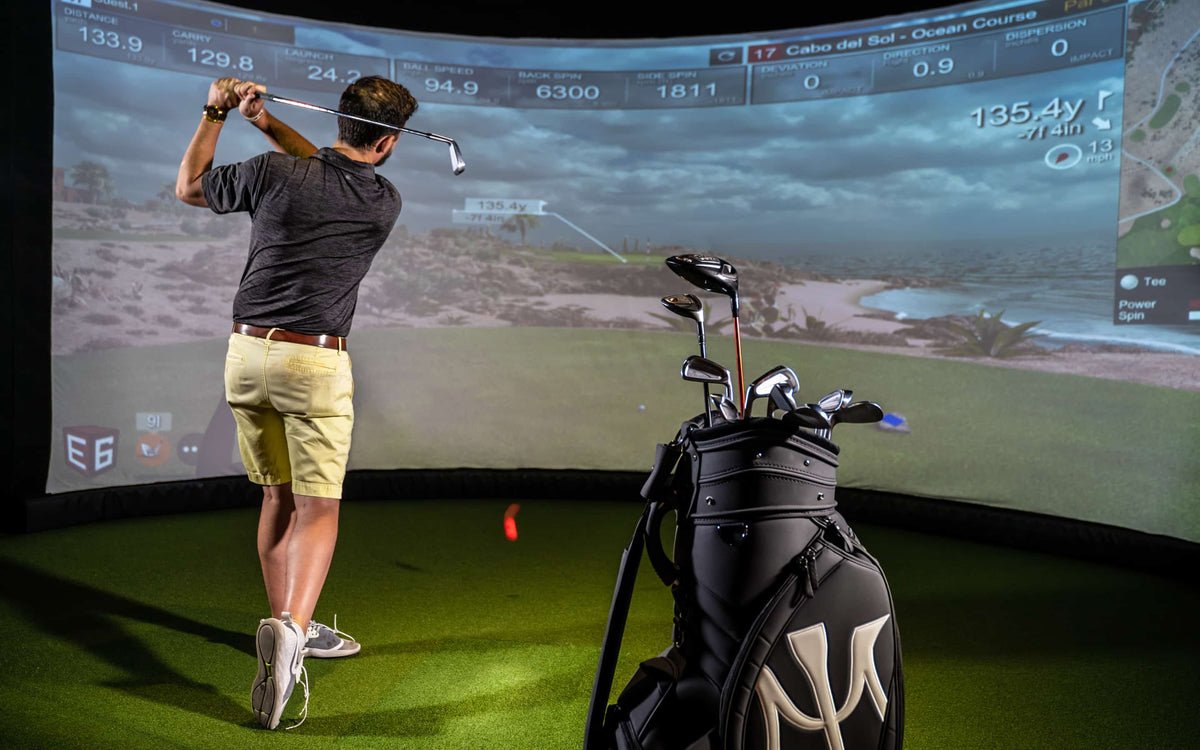
Golf simulators can indeed help your game by providing data-driven feedback and allowing for consistent practice, improving swing mechanics and overall performance.
Thinking about boosting your golf skills without needing a tee time? Many players wonder, do golf simulators help your game? The answer isn’t always straightforward, but the technology offers some very interesting possibilities for improvement.
Simulators provide a controlled environment. You can hit ball after ball, analyzing your performance with precise data points. This repetitive, focused practice can refine your swing. And help you make real gains.

Do Golf Simulators Help Your Game?
Okay, let’s dive deep into the question that’s on every golfer’s mind: Do golf simulators actually help you get better at golf? It’s a question that sparks debate among pros and amateurs alike. After all, can hitting a ball into a screen really improve your game on the actual course? The short answer is: yes, absolutely, but it’s more nuanced than that. Let’s explore why.
The Core Benefit: Data-Driven Practice
One of the biggest reasons why golf simulators are helpful is the detailed data they provide. Think about a typical driving range session. You might hit a few good shots, a few bad shots, and you kind of guess at why. But a golf simulator gives you hard, measurable facts. It’s like having a golf coach analyze every swing, telling you exactly what happened with the ball, and, importantly, what happened with your club. This is critical for improvement.
What Kind of Data Are We Talking About?
- Ball Speed: How fast the ball comes off the club. Faster ball speed usually means more distance.
- Launch Angle: The angle at which the ball leaves the club face. A good launch angle is important for getting the proper height and distance.
- Spin Rate: How much the ball is spinning, which affects how it flies. Too much or too little spin can rob you of distance.
- Carry Distance: How far the ball flies before it hits the ground.
- Total Distance: How far the ball goes in total, including roll.
- Club Path: The direction your club head is traveling through the hitting zone. An “inside-out” or “outside-in” path can cause slices or hooks.
- Club Face Angle: The angle of the club face at impact. A square face makes for straight shots, while an open or closed face sends the ball in different directions.
- Smash Factor: A measure of how well you transfer energy from your club to the ball. A higher smash factor means you’re making more efficient contact.
Having access to all of this data lets you pinpoint areas where you need work. For example, if you see that your club face is consistently open at impact, you know exactly what you need to adjust. You aren’t just guessing anymore – you’re working with facts.
Realistic Course Simulation
Another great aspect of golf simulators is the ability to play simulated versions of real golf courses. This provides valuable practice in a variety of conditions. You’re no longer just hitting the ball straight at a driving range; you can experience the challenges of different holes, including doglegs, water hazards, and bunkers. This helps you develop a strategy for different shots and scenarios.
Benefits of Course Play on a Simulator
- Course Management: Practicing different shot choices based on the hole.
- Pre-Round Practice: Simulate a course you’re about to play, so you can get a feel for the layout.
- Strategic Planning: Work on how to approach different holes and avoid hazards.
- Variety of shots: Practice hitting different types of shots such as fade, draw, low, high and many more.
This type of practice can help you mentally prepare for real rounds, making you a more confident player when you step onto the actual course.
Year-Round Practice, No Matter the Weather
Let’s face it: weather can be a major obstacle for golfers. Rain, snow, extreme heat, or cold can keep you off the course for extended periods. A golf simulator provides a solution for this. You can play and practice any time, regardless of the weather. This means you can work on your game consistently, leading to faster and more significant improvement. A simulator in your garage, basement, or local golf center means you’re always ready to golf, even when Mother Nature has other ideas.
Swing Analysis and Improvement
Many modern golf simulators incorporate swing analysis tools. Some use high-speed cameras to capture your swing from multiple angles, and then they play the swing back to you, often frame-by-frame. These systems can measure things like your swing path, swing plane, club head speed and many more parameters related to your swing. You can then review the data to see exactly where you’re going wrong. This makes it much easier to identify areas that need improvement. Furthermore, when paired with simulator’s detailed data, you have the power to make informed decisions about what to work on. It also allows the golfer to get a better understanding of how the change in swing can affect the ball flight. It is important to have a professional coach review these data for you to better understand what changes are needed.
How Swing Analysis Helps
- Visual Feedback: Seeing your swing in slow motion helps you understand what’s happening.
- Identify Flaws: Pinpoint specific areas where your swing is weak.
- Track Progress: Compare swings over time to see how you’re improving.
- Improve Consistency: By better understanding your swing, you can work to make it more consistent.
Targeted Practice: Fixing Specific Problems
Simulators are amazing for focusing on very specific aspects of your game. Are you struggling with a slice? You can use the simulator to analyze why this is happening and work specifically on that issue. Do you need more distance? You can track your swing speed and launch conditions to determine how to add some extra yards. Simulators help you diagnose the core of the problem and focus on fixing that specific issue and measure the progress at the same time.
Targeted Practice Scenarios
- Accuracy: Focus on hitting fairways or specific distances on the green.
- Distance: Work on increasing swing speed and improving ball contact for longer shots.
- Short Game: Practice chipping and pitching with different distances and trajectories.
- Putting: Practice green reading and distance control.
The Mental Game
While much of the focus on golf simulators is on the technical aspects of the game, they also play an important role in improving your mental game. The ability to practice in a calm, controlled environment helps you build confidence. Playing simulated rounds helps you visualize success and make more strategic choices. The repetition helps you build consistency and helps you make better decisions when facing tricky situations on the real course. In a nutshell, a simulator allows you to train the mind for the course as much as it allows you to train the swing.
Mental Benefits of Simulator Use:
- Reduce Course Anxiety: You can play simulated rounds as many times as you like, getting used to pressure situations.
- Improve Focus: Concentration is key on the simulator and that skill translates to the actual course.
- Boost Confidence: Seeing positive results in the simulator translates to higher confidence on the real course.
Different Types of Golf Simulators
There is a large range of golf simulators and each simulator comes with its own set of features and price tag. Knowing what you want and what is important to you will help you decide what simulator is right for you.
Launch Monitors
Launch monitors are a type of golf simulator that are used mostly in driving ranges or practice areas. These devices often only measure ball data. They typically do not have the capability to project the shot onto the screen or provide full simulated golf course play. These tend to be smaller and more portable and they are often the more affordable option compared to fully fledged golf simulators. A few examples are Trackman, Foresight, and Rapsodo.
Benefits of Launch Monitors
- Portable: Can be taken anywhere for golf practice.
- Ball Data: Provide very detailed information on what the ball does when you hit it.
- Cost-Effective: More affordable than full golf simulators.
- Ideal for Range Use: Great for analyzing your shots at the driving range.
Full Golf Simulators
These systems provide complete virtual golf experiences. They project the golf course onto a screen in front of the player, allowing you to play full rounds. They usually include both ball and club data, swing analysis tools and also provide all the simulated course features. These systems are typically more expensive and require more space. But, the more premium systems provide the most complete experience of simulated golf play. Some examples are the SkyTrak, Uneekor, and Full Swing.
Benefits of Full Simulators
- Complete Experience: Full simulated golf course play.
- Advanced Data: Provides data on both the ball and club.
- Swing Analysis: Offers tools to analyze your swing.
- Realistic Simulation: Offers a truly immersive golf experience.
The Importance of Proper Setup and Usage
It’s important to mention that to get the most out of a golf simulator, you need to set it up properly and know how to use it effectively. Accurate calibration is essential. The data that the simulator generates is only as good as its setup, so taking the time to make sure that your device is correctly calibrated is important. Also, using the simulator as a practice tool rather than just a game is very important. If you’re just mindlessly hitting balls without focusing on specific goals, you won’t see the improvement you could. Using the simulator to diagnose your weaknesses and address them in your practice is important.
Tips for Effective Simulator Practice
- Calibrate Properly: Ensure your simulator is set up and calibrated correctly.
- Set Goals: Have specific goals for each practice session.
- Analyze the Data: Pay attention to the data and use it to make adjustments.
- Work on Weaknesses: Use the simulator to work on the weakest aspects of your game.
- Get Lessons: Use simulator data during a coaching session.
Golf Simulators Aren’t a Magic Bullet
It’s crucial to remember that a golf simulator is not a magic wand that will turn you into a pro overnight. It’s a tool and like any tool, it’s only effective if used correctly. While simulators provide valuable data and opportunities for practice, nothing completely replaces the experience of playing on a real golf course. The real course offers environmental challenges such as slopes, wind, and different grass conditions that are very difficult to replicate in a simulator. You still need to get out there and use the skills that you developed in the simulator in the real-world settings. It is also important to practice using the skills you acquired during the simulator sessions on the putting green and around the greens on a real course.
So, do golf simulators help your game? The answer is a resounding yes, but with some important considerations. They offer valuable data, realistic course simulation, and the ability to practice year-round. They enable you to focus on specific areas of your game, giving you the tools to understand and improve your swing. However, you need to use the technology properly, analyze your data, and stay focused to see the best results. Golf simulators are a tool that can significantly enhance your game, but ultimately the hard work and dedication have to come from you.
Can A Golf Simulator REALLY Improve Your Golf Game?
Final Thoughts
Ultimately, golf simulators offer valuable practice. They provide consistent feedback on swing mechanics and ball flight. Analyzing data helps pinpoint areas for improvement.
Regular use of a simulator can boost confidence. It facilitates consistent practice regardless of weather. Simulators also allow focused training on specific skills.
Therefore, whether you are a beginner or pro, they improve your game. The short answer is, yes, do golf simulators help your game significantly through repetitive practice and data analysis, so this is something you must consider.

