
The “don’t say a word game” requires players to communicate concepts without speaking, often using gestures, drawings, or acting.
Have you ever tried explaining something complex without using any words? It’s surprisingly challenging and fun! This describes the essence of the “dont say a word game,” a fantastic activity for groups that tests communication skills in a nonverbal way.
It’s perfect for parties, family gatherings, or even a quick icebreaker with colleagues. The game promotes creative thinking and a lot of laughter. You will enjoy a very different kind of group interaction.

Don’t Say a Word Game: The Silent Fun Zone
Have you ever played a game where you’re not allowed to talk? It might sound tricky, but it’s a whole lot of fun! That’s what the “Don’t Say a Word” game is all about. It’s a simple game that can be played almost anywhere, and it’s perfect for all ages. It’s not just about being quiet; it’s about thinking differently and getting creative. Let’s dive into all the ways you can play this awesome game.
What is the Don’t Say a Word Game?
At its heart, the “Don’t Say a Word” game is a challenge in non-verbal communication. It’s a game where you try to get a message across to someone else without using any spoken words. This might mean using gestures, acting things out, drawing pictures, or even just making funny faces. The goal is to make your teammates understand what you are trying to say, without saying it out loud. This encourages you to think outside the box and improve your communication skills in a super fun way.
This game is also sometimes called a charades-type game, but instead of acting out specific things, you try to get your partners to guess one particular word that you are not allowed to speak. It can be adapted for many different situations and group sizes. It’s great for parties, family gatherings, classrooms, or even just a quiet evening at home.
How to Play Don’t Say a Word Game
Playing “Don’t Say a Word” is easy. You do not require any fancy equipment. Here’s a simple step-by-step guide to get you started:
- Choose a Word: First, you need a word. It could be anything like an object (a car, a tree), an animal (a cat, a dog), an action (running, sleeping), or even an emotion (happy, sad). You can use a list of words or brainstorm together.
- Decide How to Communicate: Before you start, agree on the kinds of non-verbal communication that are allowed. Are you using gestures? Are you allowed to draw pictures? Are funny faces OK? This makes the game more fair.
- Take Turns: If you’re playing with a group, you can take turns being the “communicator” and the “guesser.” One person acts out the word, and the others try to guess what it is.
- No Speaking Allowed!: The most important rule – no talking! If you say even one word, you’re out of the round, and it’s someone else’s turn.
- Guessing: The guessers can ask questions, but these questions can only be answered with non-verbal cues, like nodding or shaking your head.
- Winning: The first person to correctly guess the word can be the next to act out the new word.
Variations of the Don’t Say a Word Game
You can play the “Don’t Say a Word” game in different ways to make it even more interesting. Here are some fun variations you can try:
Themed Words
Instead of picking random words, you can choose words that all fit a theme. For example, you could have a “Movie Characters” theme, where you act out characters from your favorite movies. Or, you could have an “Animal Kingdom” theme, where all the words are different animals. This adds a fun challenge to the game and tests your knowledge of the theme.
Time Limit
To make the game more exciting, you can add a time limit. Give the communicator 60 seconds, or any time you choose, to get their point across. If the guessers don’t get it in time, they don’t get a point, and it’s another player’s turn. This makes everyone think fast and communicate clearly. It adds a competitive edge.
Drawing Only
For a drawing version, the person who has the word, needs to draw the word for their partners to guess. You can allow only drawing for the whole game. The guessers will have to guess what you are trying to convey through your drawings. It tests their observation skills and ability to interpret a picture.
One-Handed Game
Make it harder by playing with only one hand. This is quite challenging, and it will help you think differently about how you use your hands when communicating. It will definitely cause a lot of laughter.
Themed Acting
You can include themes to the way that a person acts. Like acting like a robot or an old person or acting very silly. This will make it more fun, especially for younger children. This adds an extra layer of acting skills and fun for the game.
Benefits of Playing Don’t Say a Word Game
Playing “Don’t Say a Word” is not just fun; it can be good for you too! It helps improve your communication, thinking, and social skills. Here are some benefits:
- Improves Non-Verbal Communication: This game teaches you how to use body language, gestures, and facial expressions to communicate. This is important because lots of communication is non-verbal.
- Boosts Creativity: When you can’t use words, you have to think of creative ways to explain something. This helps you to become a more imaginative thinker.
- Enhances Problem-Solving Skills: You need to think carefully about how you will get your idea across to the guessers, which helps your problem-solving abilities.
- Encourages Teamwork: Playing in groups teaches teamwork. Players must work together to figure out the word. They will all get ideas to help their teammates guess the word.
- Great for All Ages: It’s an easy game for kids to play but also fun for adults. The whole family can enjoy it together.
- Fun and Engaging: Most importantly, “Don’t Say a Word” is fun! It’s a great way to laugh and have a good time with friends and family.
Tips for Playing Don’t Say a Word Game
To play the “Don’t Say a Word” game well, you should follow a few tips. Here are some easy ones that can help you with this fun game:
For the Communicator
- Keep It Simple: Start with basic gestures, and do not overcomplicate your acting. Simple is better. Try to think of actions or gestures that are easy for other people to understand.
- Be Clear: Try to be as clear as possible in your acting. Use actions that are easy to see. Make your movements big, so that the guessers get a good idea of what you’re trying to say.
- Don’t Give Up: If they do not get it right away, don’t get frustrated. Try a different way, or try to emphasize different parts of the word you’re trying to convey.
- Use a Variety of Cues: Try using your whole body and facial expressions. This helps you convey your message in different ways and can give the guessers more to work with.
For the Guessers
- Watch Carefully: Focus on the communicator’s gestures. Watch for patterns or actions that might give clues to the word.
- Ask Questions (Non-Verbally): If you’re stuck, ask yes or no questions by nodding or shaking your head. This can help you narrow down the possibilities.
- Think Broadly: Don’t get stuck on one idea. Let your mind wander and think about different possibilities.
- Be Patient: It can sometimes take a while to guess the word. Don’t get upset if you don’t get it right away, and keep trying.
Examples of Words to Use in the Don’t Say a Word Game
The great thing about this game is that you can use all sorts of words. Here are some examples to help you get started:
Easy Words
- Cat
- Dog
- Run
- Jump
- Happy
- Sad
- Tree
- Car
- Ball
- Eat
Medium Words
- Swimming
- Cooking
- Dancing
- Singing
- Elephant
- Airplane
- Book
- Computer
- Friend
- Teacher
Harder Words
- Astronaut
- Construction
- Photographer
- Imagination
- Surprise
- Confusion
- Library
- Telescope
- Microscope
- Excitement
You can also have categories. For example, you might play with only:
- Emotions
- Animals
- Verbs (Actions)
- Occupations
- Objects in the house
You can add more challenging words as you and your friends get better at the game.
Making It More Fun
There are many things you can do to make the game even more enjoyable. Here are a few ideas:
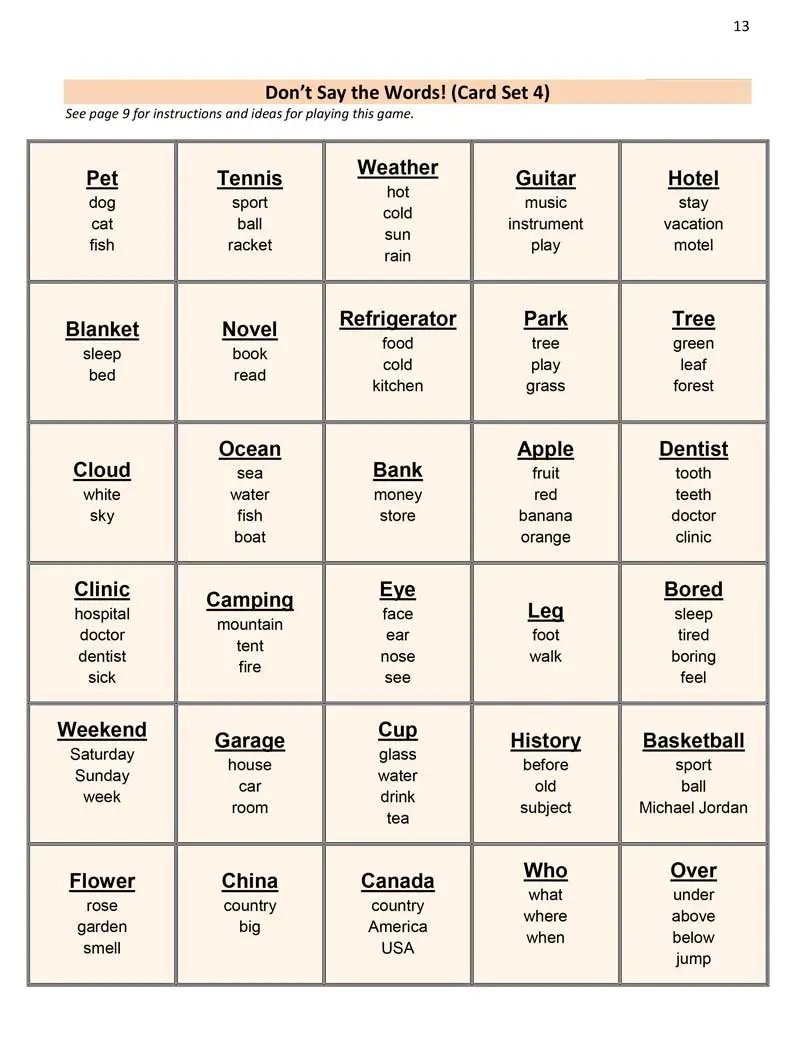
Create Word Cards
Write your words on index cards or pieces of paper. This makes it easier to choose words without anyone knowing them in advance. You can put these cards in a jar or box. Then the communicator picks a word at random.
Play in Teams
If you have a large group of people playing, you can divide the group into teams. Each team will have to get the word guessed. The first team to guess it will win. This brings a sense of competition and teamwork.
Use Props
If you want to be creative, use props! A hat, a scarf, or other items can help you act out your word. Make sure to have a supply of props available before the game begins, to make it even more creative and fun.
Play in Different Places
Try playing in different places. For example, the park, the living room, or at a party. Change of scenery makes it fun, too.
Play With Music
Play music, if you want. You can start and end the game with music, which makes it more dynamic and entertaining. You can also play the music to give the communicator a sense of the amount of time left.
Adapting the Game for Different Ages
The great thing about the “Don’t Say a Word” game is that you can change it up a little bit for kids of different ages. Here’s how:
For Younger Kids
- Use Simple Words: Use simple words that are common for kids to understand, like animals, colors, or simple actions like “jump” or “sit”.
- Keep the Acting Easy: Encourage the kids to use simple actions and big movements. It helps the guessers to understand better what you’re trying to portray.
- Focus on Fun, Not Winning: For younger children, focus on the fun of the game, not necessarily the rules. Make it relaxed and silly!
For Older Kids and Teens
- Add Complex Words: Introduce more challenging words that can make the game fun for older kids and teenagers. Use a dictionary or thesaurus to come up with different words.
- Introduce Time Limits: Add time limits to make the game more difficult and exciting. If they can’t guess it in a certain amount of time, they do not get the point.
- Play in Teams: Playing in teams can make the game more competitive, which is fun for older children. They can work together and come up with ways to win as a group.
The “Don’t Say a Word” game is a fantastic activity that combines fun, creativity, and learning. It’s an easy game to pick up but can provide hours of amusement. Whether you’re looking for something to do on a rainy day, a fun party game, or a creative exercise in the classroom, it is a great choice. The many variations and possibilities make the “Don’t Say a Word” game a timeless option for people of all ages. Now, go ahead and try it, and prepare to be amazed at how much you can communicate without even saying a word!
DON'T SAY IT! Word Game from Pressman Instructions + Review!
Final Thoughts
The ‘dont say a word game’ provides a fun method for testing communication and understanding without spoken words. This game challenges players to think creatively and rely solely on nonverbal cues. It is great for developing observation skills.
Participants must try to convey ideas or actions through gestures. This playful activity highlights the importance of body language. Effective communication is key to success in this game and requires a keen perception.
Ultimately, the ‘dont say a word game’ is an excellent way to foster teamwork and a different level of interaction, emphasizing the silent language we all share. You must try it with a group of friends or even with family for a fun and engaging time.

