
The goal in the Forget It dice game is to be the last player with remaining points, strategically rolling dice and using combinations to eliminate your score or force opponents to add to theirs.
Ready for a fun and fast-paced dice game that will test your luck and strategy? We’re diving into the simple, yet surprisingly addictive, world of the “Forget It dice game”!
This game is perfect for players of all ages and can be learned in minutes. It is also easily customizable with house rules.
Prepare yourself for some exciting rolls, tactical decisions, and maybe even a little bit of friendly rivalry! Let’s see how to play!

Forget It Dice Game: Rules, Strategies, and Variations
Forget It! is a fast-paced dice game that combines luck and strategy. It’s easy to learn, making it perfect for family game nights or casual gatherings. The goal is to be the last player with chips.
Basic Gameplay of Forget It!
The game is played with a standard set of six dice and chips. Players take turns rolling the dice, trying to avoid rolling combinations that eliminate them. Rolling certain combinations results in losing chips, forcing you closer to being “out” of the game.
Setting Up the Game
Each player starts with an equal number of chips. The number of chips can vary depending on how long you want the game to last. Typically, 10-20 chips per player is a good starting point.
Taking Your Turn
On your turn, you roll all six dice. After the initial roll, you must set aside any dice that match the “Forget It!” numbers (usually 2s and 5s).
You can then choose to roll the remaining dice again. This is optional, but it allows you to try to avoid getting more “Forget It!” numbers. You can re-roll as many times as you want, but you must always set aside any 2s or 5s that appear.
Scoring and Losing Chips
The core of the game is avoiding certain dice combinations. Rolling 2s and 5s incurs a penalty.
The more 2s and 5s you roll in a turn, the more chips you lose.
Passing the Dice
Once you are satisfied with your roll, or if you are forced to stop because all your dice are 2s or 5s, your turn ends. You then pass the dice to the next player. Play continues in this fashion until only one player has chips remaining.
The “Forget It!” Numbers: 2 and 5
The numbers 2 and 5 are the “Forget It!” numbers. Rolling these dice is what causes you to lose chips.
The number of chips you lose depends on how many 2s and 5s you roll. Typically, each 2 and each 5 cost you one chip.
If you roll all six dice and they all come up as 2s or 5s, the penalty can be quite severe. Some variations have special rules for this scenario.
Variations and House Rules
Forget It! is a game that lends itself well to house rules and variations. This allows players to customize the game to their liking and add an extra layer of strategy or excitement.
Progressive Chip Loss
Instead of losing one chip for each 2 and 5, you could increase the penalty based on the number of “Forget It!” dice. For example:
- One 2 or 5: Lose 1 chip.
- Two 2s or 5s: Lose 3 chips.
- Three 2s or 5s: Lose 5 chips.
- Four 2s or 5s: Lose 7 chips.
- Five 2s or 5s: Lose 10 chips.
- Six 2s or 5s: Lose 15 chips.
This variation adds more risk to re-rolling the dice.
“Safe” Rolls
Some house rules allow for “safe” rolls. For example, rolling all six dice and getting no 2s or 5s could allow you to pass the dice to the next player without any penalty.
Another variation could allow you to add a chip to your stack if you roll a “safe” roll. This encourages players to take risks and re-roll the dice more often.
Reversed Penalties
In this variation, rolling specific combinations other than 2s and 5s will cost you chips. For instance, rolling three of a kind might result in losing a chip, while rolling a straight could result in gaining chips. This introduces a new dynamic to the game.
Team Play
Forget It! can also be played in teams. Players on the same team can pool their chips together.
Teammates can strategize together and decide when to take risks. This adds a social element to the game.
High Roller Option
For a faster game, increase the number of chips lost per 2 or 5. This forces players to make tougher decisions about re-rolling and increases the likelihood of quick eliminations.
“Freeze” Rule
If a player loses all their chips, they are “frozen” for one round. They still participate in the game, but they cannot lose any more chips. This gives them a chance to recover if another player rolls poorly.
Strategic Tips for Forget It!
While Forget It! has a strong element of luck, there are still strategies you can use to improve your chances of winning. Knowing when to re-roll and when to stop is key.
Assess Your Risk Tolerance
Before re-rolling, consider how many 2s and 5s you already have. If you have a lot, it might be better to stop and pass the dice.
If you have few or no 2s or 5s, you can be more aggressive with your re-rolls.
Pay Attention to Your Opponents
Watch how many chips your opponents have. If someone is close to being eliminated, you might want to take more risks to try to knock them out of the game.
Conversely, if you are low on chips, you might want to play more conservatively.
Understand the Probabilities
Knowing the probability of rolling certain numbers can help you make informed decisions. For example, the probability of rolling a 2 or a 5 on a single die is 1/3.
Therefore, the probability of not rolling a 2 or a 5 is 2/3. Keep these probabilities in mind when deciding whether or not to re-roll.
Consider the Number of Dice
The more dice you have left to roll, the greater the risk of rolling a 2 or a 5.
If you only have one or two dice left, you might be more willing to re-roll. But if you have four or five dice left, the risk is much higher.
The “Safe” Re-Roll
If you have a small number of dice remaining, sometimes a “safe” re-roll is the best option. Aim for numbers that are not 2 or 5, even if it means settling for a mediocre roll. Reducing your chances of losing chips can be a winning strategy in the long run.
Bluffing
While there isn’t direct bluffing involved, the way you handle the dice can influence other players. Appearing confident even with a risky roll might discourage others from targeting you.
Take Advantage of Others’ Mistakes
Pay close attention to when other players are being overly aggressive and racking up “Forget It!” numbers. That’s your opportunity to conserve chips and let them eliminate themselves.
Forget It! and Educational Benefits
Beyond being a fun pastime, Forget It! can subtly introduce mathematical and strategic thinking skills. It’s a game that seemingly relies on chance, but players learn to assess probabilities, manage risk, and make calculated decisions.
Probability and Risk Assessment
The game inherently teaches basic probability concepts. Players intuitively understand the odds of rolling specific numbers.
This fosters a basic understanding of risk assessment as players weigh the potential benefits of re-rolling against the risk of accumulating more “Forget It!” numbers.
Decision-Making and Strategic Thinking
Players constantly make decisions about whether to re-roll or stop. This hones their decision-making skills.
Furthermore, observing other players’ strategies and adjusting one’s own gameplay accordingly encourages strategic thinking.
Mental Math
Calculating the number of chips lost for each roll involves simple addition. While subtle, this provides opportunities for mental math practice.
Social Skills
Forget It! is often played in groups, promoting social interaction and communication. Players learn to take turns, follow rules, and cooperate (in team variations).
Forget It! Dice Game: A Timeless Classic
Forget It! is a classic dice game that has been enjoyed by people of all ages for generations. Its simple rules, fast-paced gameplay, and strategic elements make it a timeless favorite.
Its adaptability to house rules and variations ensures that the game remains fresh and exciting. Whether you are a seasoned gamer or a casual player, Forget It! is sure to provide hours of entertainment.
It’s a great choice for parties, family gatherings, or any occasion where you want to have fun and test your luck and strategy. So, gather your friends, grab some dice, and get ready to “Forget It!”!
Finding Forget It! Dice Game Sets
While you can play Forget It! with a standard set of six dice and some chips, there are also commercially available sets specifically designed for the game. These sets often include special dice, scorecards, and rule variations.
Specialty Dice
Some sets include dice with unique markings or colors. This can add a visual element to the game and make it easier to track the results of each roll.
Scorecards
Scorecards can help you keep track of your chips and the scores of other players. This can be especially helpful when playing with a large group.
Rule Variations
Some sets include rule variations that add new twists to the game. This can keep the game fresh and exciting, even after you have played it many times.
DIY Options
You don’t necessarily need a commercially produced set to play Forget It!. A regular set of dice works just fine. You can use poker chips, coins, or even small pieces of paper to keep track of scores. The most important thing is to have fun!
The Enduring Appeal of Dice Games
Forget It! is just one example of the many popular dice games that exist. Dice games have been around for centuries, and their enduring appeal lies in their simplicity, randomness, and social nature.
Simplicity and Accessibility
Dice games are typically easy to learn and play, making them accessible to people of all ages and skill levels. This makes them a great choice for family game nights or casual gatherings.
Randomness and Excitement
The element of chance in dice games adds excitement and unpredictability to the gameplay. This keeps players engaged and makes each game unique.
Social Interaction
Dice games are often played in groups, promoting social interaction and communication. This makes them a great way to connect with friends and family.
Portability and Convenience
Dice are small and portable, making dice games easy to take with you on trips or to social events. This makes them a convenient and versatile entertainment option.
Forget It! vs. Other Dice Games
While Forget It! shares some similarities with other dice games, it also has its own unique characteristics that set it apart. It blends the risk of Yahtzee with the take-that element of other dice rolling games.
Yahtzee
Like Yahtzee, Forget It! involves rolling dice and trying to achieve certain combinations. However, Forget It! is faster-paced and more focused on avoiding negative outcomes rather than achieving positive scores.
Liar’s Dice
Liar’s Dice is a bluffing game that involves rolling dice and making claims about the results. Forget It! does not involve bluffing.
Tenzi
Tenzi is a fast-paced dice game where players try to roll all ten of their dice to the same number. Forget It! is less about speed and more about strategic risk management.
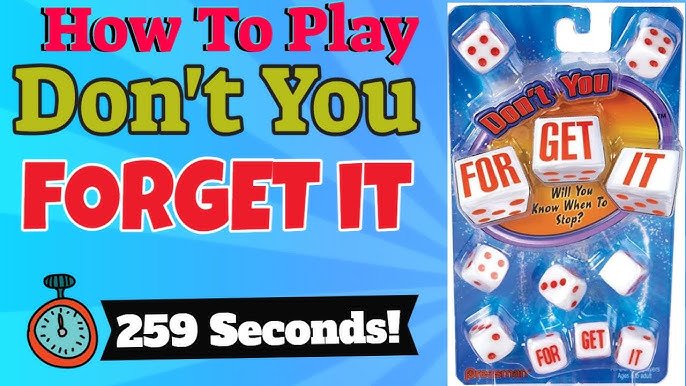
How To Play Don't You Forget It
Final Thoughts
Forget it dice game’s simple rules lead to engaging fun. Quick gameplay and a blend of luck and strategy make it appealing.
This makes it a must-try for your next game night. ‘Forget it dice game’ offers enjoyment for players of all ages.
So gather your friends, roll the dice, and get ready for some laughs. Experience the thrill of ‘Forget it dice game’.

