
A standard soccer game lasts 90 minutes, divided into two 45-minute halves, with a 15-minute halftime break.
Ever wondered how long can a soccer game last? Well, it’s a common question. The beautiful game, as many call it, typically adheres to a set time structure.
A regulation match is designed around two periods of play with a break in between. This gives players a chance to rest and coaches to make tactical changes. We’ll get into all the specifics.

How Long Can a Soccer Game Last?
Ever wondered exactly how much time those soccer players spend running around on the field? It’s a pretty good question! A standard soccer game has a set amount of playing time, but many things can make it go a little longer. Let’s dive into all the details so you can be a soccer time expert! We’ll explore the usual game length, the things that add extra time, and even how different kinds of soccer games can vary in duration.
The Standard 90 Minutes
The most basic part of understanding how long a soccer match lasts is knowing that a typical adult game is scheduled for 90 minutes of play. This 90 minutes is broken into two halves, with a break in the middle.
Two Halves
A soccer game is divided into two 45-minute halves. This means you get to see 45 minutes of exciting action, a break, and then another 45 minutes of play. Think of it as two mini-games put together. This way, everyone gets a chance to rest and strategize.
Halftime Break
Between the two halves, there’s a halftime break. This break is usually 15 minutes long. It’s a chance for players to grab some water, listen to their coaches, and take a breather before the second half. It also gives the crowd a chance to stretch their legs or grab a snack.
Extra Time: When Games Go Longer
Even with a set 90 minutes of playing time, sometimes a soccer game can last longer than you expect. This is because of extra time, which is added at the end of each half and can sometimes occur during tied matches. Let’s look at some of the reason why this occurs.
Stoppage Time (Added Time)
You’ll often hear about “stoppage time” or “added time” in soccer. This is extra time that the referee adds at the end of each half. Why? Because things happen during the game that stop play. Some common causes for stoppage time are:
- Injuries: If a player gets hurt and needs medical attention on the field, the clock stops, and that time is added on at the end of the half.
- Substitutions: When players are switched in and out, a little time is needed, so this adds to the stoppage time.
- Time-Wasting: Sometimes players or teams try to waste time. The referee can add time to make up for these delays.
- Other Delays: Things like equipment problems or other unexpected events can cause the game to pause, adding to the total time played.
How Stoppage Time is Decided
The referee keeps track of all the stoppages during the game. They are the one who decides how much stoppage time is added at the end of each half. You will notice they often hold up a board at the end of each half, letting everyone know how much extra time there will be.
Extra Time in Knockout Tournaments
Stoppage time isn’t the only thing that can make a game go longer. In tournament play, such as the World Cup or the UEFA Champions League, if a game is tied at the end of the regular 90 minutes, then sometimes the teams will enter into “Extra Time”. This usually occurs in knockout stages.
What is Extra Time?
Extra time is a set period of additional play that is added to the end of a match if the scores are level. It is a way to try and determine a winner without resorting directly to penalties.
How long is Extra Time?
Extra time is typically an additional 30 minutes, divided into two 15-minute periods, with a short break in the middle.
The Golden Goal Rule
You might hear about a “golden goal” in extra time. This means that if a team scores a goal during extra time, the game ends immediately, and the scoring team wins. However, the golden goal rule is not really used in modern football and is rarely seen in modern football.
Penalties
If the score is still tied after extra time, then we move on to a penalty shootout. Penalty kicks determine the match’s winner, with each team taking turns trying to score goals with only the goalkeeper defending. Penalty shootouts add more time to the overall length of the match.
Variations in Game Length
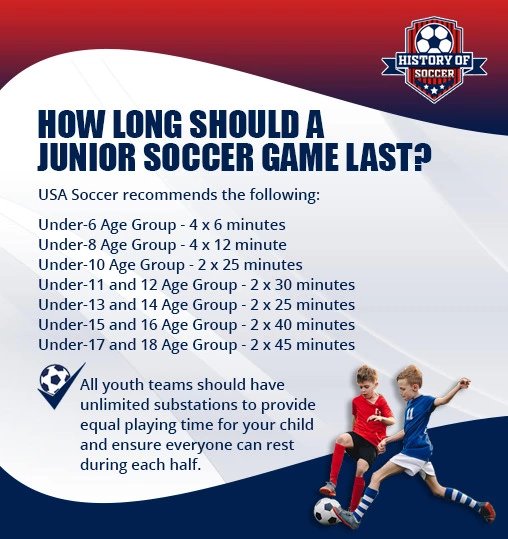
While the standard soccer game is 90 minutes, there are variations in game length, especially when it comes to different age groups and types of matches. Let’s take a look at some examples:
Youth Soccer
Younger kids don’t have the same stamina as adults, so their games are shorter. Here’s a general idea of game length in youth soccer:
- Under 6 and 7: These games are usually 40 to 50 minutes long, often with 10 or 12 minute halves.
- Under 8 to 10: Games are typically 50 to 60 minutes long.
- Under 12 to 14: Games become more similar to adult games, usually 70 to 80 minutes long.
These game lengths help young players manage their energy and stay involved without getting too tired. They also give young players good practice at playing the beautiful game of football.
Indoor Soccer (Futsal)
Indoor soccer, also called futsal, has a different approach to game length. Futsal is played on a smaller court, and the games are often shorter and fast-paced. Here’s what to expect for game lengths in Futsal:
- Game length: Generally two 20-minute halves, or 25-minute halves, depending on the level of play.
- Timeouts: Unlike regular soccer, futsal often has timeouts that can stop the clock, making the game last slightly longer overall.
- Rolling subs: Futsal has substitutions that can occur during gameplay.
Futsal games focus on quick plays, which allows them to have a fast-paced game in a short amount of time.
Other Variations
Sometimes you’ll see other types of soccer with different game lengths, such as:
- Beach Soccer: Games often have three 12-minute periods, which provides plenty of time for this exciting sport.
- Exhibition Matches: These games can have varying lengths, sometimes shorter than the standard 90 minutes.
These variations keep things interesting and adapt soccer to different environments and purposes.
A Quick Overview: How Long Can A Soccer Game Really Last?
Let’s summarize everything we have just learned. You’ll know that the standard match is 90 minutes, but it can go longer. Here’s a table to help you remember the different parts of a game:
| Game Segment | Time |
|---|---|
| First Half | 45 Minutes |
| Halftime Break | 15 Minutes |
| Second Half | 45 Minutes |
| Stoppage Time | Variable (extra minutes added) |
| Extra Time | 30 Minutes (if needed) |
| Penalty Shootout | Variable (if needed) |
So, while a typical soccer game is designed to last 90 minutes, the exact duration can be unpredictable due to added time, extra time, or even penalties. This uncertainty adds to the excitement of the game!
Why Knowing Game Length Matters
Understanding how long a soccer game lasts can be helpful for fans, players, and coaches. Here’s how knowing game length can be beneficial:
- For fans: Knowing the game’s structure and potential for extra time can help with planning the day around the game.
- For players: Understanding the duration of the game helps with managing energy and keeping focus throughout the match.
- For coaches: The expected game length is essential for planning strategy, substitutions and developing fitness regimes.
The length of a match can also affect TV broadcasts, media coverage, and much more.
The Impact of Game Length on Fitness
The game length in soccer is a big factor in how fit the players need to be. Players need to have plenty of stamina and endurance to last for a long match. Soccer has a great balance of speed, endurance, and tactics. Having to last for long periods makes it one of the most physically demanding sports.
Physical Demands
Soccer players run a lot during the game. They need to run fast, change directions quickly, and have good leg and cardiovascular fitness.
Training for Game Length
Coaches design training plans to prepare players for the full 90 minutes and any potential extra time. Fitness training and sports psychology are key components of the match preparation for a game.
In short, the length of the game directly shapes how the players train and how fit they have to be to play at a high level.
Wrapping It All Up
So, how long does a soccer game last? It is usually 90 minutes, but there can be many twists and turns. There is added time, extra time and penalties. All of this adds a unique flavor to the game and makes it all the more interesting. You now have all the information you need about soccer match times. This should help you when it comes to watching matches and you can become a soccer game time expert!
Here's how stoppage time works at the end of soccer games
Final Thoughts
A standard soccer match lasts 90 minutes, split into two 45-minute halves. There is a 15-minute halftime break between these periods. Added time for injuries or other stoppages often extends play slightly.
Extra time, usually two 15-minute periods, occurs in knockout games when the score remains tied after 90 minutes. Penalty shootouts resolve ties if extra time does not yield a winner. So, how long can a soccer game last? Including extra time and penalties, a single game’s duration can vary considerably.

