
A standard soccer game lasts 90 minutes, divided into two 45-minute halves, with a 15-minute halftime break.
Ever wondered about the duration of a soccer match? It’s a common question, especially for new fans. Many people ask, “how long is a soccer game last?” and we’re here to clarify.
The game’s time structure is quite consistent, despite any stoppage time. There are two distinct halves, with a mandatory rest period in between.

How Long is a Soccer Game Last?
Let’s dive into the heart of soccer! You’re probably wondering, “Exactly how long does a soccer match last?” Well, the simple answer is that a standard professional soccer game is 90 minutes long. But, just like with many things, there’s more to the story than that! It’s not just a flat 90 minutes of clock ticking. We need to consider things like halves, extra time, and even those nail-biting penalty shootouts.
Breaking Down the 90 Minutes
The standard 90-minute soccer game is divided into two equal halves. These halves are usually 45 minutes each. So, you get 45 minutes of action, a short break, and then another 45 minutes. That’s pretty straightforward, right? Think of it like two mini-games back to back.
The Half-Time Break
Right in the middle of the game, after those first 45 minutes, there’s a rest period called half-time. This break is typically 15 minutes long, though it can sometimes be a little shorter or longer. It gives the players a chance to catch their breath, rehydrate, and hear some important tips from their coaches. It’s also a good time for fans to grab some snacks or use the restroom!
What About Added Time?
Okay, this is where it gets a little more interesting. You might have seen a game clock that goes past the 45-minute mark in each half. That’s because referees can add extra time onto the end of each half. This added time, sometimes referred to as “stoppage time” or “injury time,” is designed to make up for moments when play is stopped during the 45 minutes. Here’s what can cause a referee to add time:
- Injuries: When a player gets hurt and needs medical attention, the clock stops. The time it takes for them to receive help is usually added at the end of the half.
- Substitutions: When a team makes a change by bringing a new player onto the field, the clock stops for a short amount of time.
- Time-wasting: Sometimes, a team that is ahead in the game might try to slow down the game by taking extra time on free kicks or goal kicks. Referees can add time at the end to compensate for that.
- Other delays: Various other delays in the game that pause the gameplay can also lead to the addition of extra time.
So, while the main part of a half is 45 minutes, the actual time played might be a little bit more because of this added time. You won’t know how much added time there will be until the referee signals for it at the end of each half.
The Game Isn’t Always 90 Minutes: Extra Time
Sometimes, after those 90 minutes of regular play (plus any added time), the score is still tied. In many leagues and tournaments, that’s not where the game ends. Instead, we get into extra time. Here’s what that looks like:
- Two Extra Periods: If the score is tied after 90 minutes, teams will usually play two extra periods of 15 minutes each.
- Short Break: Like in the regular game, there’s a short break between the two extra time periods. This break is normally just a few minutes, so players do not get the full halftime break again.
Extra time is a chance for one team to break the tie before penalty kicks come into the mix. It’s an extra chance to win and not go to penalties, which are often quite stressful! In total, with extra time being two 15 minute periods, this can add an extra 30 minutes on to the overall length of the game, potentially taking the total play time up to 120 minutes.
Penalty Shootouts: The Ultimate Tie-Breaker
If, after the extra time period, the score is still tied, the game comes down to penalty shootouts. This can be one of the most exciting parts of a soccer game because it puts the pressure on individual players and their goal scoring abilities. Here’s a basic look at how penalty shootouts work:
How Penalty Kicks Work
- Five Kicks: Each team gets to take five penalty kicks, which are a one on one shot from a designated spot in front of the goal against the opposing team’s goalie.
- Alternating Kicks: Teams alternate in taking their penalty kicks.
- Team with the most goals wins: The team that scores more penalty kicks out of the five wins the game.
- Sudden Death: If both teams have the same number of goals after five kicks, then penalty kicks continue until a team has scored a goal and the other team misses a goal.
It is difficult to say exactly how long a penalty shootout will last, but it can be a matter of a few minutes up to longer depending on the score.
Variations in Game Length
While the 90-minute game is standard for professional soccer, the game duration can change in other circumstances, particularly youth soccer games. Let’s take a look at how games may differ for various groups and levels of play.
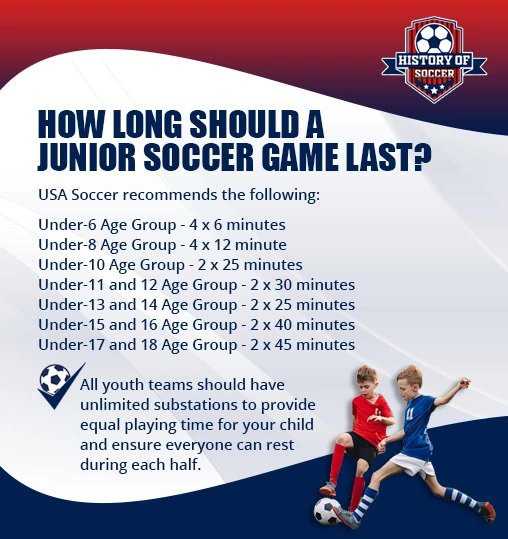
Youth Soccer
When young kids play soccer, the games are usually shorter than 90 minutes. This is because young players often don’t have the stamina for a full-length game. Shorter games help them stay engaged and enjoy the sport without getting too tired. The exact time can vary depending on the age group and league, but here are a few common examples:
- Under 6 and Under 8: Games are often divided into quarters, with each quarter usually lasting about 10-15 minutes, making the total game time about 40-60 minutes.
- Under 10 to Under 12: Game length is usually between 60 to 70 minutes, divided into two 30 to 35 minute halves.
- Under 14 to Under 16: At this level, the game length gets closer to a standard game of soccer and they may have two 40 minute halves for a total game time of 80 minutes.
Keep in mind that these times can be different depending on the organization or rules of the specific league. It is important to remember that these games will also have some added time at the end of the halves, just like in professional games.
Friendly Matches
Friendly matches, sometimes called exhibition games, are matches that are not a part of an official league or tournament. These games are often used by teams to practice or to get some game time before the season starts. These games can sometimes have shorter durations to the regular 90 minutes to make sure all players have time to play.
Different Soccer Codes
Soccer, or association football, also has variants, and these can often have different match length standards. One example of this is American soccer or Indoor soccer which are played in enclosed spaces, or arenas, and usually have shorter game times as a result.
The Clock in Soccer: Counting Up
Unlike some other sports where the clock counts down to zero, soccer games use a clock that counts up. This means the clock starts at 0:00 and goes up to 45:00 in the first half. After that, it resets to 0:00 again for the second half, and goes up to 45:00 again. Then added time is shown by the referee. So, it’s not about trying to get the time down to zero, it’s about following the progression of the game.
Key Takeaways on Game Duration
Let’s do a quick recap of all the parts of a soccer game and their related time lengths so we can make sure to understand how long a game can be.
- Regular time: A normal soccer game is 90 minutes long, divided into two 45-minute halves.
- Half-Time: There is a 15-minute break between the two halves.
- Added time: Each half includes extra time for injuries, substitutions, and other delays.
- Extra time: If the score is tied after 90 minutes, teams may play two extra periods of 15 minutes each.
- Penalty Shootouts: If the score is still tied after extra time, penalty kicks are used to determine a winner.
- Youth Games: Youth soccer games are usually shorter than 90 minutes and may vary based on age group.
Understanding all of these different factors helps you understand how long a soccer match can be! Remember, while most professional games clock in around 2 hours including halftime, extra time, and penalties can extend the match length.
So, whether you’re watching a local youth match or the World Cup finals, now you’ll know exactly what to expect when it comes to the game length. Enjoy the beautiful game!
Here's how stoppage time works at the end of soccer games
Final Thoughts
So, how long is a soccer game last? Generally, a standard soccer match lasts 90 minutes. This time is divided into two 45-minute halves. There’s also a halftime break for 15 minutes.
However, the game’s duration can extend due to added time. Referees include this extra time to account for stoppages like injuries and substitutions. Therefore, the full time can vary slightly.

